Polioptila caerulea
Blue-gray Gnatcatcher
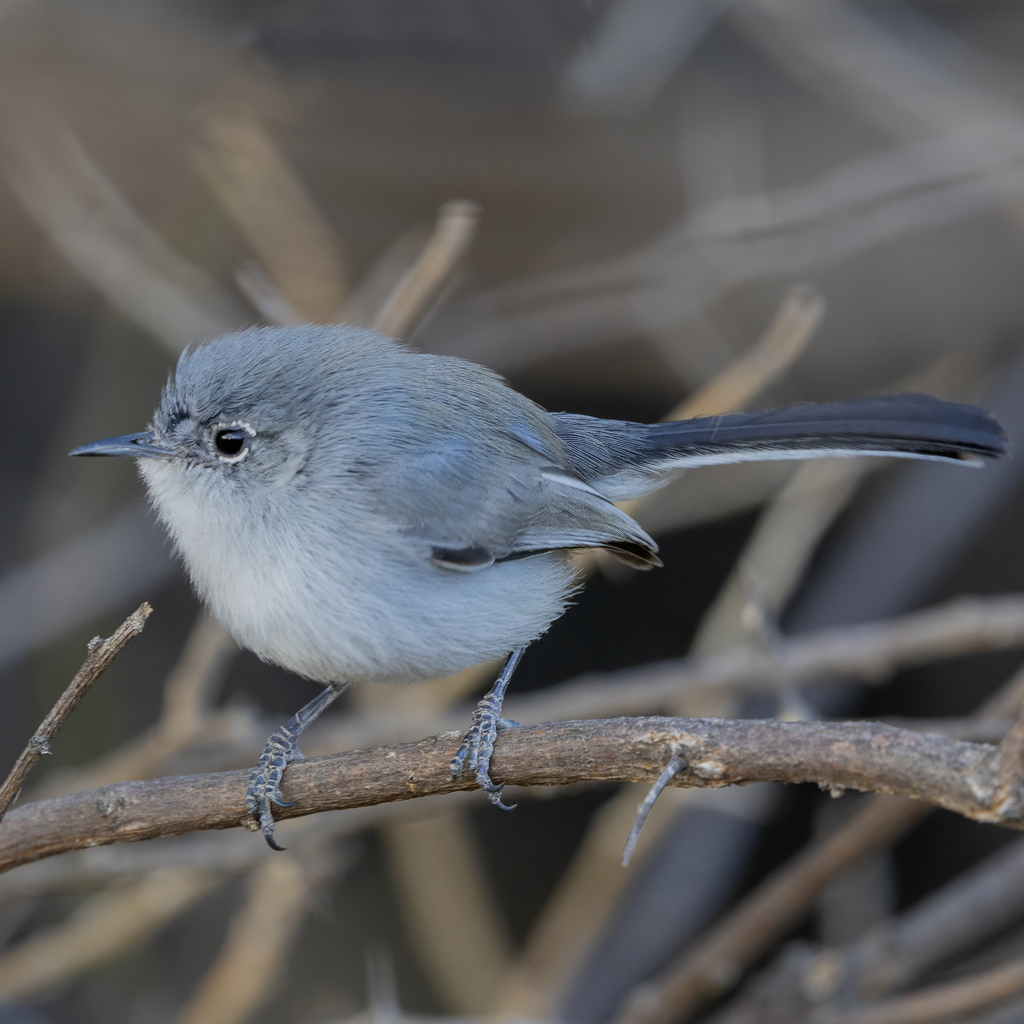
(c) Dan Vickers, some rights reserved (CC BY) · licence
Family: Polioptilidae · Class: Aves · Order: Passeriformes
Polioptila caerulea (Blue-gray Gnatcatcher) is a California animal in the Polioptilidae family.
The Blue-gray Gnatcatcher is a small, active passerine bird measuring 10 to 13 centimeters (4 to 5 inches) in length with a wingspan of 16 to 18 centimeters (6 to 7 inches). Adults weigh 5 to 7 grams. Males display blue-gray upperparts and white underparts, with a distinctive black eyeline extending from the bill to behind the eye during breeding season. Females lack the black eyeline and appear slightly grayer overall. Both sexes have a long, slender black tail with white outer tail feathers that are frequently flicked and fanned, and a thin, pointed black bill adapted for gleaning small insects. The Blue-gray Gnatcatcher breeds across much of the continental United States and southern Canada, with California populations found throughout the state except at high elevations and in desert regions. The species occurs from sea level to approximately 2,400 meters (8,000 feet) elevation, with highest densities in foothill and montane areas. Winter range extends from the southern United States through Mexico and Central America to Guatemala, with some California populations remaining year-round in coastal and southern regions. This species inhabits diverse woodland and scrubland environments, including oak woodlands, riparian forests, chaparral, pinyon-juniper woodlands, and mixed coniferous forests. Blue-gray Gnatcatchers prefer areas with dense canopy cover and abundant understory vegetation. They are commonly found in habitats with oaks, especially coast live oak and interior live oak, as well as areas with manzanita, ceanothus, and other shrubs that support high insect diversity. Blue-gray Gnatcatchers are primarily insectivorous, feeding on small insects and spiders gleaned from foliage, bark, and spider webs. Their diet includes gnats, flies, aphids, scale insects, caterpillars, and beetles. These highly active birds forage continuously throughout the day, often hovering briefly to capture prey or sallying from perches. Breeding occurs from March through July, with pairs constructing cup-shaped nests 1 to 25 meters above ground in shrubs or trees. Nests are built using plant fibers, spider webs, and lichen, creating a structure that closely resembles the surrounding bark. Females lay 3 to 5 pale blue eggs with brown speckles, which are incubated for 13 to 15 days. Both parents feed nestlings, which fledge after 10 to 15 days. The Blue-gray Gnatcatcher is not federally or state listed and maintains stable populations across most of its range. According to the North American Breeding Bird Survey, populations have remained relatively stable since 1970, with some regional increases. The species benefits from diverse habitat management that maintains structural complexity in woodland environments. Climate change may affect future distributions through shifts in suitable habitat zones, particularly in southern California where warming temperatures could alter vegetation communities. Brown-headed Cowbird parasitism and habitat fragmentation from urban development represent localized threats in some areas.
Classification
Class: Aves · Order: Passeriformes · Family: Polioptilidae
Frequently asked questions
How is Polioptila caerulea classified?
Polioptila caerulea belongs to class Aves, order Passeriformes, family Polioptilidae.
What family does Polioptila caerulea belong to?
Polioptila caerulea is in the Polioptilidae family.
What is Polioptila caerulea?
The Blue-gray Gnatcatcher is a small, active passerine bird measuring 10 to 13 centimeters (4 to 5 inches) in length with a wingspan of 16 to 18 centimeters (6 to 7 inches).
Is Polioptila caerulea found in California?
Yes. Polioptila caerulea is recorded in California in The California Species Project's catalogue.
Related species
Other California species in the same genus, family, or bioregion.
Data from The California Species Project — 14,000+ California species with verified data from CNPS, CDFW, USFWS, and more.