Polioptila melanura
Black-tailed Gnatcatcher
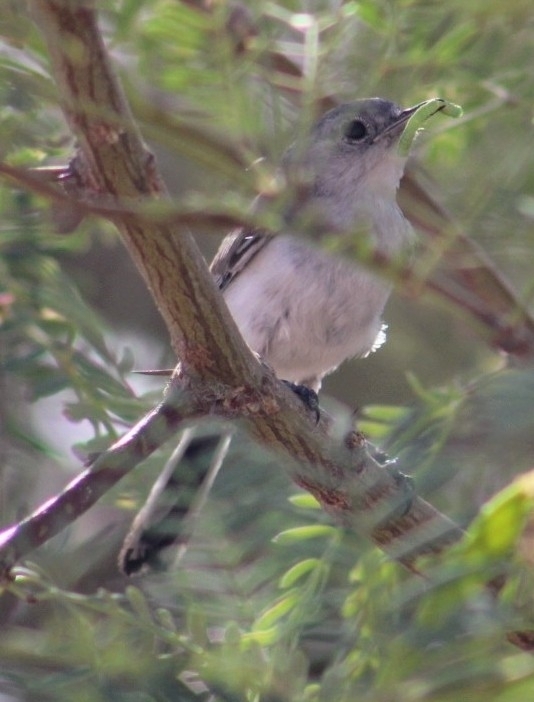
(c) Julio Cesar Ruiz García, some rights reserved (CC BY) · licence
Family: Polioptilidae · Class: Aves · Order: Passeriformes
Conservation status: WL · G5 S3S4
Polioptila melanura (Black-tailed Gnatcatcher) is a California animal in the Polioptilidae family.
The Black-tailed Gnatcatcher is a small, active songbird measuring 10 to 11 cm (3.9 to 4.3 inches) in length with a wingspan of 14 to 16 cm (5.5 to 6.3 inches). Males in breeding plumage display a distinctive black cap extending from the forehead to the nape, contrasting with blue-gray upperparts and whitish underparts. Females and non-breeding males lack the black cap, showing uniform blue-gray above and pale gray below. The species is distinguished from the similar Blue-gray Gnatcatcher by its primarily black undertail with white outer tail feathers, creating a distinctive pattern visible during flight and tail-flicking displays. The bill is thin and pointed, adapted for gleaning small insects from vegetation. The Black-tailed Gnatcatcher occurs in the southwestern United States and northwestern Mexico. In California, the species is found primarily in the Colorado and Mojave deserts, with populations extending from the Mexican border north to Inyo County and west to eastern Riverside and Imperial counties. The range includes desert regions around the Salton Sea, Joshua Tree National Park, and Mojave National Preserve. Small populations may occur in suitable habitat in eastern San Bernardino County. This species inhabits desert scrub and semi-arid environments, typically at elevations below 1,200 meters (3,900 feet). Primary habitat consists of desert washes, arroyos, and flats dominated by creosote bush, desert ironwood, palo verde, and catclaw acacia. The species shows strong association with microphyll woodland and desert riparian areas where larger shrubs and small trees provide nesting sites and foraging opportunities. Black-tailed Gnatcatchers prefer areas with moderate to dense shrub cover rather than completely open desert. Black-tailed Gnatcatchers are primarily insectivorous, foraging by gleaning small arthropods from foliage, bark, and flowers. Their diet consists of flies, gnats, aphids, small beetles, caterpillars, and spiders. The species is highly active, constantly flicking its tail and moving through vegetation while foraging. Breeding occurs from March through July, with peak activity in April and May. Pairs construct cup-shaped nests 1 to 3 meters above ground in dense shrub branches, using plant fibers, spider webs, and small twigs bound with spider silk. Females lay 3 to 5 pale blue eggs with fine brown spots. Both parents incubate eggs for 14 days and feed nestlings for approximately 13 days until fledging. The Black-tailed Gnatcatcher is listed as a Watch List species by the California Department of Fish and Wildlife, indicating declining populations or limited distribution within the state. The species has a global rank of G5 (secure globally) but a state rank of S3S4 (vulnerable to apparently secure) in California. Primary threats include habitat loss from urban development, renewable energy projects, and off-road vehicle use in desert regions. Climate change poses additional risks through altered precipitation patterns and increased temperatures in desert habitats. The species benefits from habitat protection within national parks and preserves, though populations outside protected areas face ongoing pressure from human activities.
Classification
Class: Aves · Order: Passeriformes · Family: Polioptilidae
Conservation status
WL · G5 S3S4
Frequently asked questions
How is Polioptila melanura classified?
Polioptila melanura belongs to class Aves, order Passeriformes, family Polioptilidae.
What family does Polioptila melanura belong to?
Polioptila melanura is in the Polioptilidae family.
Is Polioptila melanura protected or of conservation concern?
Polioptila melanura carries the following status: WL · G5 S3S4.
What is Polioptila melanura?
The Black-tailed Gnatcatcher is a small, active songbird measuring 10 to 11 cm (3.9 to 4.3 inches) in length with a wingspan of 14 to 16 cm (5.5 to 6.3 inches).
Is Polioptila melanura found in California?
Yes. Polioptila melanura is recorded in California in The California Species Project's catalogue.
Related species
Other California species in the same genus, family, or bioregion.
Data from The California Species Project — 14,000+ California species with verified data from CNPS, CDFW, USFWS, and more.