Polistes aurifer
Golden Paper Wasp
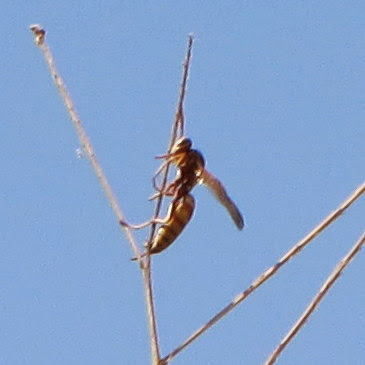
(c) 101595408250610106310, some rights reserved (CC BY) · licence
Family: Vespidae · Class: Insecta · Order: Hymenoptera
Polistes aurifer (Golden Paper Wasp) is a California animal in the Vespidae family.
The Golden Paper Wasp (Polistes aurifer) is a social wasp belonging to the family Vespidae. This species is classified taxonomically as a subspecies of Polistes fuscatus (Polistes fuscatus aurifer) according to the U.S. Fish and Wildlife Service taxonomic database. Adult Golden Paper Wasps are medium-sized wasps with distinctive coloration that gives them their common name, though specific morphological measurements have not been well documented in the scientific literature. The Golden Paper Wasp occurs in western North America, with confirmed presence in California and extending into Hawaii where it has been documented as a non-native species. In California, this wasp inhabits diverse ecosystems from coastal areas to inland regions. The species has been recorded in various habitat types including chaparral, woodland edges, and developed areas where suitable nesting sites are available. In Hawaii, Polistes aurifer has been observed visiting native plant species, including documented interactions with the endangered Sicyos macrophyllus (chūpala) at Kīpuka Kī in 2006 (USFWS Recovery Plan for Sicyos macrophyllus). Golden Paper Wasps construct paper nests from chewed wood fibers mixed with saliva, creating a papery material characteristic of the genus Polistes. These nests are typically open, umbrella-shaped structures attached to protected overhangs, eaves, or vegetation. The species exhibits typical paper wasp social structure with a founding queen establishing colonies in spring, followed by worker production through the summer months. Workers forage for arthropod prey to feed developing larvae while also visiting flowers for nectar to meet their own energy requirements. The foraging behavior of Golden Paper Wasps provides beneficial ecosystem services through predation on various pest insects. Workers hunt caterpillars, beetle larvae, and other soft-bodied arthropods, which they macerate and feed to larvae in the nest. Adults also visit flowers for nectar, potentially contributing to pollination services, though their effectiveness as pollinators compared to bees has not been quantified for this species. As a non-native species in Hawaii, Polistes aurifer represents part of the broader challenge of introduced insects in island ecosystems. While the species does not currently hold any federal or state conservation listing status, its presence in Hawaii raises questions about potential impacts on native arthropod communities and plant-pollinator relationships. The species' ability to establish in diverse habitats suggests adaptability to various environmental conditions. In its native California range, the Golden Paper Wasp appears to maintain stable populations without significant conservation concerns, though comprehensive population studies have not been conducted. Climate change and habitat modification may affect future distribution patterns, particularly at range margins and elevational limits. More research is needed to understand the full ecological role of this species in both its native and introduced ranges, including its interactions with native species and potential management implications in non-native habitats.
Classification
Class: Insecta · Order: Hymenoptera · Family: Vespidae
Frequently asked questions
How is Polistes aurifer classified?
Polistes aurifer belongs to class Insecta, order Hymenoptera, family Vespidae.
What family does Polistes aurifer belong to?
Polistes aurifer is in the Vespidae family.
What is Polistes aurifer?
The Golden Paper Wasp (Polistes aurifer) is a social wasp belonging to the family Vespidae.
Is Polistes aurifer found in California?
Yes. Polistes aurifer is recorded in California in The California Species Project's catalogue.
Related species
Other California species in the same genus, family, or bioregion.
Data from The California Species Project — 14,000+ California species with verified data from CNPS, CDFW, USFWS, and more.