Polistes exclamans
Guinea Paper Wasp
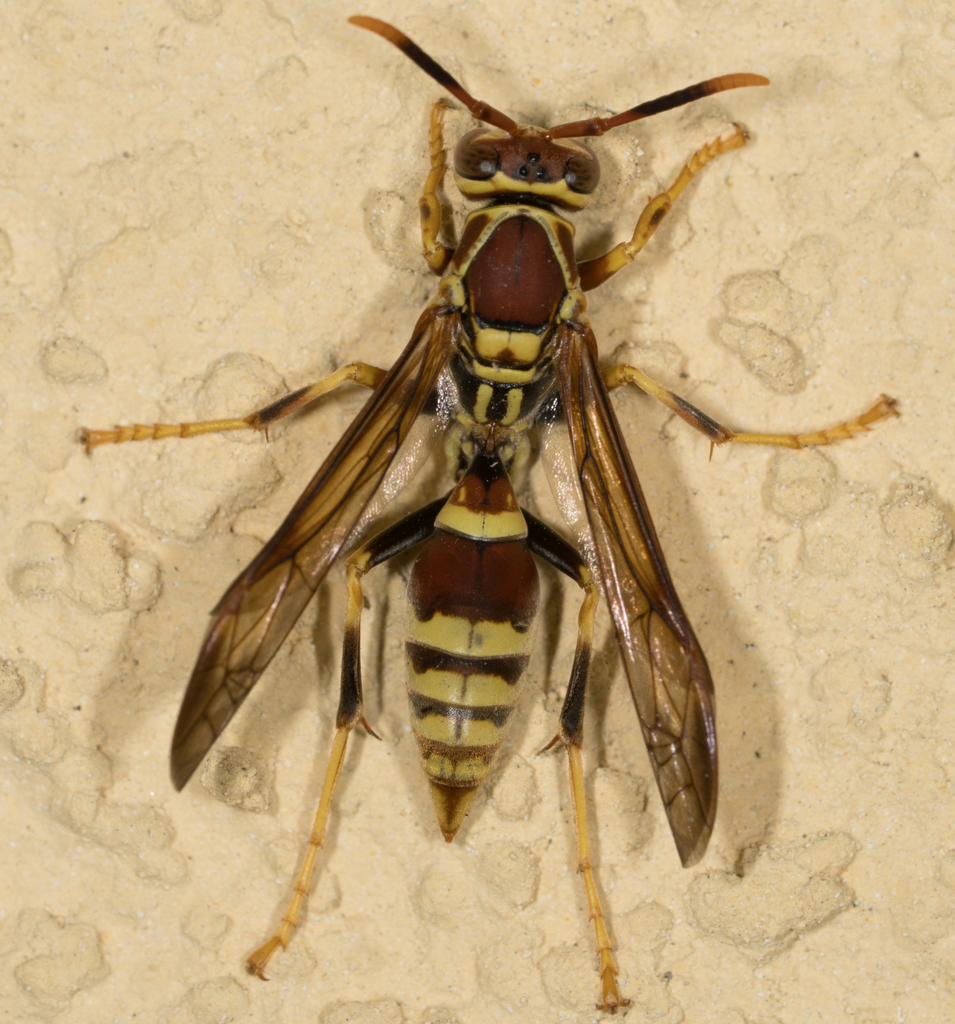
no rights reserved · CC0
Family: Vespidae · Class: Insecta · Order: Hymenoptera
Polistes exclamans (Guinea Paper Wasp) is a California animal in the Vespidae family.
The Guinea Paper Wasp (Polistes exclamans) is a social wasp belonging to the subfamily Polistinae within the family Vespidae. This species is characterized by its typical paper wasp morphology, with a slender body, constricted waist, and long legs that dangle during flight. Adults display the characteristic yellow and black coloration pattern common to many Polistes species, with variable markings that can include reddish-brown elements. The species belongs to the subgenus Aphanilopterus and constructs the familiar open-comb paper nests suspended from a single petiole. Polistes exclamans has a broad distribution across the United States, extending from the southeastern states through much of the central and western regions. In California, the species has been documented in various locations, including Orange County where specimens have been photographed at the Fullerton Arboretum (BugGuide 2007). The species appears to be well-established in the state, with observations recorded from multiple counties across different seasons. This wasp inhabits diverse environments including urban areas, suburban gardens, agricultural landscapes, and natural habitats. The species demonstrates considerable habitat flexibility, adapting to both native plant communities and human-modified environments. Guinea Paper Wasps typically construct their nests in protected locations such as under eaves, in shrubs, or beneath other overhead structures that provide shelter from rain and direct sunlight. As a eusocial species, Polistes exclamans exhibits complex behavioral patterns centered around colony development and maintenance. Foundress queens emerge from winter hibernation to establish new colonies in spring, constructing small paper nests from chewed wood fiber mixed with saliva. The colony grows throughout the warm months as workers expand the nest and rear successive broods of larvae. Adults are predatory, capturing various soft-bodied insects including caterpillars, fly larvae, and other arthropods to feed developing larvae. Adult wasps also visit flowers for nectar, playing a role in pollination of various plant species. The species exhibits seasonal activity patterns, with peak colony development occurring during summer months. Polistes exclamans is not federally or state listed and appears to maintain stable populations throughout its range. According to NatureServe, the species has a global conservation rank of G5 (Secure), indicating it faces no immediate conservation concerns (NatureServe 2025). The species' adaptability to human-modified environments and broad habitat tolerance contribute to its stable status. Like other paper wasps, P. exclamans provides ecological benefits through pest control services and pollination activities. The species faces typical challenges associated with habitat modification and pesticide use, but these do not appear to threaten overall population stability. Climate change impacts on this species have not been extensively studied, though the species' broad geographic range may provide some resilience to environmental changes. Scientific documentation of specific ecological requirements, population dynamics, and detailed life history traits remains limited compared to more intensively studied social wasp species.
Classification
Class: Insecta · Order: Hymenoptera · Family: Vespidae
Frequently asked questions
How is Polistes exclamans classified?
Polistes exclamans belongs to class Insecta, order Hymenoptera, family Vespidae.
What family does Polistes exclamans belong to?
Polistes exclamans is in the Vespidae family.
What is Polistes exclamans?
The Guinea Paper Wasp (Polistes exclamans) is a social wasp belonging to the subfamily Polistinae within the family Vespidae.
Is Polistes exclamans found in California?
Yes. Polistes exclamans is recorded in California in The California Species Project's catalogue.
Related species
Other California species in the same genus, family, or bioregion.
Data from The California Species Project — 14,000+ California species with verified data from CNPS, CDFW, USFWS, and more.