Polites mardon
Mardon Skipper
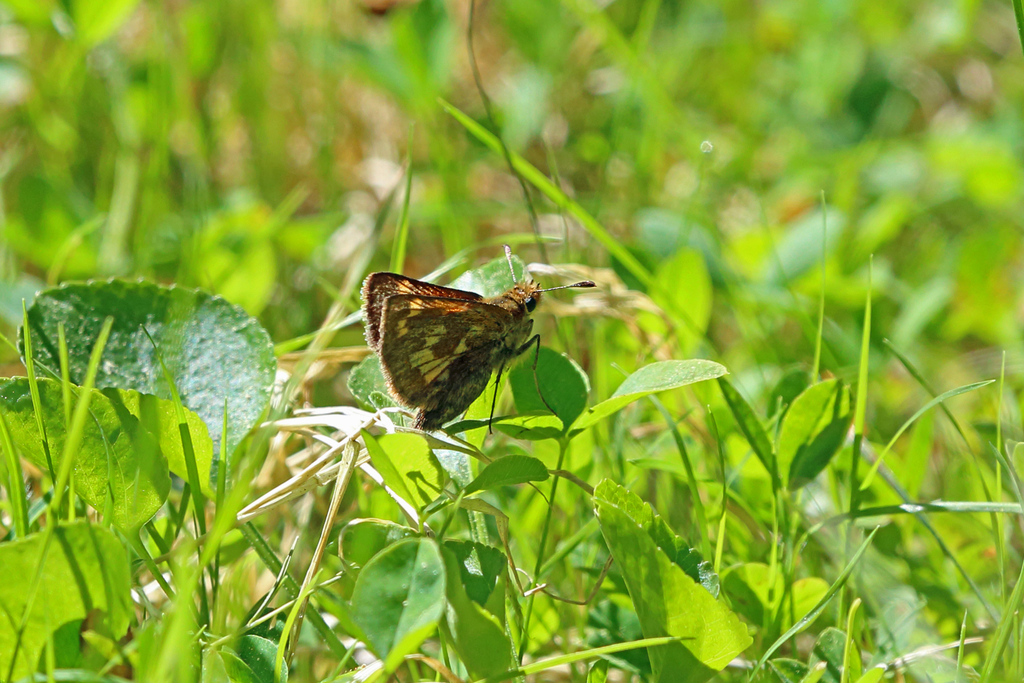
(c) Nigel Voaden, some rights reserved (CC BY) · licence
Family: Hesperiidae · Class: Insecta · Order: Lepidoptera
Conservation status: G2 S1
Polites mardon (Mardon Skipper) is a California animal in the Hesperiidae family.
The Mardon skipper is a small butterfly in the family Hesperiidae, measuring 23 to 28 millimeters (0.9 to 1.1 inches) in wingspan. Males display orange-brown forewings with distinctive dark stigma patches and scattered light spots, while the hindwings are predominantly brown with pale yellow spotting. Females are typically darker brown with reduced orange coloration and more prominent light spotting on both wings. The underside of the hindwings shows distinctive white or pale yellow spots arranged in irregular patterns. The antennae are club-shaped with orange tips, and the body is robust and densely covered with brown to orange-brown scales. The Mardon skipper has a highly restricted distribution, occurring locally in western Washington, western Oregon, and northwestern California. Within California, populations are documented from several counties in the northwestern region, including Humboldt and Mendocino counties. The species has experienced significant range contraction since the early 20th century, with many historical populations no longer extant. Current populations are fragmented and occur as isolated colonies separated by unsuitable habitat. This species inhabits native grasslands and prairie remnants at elevations typically ranging from sea level to 1,200 meters (3,937 feet). The butterfly requires high-quality native bunchgrass communities dominated by perennial grasses. Suitable habitat is characterized by relatively undisturbed areas with low shrub cover and minimal invasive species encroachment. The species shows strong fidelity to sites with specific microclimatic conditions, including areas that remain relatively moist during summer months but provide adequate drainage during winter. Mardon skipper larvae feed exclusively on native perennial grasses, with documented host plants including Idaho fescue (Festuca idahoensis) and red fescue (Festuca rubra). Adults are active from late June through August, with peak flight periods typically occurring in July. Males establish territories in open areas and engage in patrolling behavior to locate females. Females deposit eggs singly on or near host plants, and larvae develop through five instars before overwintering in the final larval stage. The species completes one generation annually, with adults emerging the following summer after pupation in early spring. The Mardon skipper has a global conservation ranking of G2, indicating it is imperiled globally due to rarity or factors making it vulnerable to extinction. In California, the species receives a state ranking of S1, denoting critical imperiled status within the state. The primary threats include habitat loss and degradation from agricultural conversion, urban development, and invasive species encroachment. Fire suppression has altered natural disturbance regimes in native grasslands, leading to woody encroachment and changes in grass community composition. Climate change poses additional threats through altered precipitation patterns and increased drought stress on host plants. Conservation efforts focus on habitat restoration, invasive species control, and protection of remaining native grassland fragments. Several populations occur on protected lands managed by federal and state agencies, though active management is required to maintain suitable habitat conditions.
Classification
Class: Insecta · Order: Lepidoptera · Family: Hesperiidae
Conservation status
G2 S1
Frequently asked questions
How is Polites mardon classified?
Polites mardon belongs to class Insecta, order Lepidoptera, family Hesperiidae.
What family does Polites mardon belong to?
Polites mardon is in the Hesperiidae family.
Is Polites mardon protected or of conservation concern?
Polites mardon carries the following status: G2 S1.
What is Polites mardon?
The Mardon skipper is a small butterfly in the family Hesperiidae, measuring 23 to 28 millimeters (0.9 to 1.1 inches) in wingspan.
Is Polites mardon found in California?
Yes. Polites mardon is recorded in California in The California Species Project's catalogue.
Related species
Other California species in the same genus, family, or bioregion.
Data from The California Species Project — 14,000+ California species with verified data from CNPS, CDFW, USFWS, and more.