Polites sabuleti
Sandhill Skipper
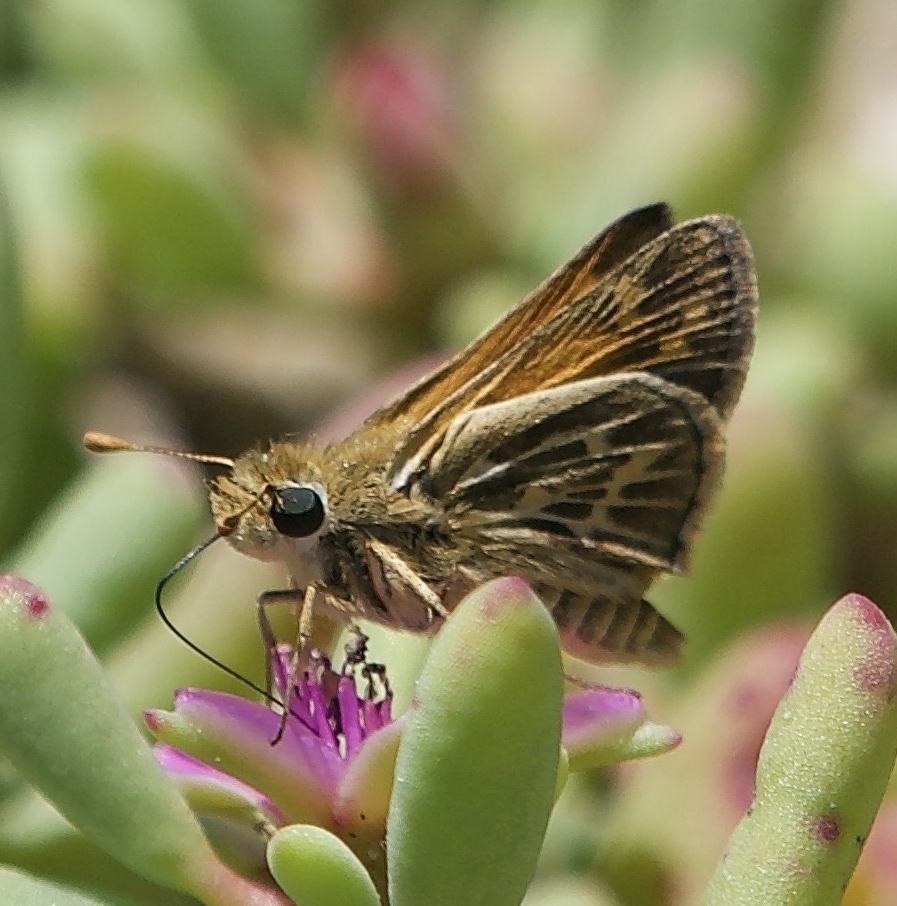
(c) Bill Levine, some rights reserved (CC BY) · licence
Family: Hesperiidae · Class: Insecta · Order: Lepidoptera
Polites sabuleti (Sandhill Skipper) is a California animal in the Hesperiidae family.
The Sandhill Skipper is a small butterfly in the family Hesperiidae, characterized by tawny-orange coloration with distinctive dark markings. Males typically measure 22-28 mm (0.9-1.1 inches) in wingspan, while females are slightly larger at 24-30 mm (0.9-1.2 inches). The dorsal wing surfaces display bright orange-brown coloration with dark borders and distinctive black stigma patches on the male forewings. The ventral surfaces are paler, with the hindwings showing yellowish-white spotting that helps distinguish this species from similar skippers. Males possess prominent scent patches used in courtship displays. The species ranges from southern British Columbia and eastern Washington south through California and northern Arizona to Baja California, extending east to southeastern Wyoming, central Colorado, and northeastern New Mexico. In California, Polites sabuleti occurs throughout much of the state, from coastal areas to montane regions, demonstrating considerable ecological adaptability across diverse geographic zones. Sandhill Skippers inhabit open grasslands, meadows, parks, gardens, and disturbed areas where host grasses are abundant. The species tolerates a wide elevation range, from sea level to approximately 3,200 meters (10,500 feet) in montane environments. Adults prefer sunny, open areas with nectar sources including asters, thistles, and various wildflowers. The species thrives in both natural grasslands and human-modified landscapes, including agricultural areas and urban spaces with suitable grass populations. Larvae feed on various grass species including Bermuda grass (Cynodon dactylon), bluegrass (Poa pratensis), desert salt grass (Distichlis spicata var. stricta), sand lovegrass (Eragrostis trichodes), rough bentgrass (Agrostis scabra), Idaho fescue (Festuca idahoensis), and alpine fescue (Festuca brachyphylla). This broad host range contributes to the species' widespread distribution and ecological success. Adult flight periods vary by location and elevation, typically occurring from April through October in lower elevations, with peak activity during summer months. The species produces multiple broods annually in warmer areas, while higher elevation populations may have only one or two generations per year. Males establish territories in grass patches and engage in perching behavior, darting out to investigate potential mates or rivals. Courtship involves aerial displays and chemical communication through pheromones released from the male scent patches. Females deposit eggs singly on host grass blades, and larvae construct silk shelters within grass clumps where they feed and pupate. The Sandhill Skipper maintains stable populations across most of its range and currently holds no special conservation status at federal or state levels. The species benefits from its adaptability to human-modified environments and broad host plant range. However, localized populations may face pressure from habitat conversion, intensive agriculture, and urbanization that eliminates native grasslands. Climate change may affect high-elevation populations as temperature patterns shift, potentially altering the timing of life cycles and availability of suitable habitat.
Classification
Class: Insecta · Order: Lepidoptera · Family: Hesperiidae
Frequently asked questions
How is Polites sabuleti classified?
Polites sabuleti belongs to class Insecta, order Lepidoptera, family Hesperiidae.
What family does Polites sabuleti belong to?
Polites sabuleti is in the Hesperiidae family.
What is Polites sabuleti?
The Sandhill Skipper is a small butterfly in the family Hesperiidae, characterized by tawny-orange coloration with distinctive dark markings.
Is Polites sabuleti found in California?
Yes. Polites sabuleti is recorded in California in The California Species Project's catalogue.
Related species
Other California species in the same genus, family, or bioregion.
Data from The California Species Project — 14,000+ California species with verified data from CNPS, CDFW, USFWS, and more.