Polites sabuleti albamontana
White Mountains Sandhill Skipper
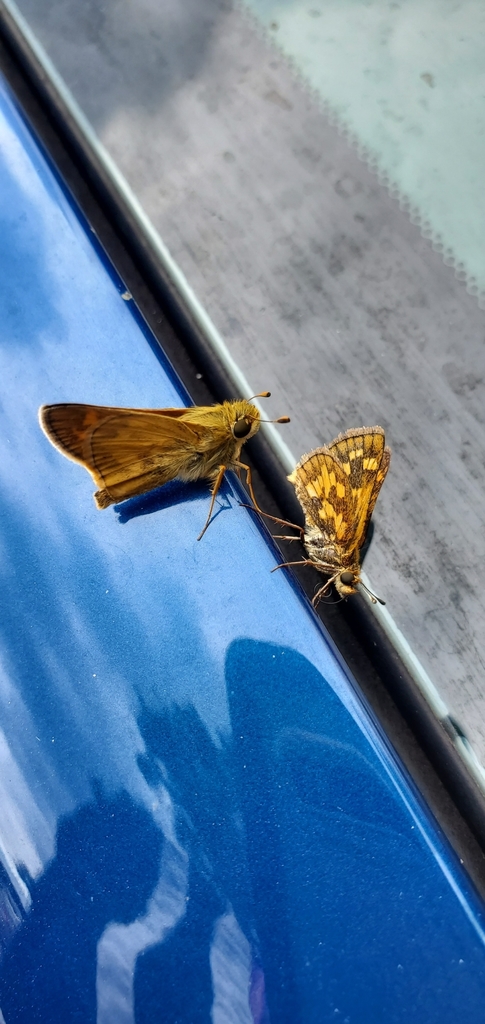
no rights reserved · CC0
Family: Hesperiidae · Class: Insecta · Order: Lepidoptera
Conservation status: G4T2 S1S2
Polites sabuleti albamontana (White Mountains Sandhill Skipper) is a California animal in the Hesperiidae family.
The White Mountains Sandhill Skipper (Polites sabuleti albamontana) is a subspecies of the widespread Sandhill Skipper, endemic to high-elevation habitats in California's White Mountains. Adults measure approximately 25 to 30 mm (1.0 to 1.2 inches) in wingspan. The dorsal wing surfaces are orange-brown with dark borders and scattered dark spots, while the ventral hindwings display a distinctive pale yellowish-brown coloration with light spots. Males possess a prominent black stigma (scent patch) on the forewings. The subspecies is distinguished from other Polites sabuleti populations by its paler coloration and slightly smaller size, adaptations to its harsh alpine environment. This subspecies is restricted to the White Mountains of Mono and Inyo counties in east-central California, primarily along the California-Nevada border. The range extends from approximately Boundary Peak south to the Patriarch Grove area, representing one of the most geographically limited butterfly distributions in California. Historical records suggest the population may have occupied a slightly broader range within the White Mountains, but current distribution appears fragmented across suitable habitat patches. The White Mountains Sandhill Skipper inhabits high-elevation meadows, seeps, and streamside areas between 2,400 and 3,400 meters (7,900 to 11,200 feet) elevation. These alpine and subalpine environments are characterized by short growing seasons, intense solar radiation, and extreme temperature fluctuations. The subspecies requires areas with adequate moisture and specific host plant communities, typically found in protected swales and north-facing slopes where snow persists longer into the summer months. Adults are active from late June through August, with peak flight occurring in July. The species exhibits a single annual generation. Females deposit eggs singly on or near host plants, which include various grasses in the Poaceae family, particularly species adapted to high-elevation conditions. Larvae overwinter in early instars, requiring nearly ten months to complete development due to the shortened growing season. Adults are fast-flying and territorial, with males establishing perches on prominent rocks or vegetation from which they investigate passing insects. The subspecies holds a Global T-rank of T2 (imperiled subspecies) and California S-rank of S1S2 (critically imperiled to imperiled in the state), reflecting its extremely limited distribution and small population size. Climate change poses a significant threat, as warming temperatures may force suitable habitat to higher elevations where it becomes increasingly scarce. The White Mountains' already harsh conditions leave little margin for environmental shifts. Additional threats include potential habitat degradation from recreational activities and livestock grazing in sensitive meadow areas. The subspecies' persistence depends on maintaining the integrity of high-elevation wetland habitats and natural hydrological processes that sustain these specialized alpine ecosystems. Long-term monitoring is essential to track population trends and habitat condition changes in response to climate variability.
Classification
Class: Insecta · Order: Lepidoptera · Family: Hesperiidae
Conservation status
G4T2 S1S2
Frequently asked questions
How is Polites sabuleti albamontana classified?
Polites sabuleti albamontana belongs to class Insecta, order Lepidoptera, family Hesperiidae.
What family does Polites sabuleti albamontana belong to?
Polites sabuleti albamontana is in the Hesperiidae family.
Is Polites sabuleti albamontana protected or of conservation concern?
Polites sabuleti albamontana carries the following status: G4T2 S1S2.
What is Polites sabuleti albamontana?
The White Mountains Sandhill Skipper (Polites sabuleti albamontana) is a subspecies of the widespread Sandhill Skipper, endemic to high-elevation habitats in California's White Mountains.
Is Polites sabuleti albamontana found in California?
Yes. Polites sabuleti albamontana is recorded in California in The California Species Project's catalogue.
Related species
Other California species in the same genus, family, or bioregion.
Data from The California Species Project — 14,000+ California species with verified data from CNPS, CDFW, USFWS, and more.