Polites themistocles
Tawny-edged Skipper
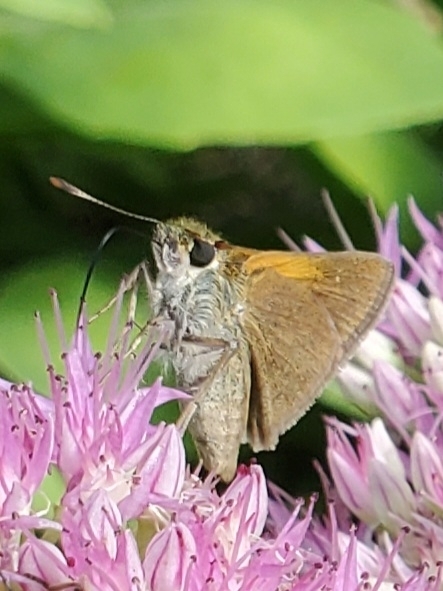
no rights reserved · CC0
Family: Hesperiidae · Class: Insecta · Order: Lepidoptera
Polites themistocles (Tawny-edged Skipper) is a California animal in the Hesperiidae family.
The Tawny-edged Skipper (Polites themistocles) is a small butterfly with a wingspan ranging from 22 to 28 mm (0.9 to 1.1 inches). Males display orange-brown forewings with distinctive tawny or golden-orange patches along the leading edges, bordered by dark brown margins. The hindwings are predominantly brown with scattered orange markings. Females are darker overall, with reduced orange coloration and more extensive brown areas on both wing surfaces. The underside of the hindwings shows pale yellow-brown coloration with small, light-colored spots. The antennae are short and club-shaped, typical of skipper butterflies, and the body is robust and hairy. This species maintains one of the most extensive distributions among North American skippers, ranging from southern British Columbia east across southern Canada to Nova Scotia, then south to northern California, central Arizona, central Texas, the Gulf states, and central Florida. In California, populations are primarily found in the northern counties, with records extending south along the Sierra Nevada foothills. The species has experienced some range contraction in portions of its historical distribution, particularly in urbanized areas. Tawny-edged Skippers inhabit open grasslands, prairies, meadows, old fields, and disturbed areas with abundant grasses. They occur from sea level to elevations of approximately 2,400 meters (8,000 feet) in mountainous regions. The species prefers areas with a mixture of native and non-native grasses, often thriving in agricultural margins, roadsides, and suburban parks where host plants are present. Larvae feed exclusively on grasses, with documented host plants including panic grasses (Panicum species), slender crabgrass (Digitaria filiformis), and bluegrass (Poa pratensis). Adults are active from late spring through early fall, with flight periods varying by latitude and elevation. In most regions, the species produces two broods annually, with the first generation emerging in May to June and the second in July to August. Males establish territories in open areas and patrol for receptive females through rapid, erratic flight patterns. Adults nectar on various wildflowers, showing preference for composites, mints, and legumes. Mating occurs during midday hours, and females deposit eggs singly on or near host grass leaves. Larvae overwinter in the third or fourth instar stage. The Tawny-edged Skipper is not federally or state-listed and maintains stable populations across most of its range. However, local declines have been documented in areas experiencing intensive agriculture, urban development, and habitat fragmentation. The species benefits from conservation practices that maintain grassland habitats and native plant communities. Climate change may affect northern populations through shifting temperature and precipitation patterns, though the species' broad ecological tolerance and multiple host plant relationships provide some resilience to environmental changes.
Classification
Class: Insecta · Order: Lepidoptera · Family: Hesperiidae
Frequently asked questions
How is Polites themistocles classified?
Polites themistocles belongs to class Insecta, order Lepidoptera, family Hesperiidae.
What family does Polites themistocles belong to?
Polites themistocles is in the Hesperiidae family.
What is Polites themistocles?
The Tawny-edged Skipper (Polites themistocles) is a small butterfly with a wingspan ranging from 22 to 28 mm (0.9 to 1.1 inches).
Is Polites themistocles found in California?
Yes. Polites themistocles is recorded in California in The California Species Project's catalogue.
Related species
Other California species in the same genus, family, or bioregion.
Data from The California Species Project — 14,000+ California species with verified data from CNPS, CDFW, USFWS, and more.