Polycaon stoutii
Stout's Hardwood Borer
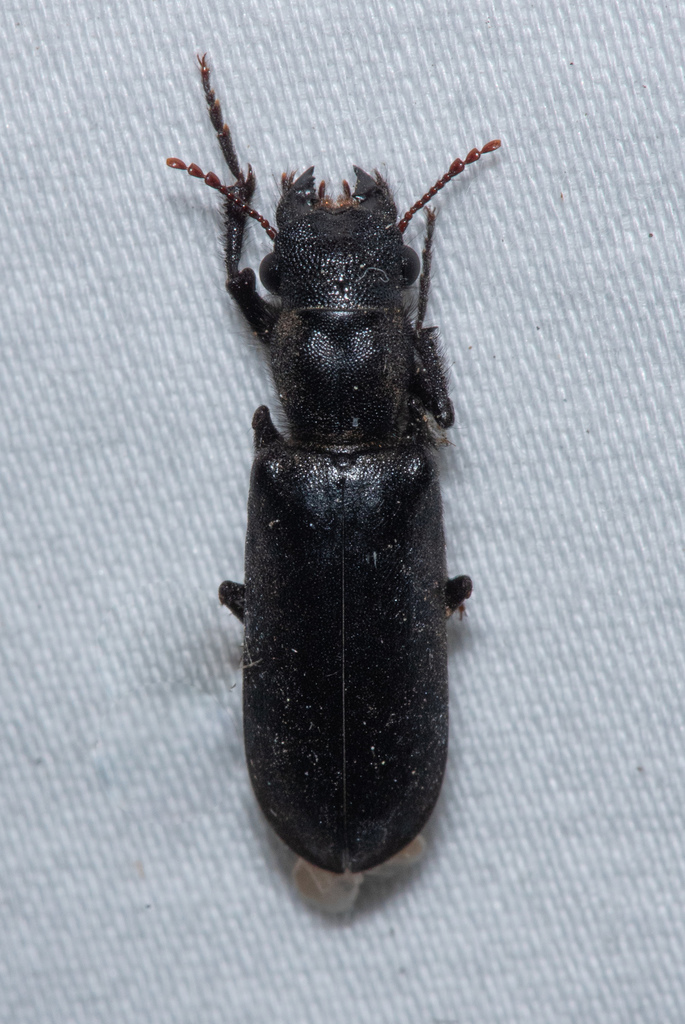
(c) Don Loarie, some rights reserved (CC BY) · licence
Family: Bostrichidae · Class: Insecta · Order: Coleoptera
Polycaon stoutii (Stout's Hardwood Borer) is a California animal in the Bostrichidae family.
Stout's Hardwood Borer is a wood-boring beetle in the family Bostrichidae, subfamily Polycaoninae. Adults are robust, cylindrical beetles typically measuring 8-15 mm in length, with a dark brown to black coloration. The head is deflexed beneath the pronotum, giving the beetle a characteristic humpbacked appearance. The pronotum is typically wider than long and may bear small tubercles or granules on the surface. The elytra are parallel-sided and cover the entire abdomen, with faint longitudinal ridges or striae. Polycaon stoutii occurs along the Pacific Coast of North America, with its primary distribution in California and extending into Oregon. The species is most commonly found in coastal and foothill regions, particularly in areas with oak woodlands and mixed hardwood forests. Records indicate the species occurs from sea level to approximately 1,500 meters elevation, though it is most abundant in lower elevation sites. This species inhabits hardwood forest ecosystems, showing a strong association with oak species (Quercus spp.) and other native hardwoods. Adults are typically found in areas with mature trees, dead wood, and forest debris. The beetles prefer environments with adequate moisture and organic matter, including forest edges, riparian corridors, and areas with mixed canopy cover. They are often associated with decaying hardwood logs, stumps, and large woody debris. As wood-boring beetles, both larvae and adults of P. stoutii feed on hardwood materials. Females bore into dead or dying hardwood trees to create galleries where they deposit eggs. The larvae develop within the wood, creating extensive tunnel systems as they feed on the cellulose and lignin components. Development from egg to adult typically requires one to two years, depending on environmental conditions and wood quality. Adults emerge through characteristic round exit holes and are most active during warmer months, typically from late spring through early fall. The species plays an ecological role in forest decomposition processes, helping to break down dead wood and recycle nutrients. Polycaon stoutii is tracked by the California Department of Fish and Wildlife's California Natural Diversity Database as a special status species, though it lacks formal state or federal listing protection. The species faces potential threats from habitat loss due to urban development, logging practices that remove dead wood habitat, and forest management activities that eliminate coarse woody debris. Climate change may also affect the species through altered precipitation patterns and increased frequency of wildfires, which could impact hardwood forest ecosystems. NatureServe ranks the species as G4 (Apparently Secure) globally, indicating that while the species faces some conservation concerns, it is not at immediate risk of extinction. Conservation efforts focus on maintaining mature hardwood forests and ensuring adequate retention of dead wood and organic matter in managed forest systems. The species would benefit from forest management practices that preserve snags, logs, and other woody debris essential for its life cycle.
Classification
Class: Insecta · Order: Coleoptera · Family: Bostrichidae
Frequently asked questions
How is Polycaon stoutii classified?
Polycaon stoutii belongs to class Insecta, order Coleoptera, family Bostrichidae.
What family does Polycaon stoutii belong to?
Polycaon stoutii is in the Bostrichidae family.
What is Polycaon stoutii?
Stout's Hardwood Borer is a wood-boring beetle in the family Bostrichidae, subfamily Polycaoninae.
Is Polycaon stoutii found in California?
Yes. Polycaon stoutii is recorded in California in The California Species Project's catalogue.
More California species
This species has no close relatives in our California data — here are other species to explore.
Data from The California Species Project — 14,000+ California species with verified data from CNPS, CDFW, USFWS, and more.