Polygonia faunus
Green Comma
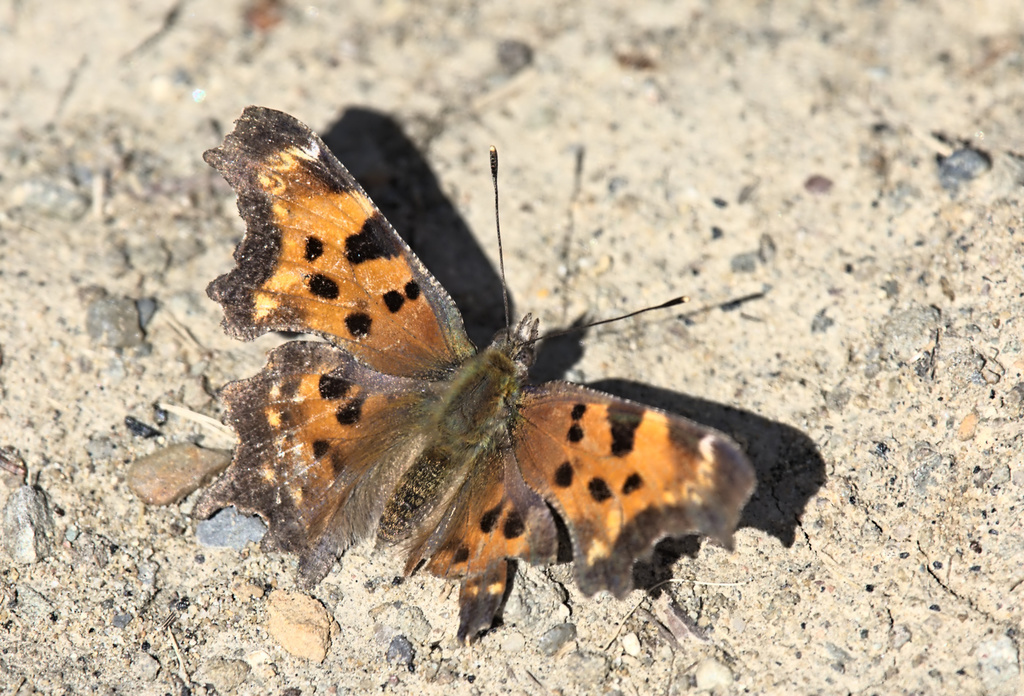
(c) Jimmy Dee, some rights reserved (CC BY-SA) · licence
Family: Nymphalidae · Class: Insecta · Order: Lepidoptera
Polygonia faunus (Green Comma) is a California animal in the Nymphalidae family.
The Green Comma is a medium-sized butterfly with a wingspan ranging from 44 to 54 mm (1.7 to 2.1 inches). The upper wing surfaces are bright orange with irregular black spots and markings, creating a distinctive tortoiseshell pattern. The forewings display prominent black borders and patches, while the hindwings feature scalloped edges typical of comma butterflies. The undersides are cryptically colored in mottled browns and grays, providing effective camouflage when the wings are closed. A distinctive white comma-shaped mark on the underside of each hindwing gives this species its common name, distinguishing it from similar comma butterflies. The Green Comma occurs across boreal North America south of the tundra zone, ranging from central Alaska south to central California and northern New Mexico. The species extends eastward across southern Canada and the Great Lakes region to New England and the Maritime Provinces. A geographically isolated population persists in the southern Appalachian Mountains. In California, the species is found primarily in mountainous regions of the Sierra Nevada and Cascade Range, typically at elevations between 1,200 and 3,000 meters (4,000 to 10,000 feet). This butterfly inhabits mixed coniferous and deciduous forests, particularly areas with openings, clearings, and forest edges. Green Commas favor riparian zones and moist woodland areas where their host plants thrive. The species is closely associated with early successional habitats, including areas recovering from natural disturbances such as avalanches, landslides, or forest fires. Adults are frequently observed along forest roads, hiking trails, and in sunny clearings within otherwise dense forest canopy. Green Comma larvae feed on multiple host plant species, including small pussy willow (Salix humilis), black birch (Betula lenta), various alder species (Alnus), western azalea (Rhododendron occidentale), and gooseberry (Ribes). Adults are active from late spring through early fall, with peak flight periods occurring in June and July at higher elevations. The species typically produces one generation per year in most of its range, though partial second broods may occur in warmer, lower elevation areas. Adults feed on tree sap, rotting fruit, dung, and occasionally flower nectar. Males establish territories in sunny forest openings and engage in aggressive territorial behavior, pursuing other butterflies and potential mates. Overwintering occurs in the adult stage, with butterflies seeking shelter under bark, in rock crevices, or within hollow logs. Mated females emerge in spring to lay eggs singly on host plant leaves. The species exhibits strong site fidelity, with adults rarely straying far from suitable breeding habitat. The Green Comma is not federally or state-listed as threatened or endangered. However, populations may face localized pressures from habitat loss due to intensive forest management practices, urban development at lower elevations, and climate change impacts on montane forest ecosystems. Forest fragmentation can isolate populations and reduce genetic diversity. The species' dependence on specific microhabitats and host plants makes it vulnerable to ecosystem-level changes affecting boreal and montane forest communities.
Classification
Class: Insecta · Order: Lepidoptera · Family: Nymphalidae
Frequently asked questions
How is Polygonia faunus classified?
Polygonia faunus belongs to class Insecta, order Lepidoptera, family Nymphalidae.
What family does Polygonia faunus belong to?
Polygonia faunus is in the Nymphalidae family.
What is Polygonia faunus?
The Green Comma is a medium-sized butterfly with a wingspan ranging from 44 to 54 mm (1.7 to 2.1 inches).
Is Polygonia faunus found in California?
Yes. Polygonia faunus is recorded in California in The California Species Project's catalogue.
Related species
Other California species in the same genus, family, or bioregion.
Data from The California Species Project — 14,000+ California species with verified data from CNPS, CDFW, USFWS, and more.