Polygonia progne
Gray Comma
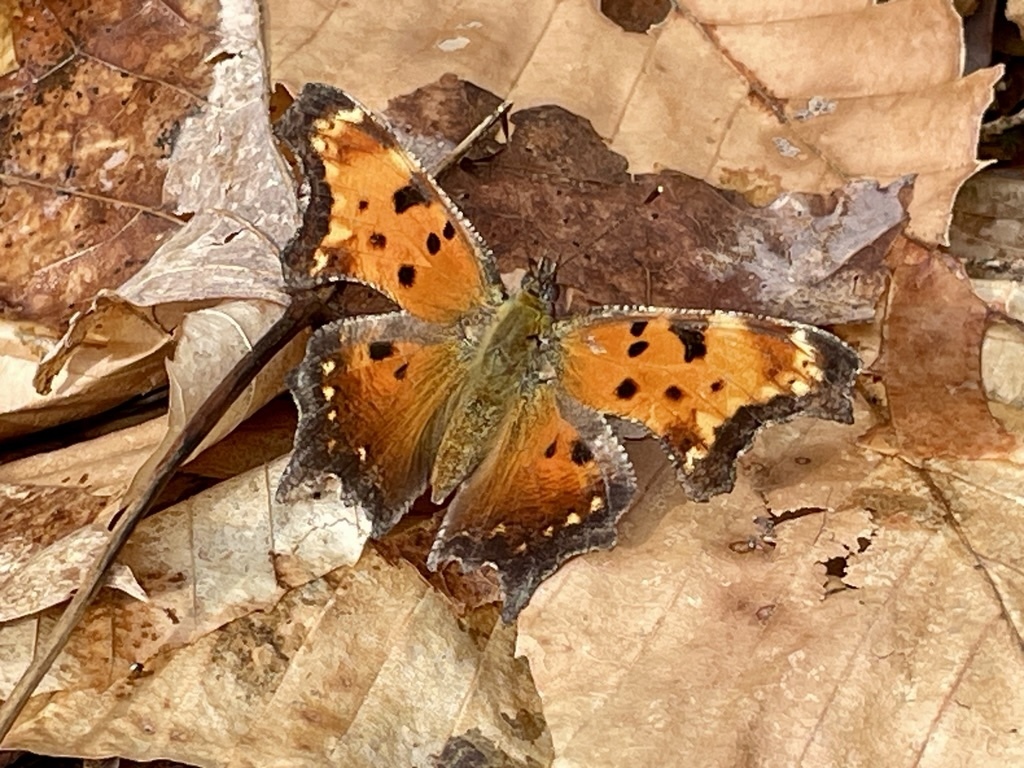
(c) Michael Nerrie, some rights reserved (CC BY) · licence
Family: Nymphalidae · Class: Insecta · Order: Lepidoptera
Polygonia progne (Gray Comma) is a California animal in the Nymphalidae family.
The Gray Comma (Polygonia progne) is a medium-sized butterfly in the family Nymphalidae, characterized by its angular wing shape and cryptic coloration. Adults have a wingspan of 45-60 mm (1.8-2.4 inches). The dorsal wing surfaces are orange-brown with dark brown to black markings, including distinctive dark borders and irregular spotting. The ventral surfaces are mottled gray-brown, providing exceptional camouflage when the butterfly rests with wings closed on tree bark or dead leaves. A small white comma-shaped mark on the underside of the hindwing gives the species its common name. Males and females are similar in appearance, though females are typically slightly larger. The Gray Comma has one of the most extensive distributions among North American angle-wing butterflies, ranging from the Northwest Territories and British Columbia south along the Pacific coast to central California. The range extends southeast through Montana, Utah, Colorado, and the Dakotas to eastern Nebraska, central Kansas, and central Arkansas. The distribution continues east through southern Canada and the northern United States to Maine and the Maritimes, extending south in the Appalachian Mountains to North Carolina. In California, populations occur primarily in the northern and central regions. This species inhabits a variety of forested environments, including deciduous and mixed woodlands, riparian zones, mountain slopes, and woodland edges. Gray Commas are found from sea level to elevations exceeding 2,400 meters (8,000 feet) in mountainous regions. Adults frequent areas near their host plants and are commonly observed along forest trails, in clearings, and around water sources where they feed on tree sap, rotting fruit, dung, and carrion. Gray Comma larvae feed exclusively on gooseberries (Ribes species) and azalea (Rhododendron species). Adults are strong fliers and highly territorial, with males establishing perching sites on prominent objects to await passing females. The species typically produces one to two broods per year, depending on latitude and elevation. Overwintering occurs in the adult stage, with hibernating butterflies seeking shelter under bark, in rock crevices, or in other protected locations. Spring emergence coincides with host plant leaf development. Females deposit eggs singly on young leaves of host plants. The Gray Comma is not currently listed under federal or state endangered species legislation. Populations appear stable across most of the species' range, though local declines may occur due to habitat loss from development and forest management practices. The species' broad host plant range and extensive distribution provide some resilience against environmental changes. Climate change may affect northern populations as temperature and precipitation patterns shift, potentially altering the timing of emergence and host plant phenology. Conservation of diverse forest ecosystems and maintenance of native Ribes and Rhododendron populations support Gray Comma habitat requirements.
Classification
Class: Insecta · Order: Lepidoptera · Family: Nymphalidae
Frequently asked questions
How is Polygonia progne classified?
Polygonia progne belongs to class Insecta, order Lepidoptera, family Nymphalidae.
What family does Polygonia progne belong to?
Polygonia progne is in the Nymphalidae family.
What is Polygonia progne?
The Gray Comma (Polygonia progne) is a medium-sized butterfly in the family Nymphalidae, characterized by its angular wing shape and cryptic coloration.
Is Polygonia progne found in California?
Yes. Polygonia progne is recorded in California in The California Species Project's catalogue.
Related species
Other California species in the same genus, family, or bioregion.
Data from The California Species Project — 14,000+ California species with verified data from CNPS, CDFW, USFWS, and more.