Polygonia satyrus
Satyr Comma
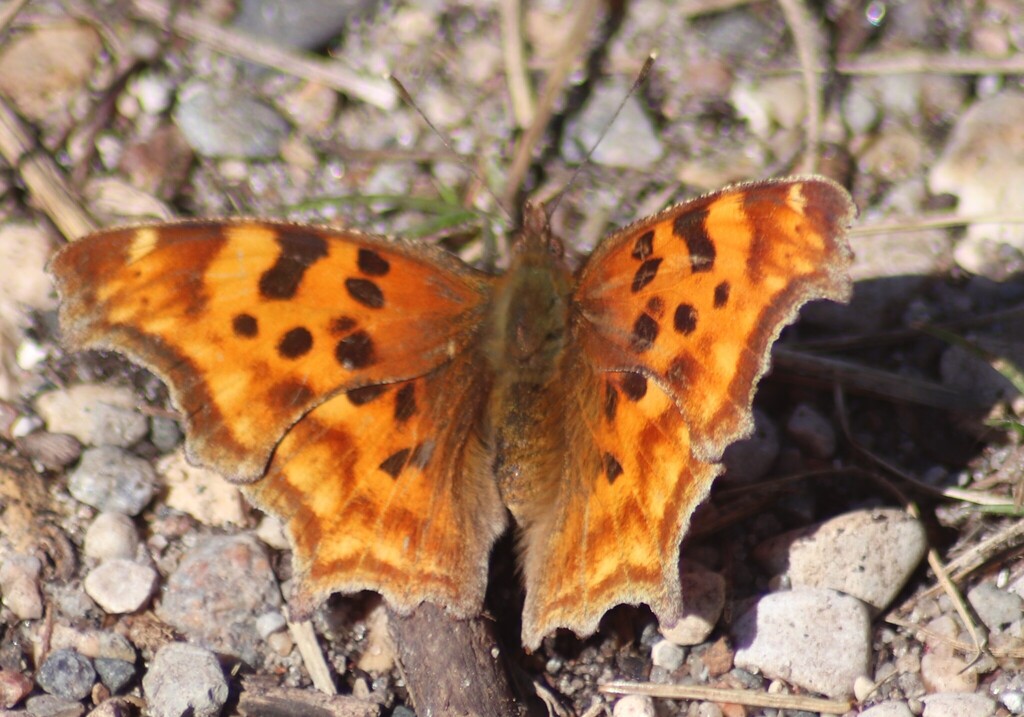
(c) Sean Frey, some rights reserved (CC BY) · licence
Family: Nymphalidae · Class: Insecta · Order: Lepidoptera
Polygonia satyrus (Satyr Comma) is a California animal in the Nymphalidae family.
The Satyr Comma (Polygonia satyrus) is a medium-sized butterfly in the family Nymphalidae, characterized by its angular wing shape and distinctive comma-shaped marking on the hindwing underside. Adults have a wingspan ranging from 44 to 51 mm (1.7 to 2.0 inches). The dorsal wing surfaces display bright orange coloration with irregular black borders and spots, while the ventral surfaces are mottled brown and gray, providing effective camouflage when the wings are closed. The species exhibits seasonal color dimorphism, with spring individuals typically showing brighter coloration than their darker autumn counterparts. The Satyr Comma has an extensive North American distribution, ranging from southern Yukon and Northwest Territories south through western Canada and the western United States to Baja California, southern Arizona, and southwest New Mexico. The range extends eastward across the Great Lakes states to northern New England and Nova Scotia. In California, the species occurs in mountainous regions and foothills throughout much of the state, with populations documented from the Cascade Range south through the Sierra Nevada and Coast Ranges. This species inhabits diverse woodland environments, including mixed coniferous-deciduous forests, riparian corridors, mountain meadows, and forest edges. Satyr Commas are typically found at elevations ranging from near sea level to approximately 3,000 meters (9,800 feet), showing preference for areas with dappled sunlight and proximity to host plants. Adults frequent sunny clearings, woodland paths, and flower-rich areas within or adjacent to forested habitats. Satyr Commas are multivoltine, producing two to three broods annually in most regions, with timing dependent on local climate conditions. Adults are strong fliers and exhibit territorial behavior, with males establishing perching sites on exposed branches or rocks to await females. The species overwinters as adults, seeking shelter under loose bark, in tree crevices, or among leaf litter. Mating occurs in spring after hibernation, and females deposit eggs singly on young nettle leaves. Larvae develop through five instars over approximately one month, feeding exclusively on various nettles (Urticaceae species), including stinging nettle (Urtica dioica) and false nettle (Boehmeria cylindrica). Pupation occurs in a chrysalis suspended from the host plant or nearby vegetation. The Satyr Comma is not federally listed and appears to maintain stable populations across most of its range. The species benefits from its broad habitat tolerance and widespread distribution of nettle host plants. However, local populations may be affected by habitat fragmentation, urbanization, and changes in forest management practices. Climate change may influence the species' range boundaries and seasonal timing, particularly in mountainous regions where temperature increases could affect overwintering success and host plant phenology.
Classification
Class: Insecta · Order: Lepidoptera · Family: Nymphalidae
Frequently asked questions
How is Polygonia satyrus classified?
Polygonia satyrus belongs to class Insecta, order Lepidoptera, family Nymphalidae.
What family does Polygonia satyrus belong to?
Polygonia satyrus is in the Nymphalidae family.
What is Polygonia satyrus?
The Satyr Comma (Polygonia satyrus) is a medium-sized butterfly in the family Nymphalidae, characterized by its angular wing shape and distinctive comma-shaped marking on the hindwing underside.
Is Polygonia satyrus found in California?
Yes. Polygonia satyrus is recorded in California in The California Species Project's catalogue.
Related species
Other California species in the same genus, family, or bioregion.
Data from The California Species Project — 14,000+ California species with verified data from CNPS, CDFW, USFWS, and more.