Polyphylla barbata
Mount Hermon (=barbate) June beetle
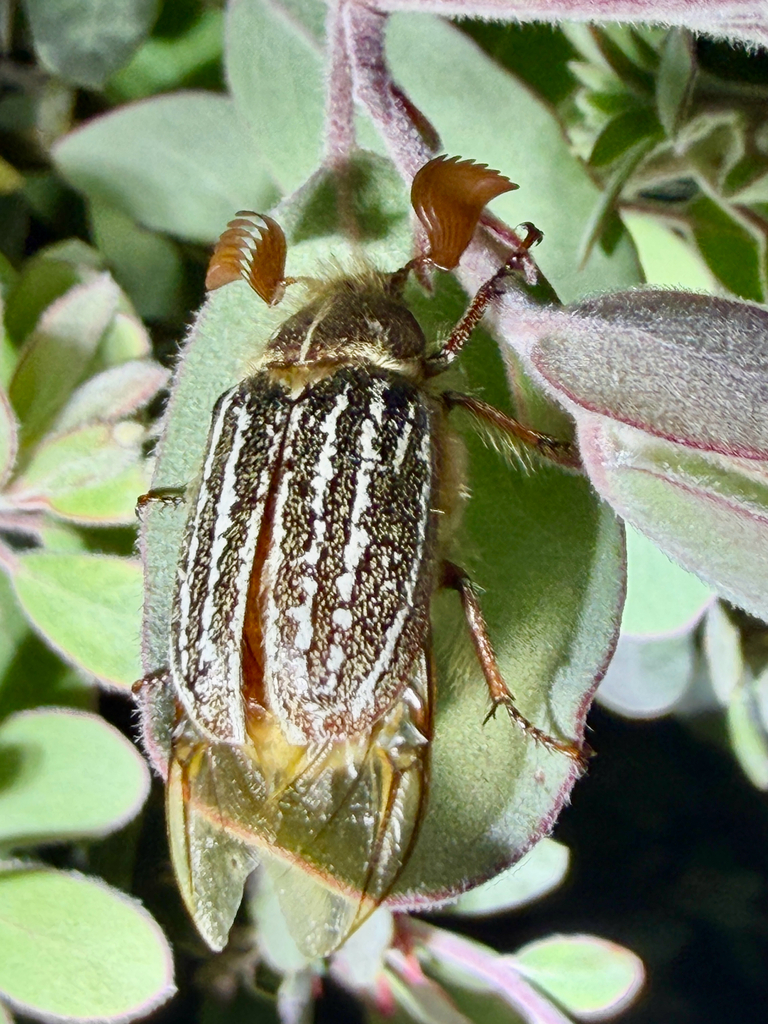
(c) Chris Sulots, some rights reserved (CC BY) · licence
Family: Scarabaeidae · Class: Insecta · Order: Coleoptera
Conservation status: Endangered · G1 S2
Polyphylla barbata (Mount Hermon (=barbate) June beetle) is a California animal in the Scarabaeidae family.
The Mount Hermon June beetle is a medium-sized scarab beetle endemic to the Mount Hermon region of Santa Cruz County, California. Adults are robust beetles measuring approximately 15-25 mm (0.6-1.0 inches) in length. The species exhibits the characteristic stout, oval body shape typical of genus Polyphylla, with prominent antennae bearing enlarged, fan-like clubs. Males display more developed antennal clubs than females, a common sexual dimorphism in scarab beetles. The common name references the distinctive "barbate" or bearded appearance created by dense setae on various body parts. The Mount Hermon June beetle has one of the most restricted ranges of any North American beetle, occurring only in the Mount Hermon area of Santa Cruz County, California. This extremely limited distribution encompasses approximately 80 square kilometers of the Santa Cruz Mountains, specifically in sandy soils derived from ancient marine deposits known as the Purisima Formation. The species' range centers on the town of Mount Hermon and extends into adjacent areas of similar geological substrate. This beetle is associated with unique sandy soil habitats characteristic of the Mount Hermon region, including Zayante sand hills and associated scrub communities. These well-drained, nutrient-poor sandy soils support specialized plant communities dominated by ponderosa pine, knobcone pine, and various chaparral shrubs. The species occurs at elevations ranging from approximately 180 to 520 meters (600 to 1,700 feet). Adults are active during late spring and early summer months, emerging from sandy substrates where larvae develop. Like other Polyphylla species, Mount Hermon June beetles are nocturnal and attracted to artificial lights during their flight period. Adults are active from May through July, with peak activity typically occurring in June, hence the common name "June beetle." Larvae develop in sandy soil, likely feeding on organic matter and plant roots over a multi-year development period typical of scarab beetles. The species' life cycle remains poorly documented due to its rarity and restricted habitat. The U.S. Fish and Wildlife Service listed the Mount Hermon June beetle as federally endangered on October 13, 1997 (USFWS 1997). The species receives a Global Heritage Rank of G1, indicating it is critically imperiled globally. Primary threats include habitat loss and fragmentation due to residential and commercial development in the Santa Cruz Mountains. Sand mining operations historically impacted suitable habitat. Urban development continues to fragment the already limited sandy soil habitats essential for the species' survival. Climate change may exacerbate these threats by altering precipitation patterns and vegetation communities. Federal expenditure reports document ongoing conservation efforts, with annual funding ranging from $2,000 to $65,000 for species protection and habitat management activities (USFWS 1998, 1999, 2000). The species lacks a published recovery plan as of December 2025, though habitat conservation plans have been developed for specific development projects within its range.
Classification
Class: Insecta · Order: Coleoptera · Family: Scarabaeidae
Conservation status
Endangered · G1 S2
Frequently asked questions
How is Polyphylla barbata classified?
Polyphylla barbata belongs to class Insecta, order Coleoptera, family Scarabaeidae.
What family does Polyphylla barbata belong to?
Polyphylla barbata is in the Scarabaeidae family.
Is Polyphylla barbata protected or of conservation concern?
Polyphylla barbata carries the following status: Endangered · G1 S2.
What is Polyphylla barbata?
The Mount Hermon June beetle is a medium-sized scarab beetle endemic to the Mount Hermon region of Santa Cruz County, California.
Is Polyphylla barbata found in California?
Yes. Polyphylla barbata is recorded in California in The California Species Project's catalogue.
Related species
Other California species in the same genus, family, or bioregion.
Data from The California Species Project — 14,000+ California species with verified data from CNPS, CDFW, USFWS, and more.