Polyphylla decemlineata
Ten-lined June Beetle
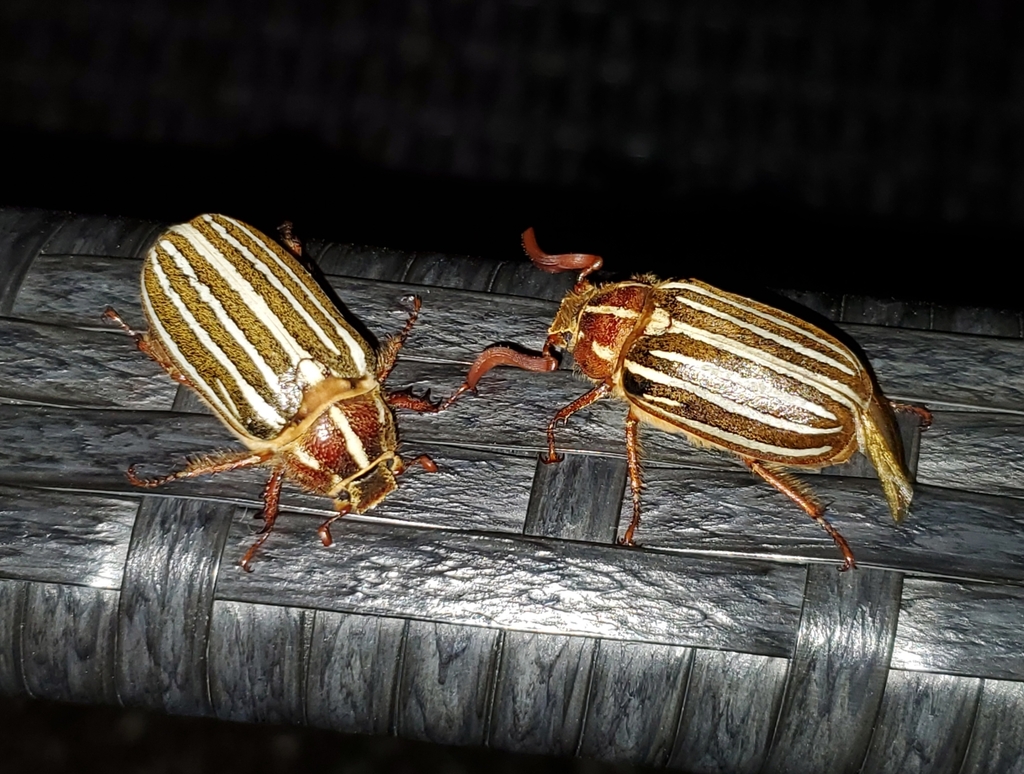
no rights reserved · CC0
Family: Scarabaeidae · Class: Insecta · Order: Coleoptera
Polyphylla decemlineata (Ten-lined June Beetle) is a California animal in the Scarabaeidae family.
The Ten-lined June beetle is a large scarab beetle measuring 22 to 35 mm (0.9 to 1.4 inches) in length. The species is characterized by its robust, oval-shaped body and distinctive white or yellow longitudinal stripes running along the elytra (wing covers), which give the beetle its common name. The background coloration ranges from reddish-brown to dark brown or black. Males are distinguished by prominent, fan-shaped antennae with elongated terminal segments, while females have smaller, less elaborate antennae. Polyphylla decemlineata occurs throughout much of western North America, with populations documented from California, Colorado, Idaho, Montana, and Nebraska (BugGuide). In California, the species is widely distributed across the state, found in both coastal and inland regions. The beetle's range extends from sea level to mountainous areas, demonstrating considerable ecological adaptability. The species inhabits diverse environments including chaparral, oak woodlands, coniferous forests, and urban areas with suitable vegetation. Adults are commonly found in areas with sandy or loose soils that facilitate burrowing behavior. The beetle shows a preference for locations with deciduous trees and shrubs, particularly oak species, which serve as primary food sources for adults. Ten-lined June beetles exhibit nocturnal behavior and are strongly attracted to artificial lights during their flight period, which typically occurs from late spring through early summer. Adults are phytophagous, feeding on the leaves of various trees and shrubs, with oak species being preferred hosts. According to federal documents, adults of related Polyphylla species are known to feed on tree leaves (USFWS 1997). Males engage in active mate-seeking flights during evening hours, using pheromone detection to locate females. After mating, females burrow into soil to deposit eggs at depths of 15 to 30 cm. The larval stage lasts two to three years, during which white grubs feed on plant roots and organic matter in the soil. Larvae can cause damage to agricultural crops and ornamental plants when present in high densities. The Ten-lined June beetle is not federally or state listed and appears to maintain stable populations across its range. The species demonstrates considerable adaptability to human-modified environments and is commonly encountered in urban and suburban areas. Unlike some congeners such as the Mount Hermon June beetle (Polyphylla barbata), which faces extinction risks, P. decemlineata benefits from its broad ecological tolerance and wide distribution. Primary conservation concerns are minimal, though localized populations may experience pressure from habitat development and pesticide applications in agricultural areas. The species' ability to utilize diverse plant communities and soil types contributes to its overall population stability throughout its range.
Classification
Class: Insecta · Order: Coleoptera · Family: Scarabaeidae
Frequently asked questions
How is Polyphylla decemlineata classified?
Polyphylla decemlineata belongs to class Insecta, order Coleoptera, family Scarabaeidae.
What family does Polyphylla decemlineata belong to?
Polyphylla decemlineata is in the Scarabaeidae family.
What is Polyphylla decemlineata?
The Ten-lined June beetle is a large scarab beetle measuring 22 to 35 mm (0.9 to 1.4 inches) in length.
Is Polyphylla decemlineata found in California?
Yes. Polyphylla decemlineata is recorded in California in The California Species Project's catalogue.
Related species
Other California species in the same genus, family, or bioregion.
Data from The California Species Project — 14,000+ California species with verified data from CNPS, CDFW, USFWS, and more.