Polyphylla morroensis
Morro Bay June Beetle
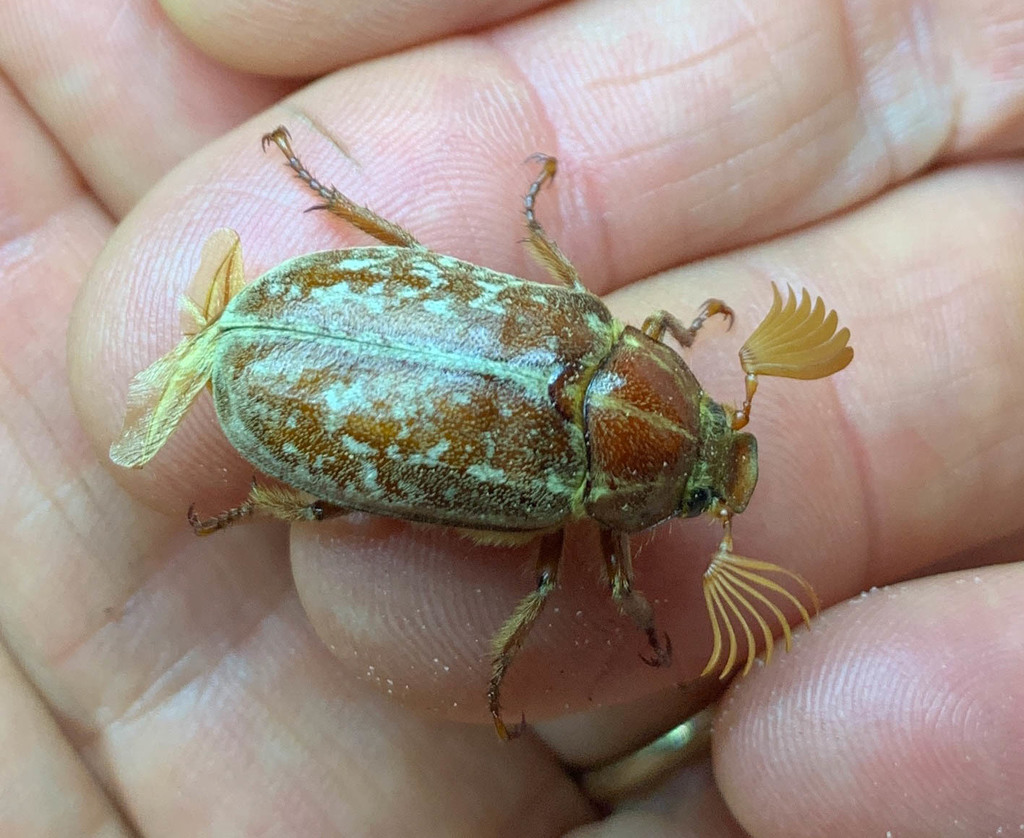
(c) Carrie Seltzer, some rights reserved (CC BY) · licence
Family: Scarabaeidae · Class: Insecta · Order: Coleoptera
Conservation status: G1 S1
Polyphylla morroensis (Morro Bay June Beetle) is a California animal in the Scarabaeidae family.
The Morro Bay June beetle (Polyphylla morroensis) is a scarab beetle in the family Scarabaeidae, subfamily Melolonthinae. This species is endemic to a very restricted geographic area along California's central coast, representing one of the most geographically limited scarab beetles in North America. As a member of the genus Polyphylla, this species likely exhibits the typical robust, oval body form characteristic of June beetles. Adult Polyphylla beetles are generally medium to large-sized scarabs, typically measuring 15-35 millimeters (0.6-1.4 inches) in length. The body is usually convex dorsally with a brown to reddish-brown coloration, though specific morphological details for P. morroensis have not been well documented in available literature. The species is known only from the immediate vicinity of Morro Bay in San Luis Obispo County, California. This extremely restricted range makes it one of the most geographically limited beetle species in the state. The type locality and apparently the only known occurrence area is associated with the coastal dune and maritime chaparral ecosystems surrounding Morro Bay. Morro Bay June beetles inhabit coastal dune systems and adjacent upland areas near Morro Bay. Like other Polyphylla species, adults are likely associated with sandy soils where larvae develop. The coastal location suggests adaptation to maritime influences including salt spray tolerance and the specialized plant communities of California's central coast dune systems. Specific elevation range and microhabitat preferences have not been thoroughly documented. As with other June beetles, adults are presumed to be active during late spring and early summer months, emerging to mate and feed. Polyphylla larvae typically develop in soil, feeding on plant roots over a multi-year period before pupating and emerging as adults. Adult beetles in this genus are often attracted to lights and may feed on foliage of various plants, though specific host plant relationships for P. morroensis remain undocumented. The species likely has a 2-3 year life cycle typical of large scarab beetles. The Morro Bay June beetle has a global rank of G1 (critically imperiled) and state rank of S1 (critically imperiled in California), reflecting its extremely limited distribution and small population size. The species appears in federal expenditure reports, suggesting some level of federal conservation concern, though it lacks formal federal listing status under the Endangered Species Act. The primary threats to this species likely include habitat loss from coastal development, recreational activities in dune systems, and the inherent vulnerability associated with having such a restricted range. Climate change impacts on coastal dune ecosystems may pose additional threats to this endemic species. Scientific documentation for this species remains extremely limited. The information presented here is based on available federal reports and taxonomic databases. If you have additional verified information about this species' biology, distribution, or ecology, please contact us to help improve this species account.
Classification
Class: Insecta · Order: Coleoptera · Family: Scarabaeidae
Conservation status
G1 S1
Frequently asked questions
How is Polyphylla morroensis classified?
Polyphylla morroensis belongs to class Insecta, order Coleoptera, family Scarabaeidae.
What family does Polyphylla morroensis belong to?
Polyphylla morroensis is in the Scarabaeidae family.
Is Polyphylla morroensis protected or of conservation concern?
Polyphylla morroensis carries the following status: G1 S1.
What is Polyphylla morroensis?
The Morro Bay June beetle (Polyphylla morroensis) is a scarab beetle in the family Scarabaeidae, subfamily Melolonthinae.
Is Polyphylla morroensis found in California?
Yes. Polyphylla morroensis is recorded in California in The California Species Project's catalogue.
Related species
Other California species in the same genus, family, or bioregion.
Data from The California Species Project — 14,000+ California species with verified data from CNPS, CDFW, USFWS, and more.