Polysticta stelleri
Steller's Eider
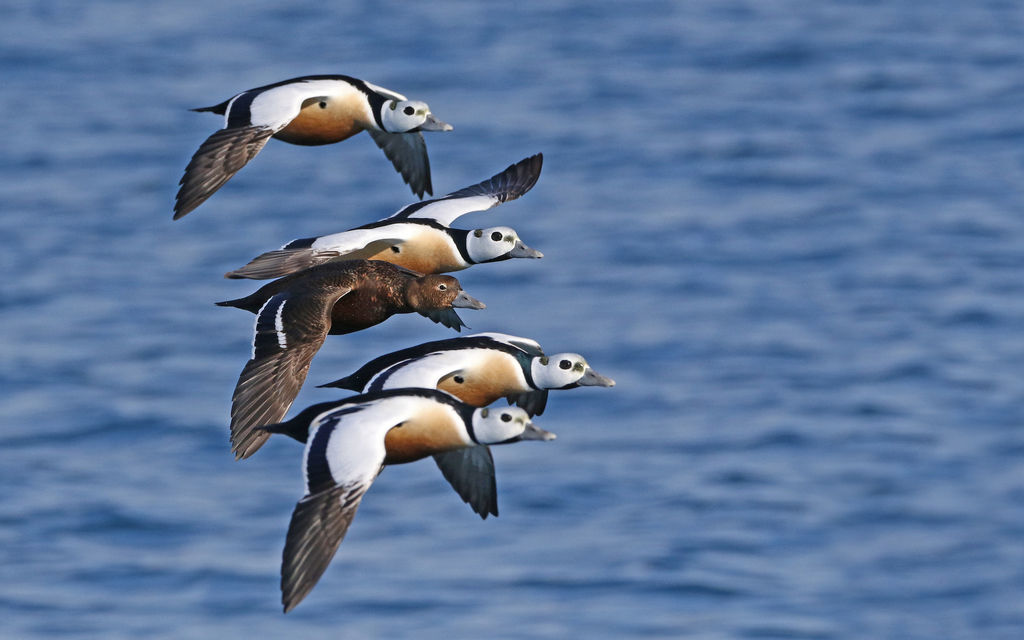
(c) Christoph Moning, some rights reserved (CC BY) · licence
Family: Anatidae · Class: Aves · Order: Anseriformes
Polysticta stelleri (Steller's Eider) is a California animal in the Anatidae family.
Steller's Eider is a smallish marine duck measuring 43-47 cm (17-18.5 inches) in length with a distinctive squarish head and angular bill. Breeding males display unmistakable plumage featuring a white head with a black eye patch, iridescent green nape, black throat and collar, and cinnamon-buff breast. The back appears blue-black with prominent white shoulder patches. Eclipse males become blackish with white secondary coverts, while females are mottled brown throughout. Both sexes show a distinctive pale blue speculum bordered by white. Most of the world's Steller's Eiders nest in remote areas of Arctic Russia, with a small but significant breeding population on Alaska's Arctic Coastal Plain, particularly concentrated near Utqiagvik (USFWS). The species historically bred on Alaska's Yukon-Kuskokwim Delta, where nesting is now rare. California records are extremely limited, with only three documented occurrences at Crescent City representing the southernmost extent of the species' range (Birds of the World). During winter, populations concentrate in waters adjacent to the Alaska Peninsula and Aleutian Islands. Breeding habitat consists of polygonal tundra pond environments of Alaska's Arctic Coastal Plain, where birds utilize freshwater ponds surrounded by wet sedge meadows and low-center polygon complexes. Critical habitat designated by USFWS includes breeding areas on the Yukon-Kuskokwim Delta and four marine units in southwest Alaska: Kuskokwim Shoals in northern Kuskokwim Bay, Seal Islands, Nelson Lagoon, and Izembek Lagoon on the Alaska Peninsula's north side. During non-breeding seasons, the species inhabits shallow, near-shore marine waters of southwest and southcentral Alaska. Steller's Eiders are opportunistic feeders with diet varying by season and habitat. On breeding areas, they consume midge larvae (Chironomidae), caddisfly larvae (Trichoptera), and other freshwater invertebrates from tundra ponds (Birds of the World). In marine environments, they dive for mollusks, crustaceans, and other benthic invertebrates in shallow coastal waters. The species exhibits complex migration patterns, with Alaska breeders joining Russian populations in shared molting and wintering areas. During non-breeding seasons, Steller's Eiders may gather in flocks numbering in the thousands in molting areas offshore of southwest Alaska. The Alaska-breeding population of Steller's Eider was listed as threatened under the Endangered Species Act, with critical habitat designated in 2001. The species faces challenges from its naturally low breeding numbers, remote nesting areas that make monitoring difficult, and concentration in limited wintering areas. Climate change poses additional threats through alterations to Arctic breeding habitat and marine food webs. The wide breeding range, while providing some resilience, remains concentrated near Utqiagvik, a human population center subject to anthropogenic factors that may impact local breeding success.
Classification
Class: Aves · Order: Anseriformes · Family: Anatidae
Frequently asked questions
How is Polysticta stelleri classified?
Polysticta stelleri belongs to class Aves, order Anseriformes, family Anatidae.
What family does Polysticta stelleri belong to?
Polysticta stelleri is in the Anatidae family.
What is Polysticta stelleri?
Steller's Eider is a smallish marine duck measuring 43-47 cm (17-18.5 inches) in length with a distinctive squarish head and angular bill.
Is Polysticta stelleri found in California?
Yes. Polysticta stelleri is recorded in California in The California Species Project's catalogue.
Related species
Other California species in the same genus, family, or bioregion.
Data from The California Species Project — 14,000+ California species with verified data from CNPS, CDFW, USFWS, and more.