Pontia sisymbrii
Spring White
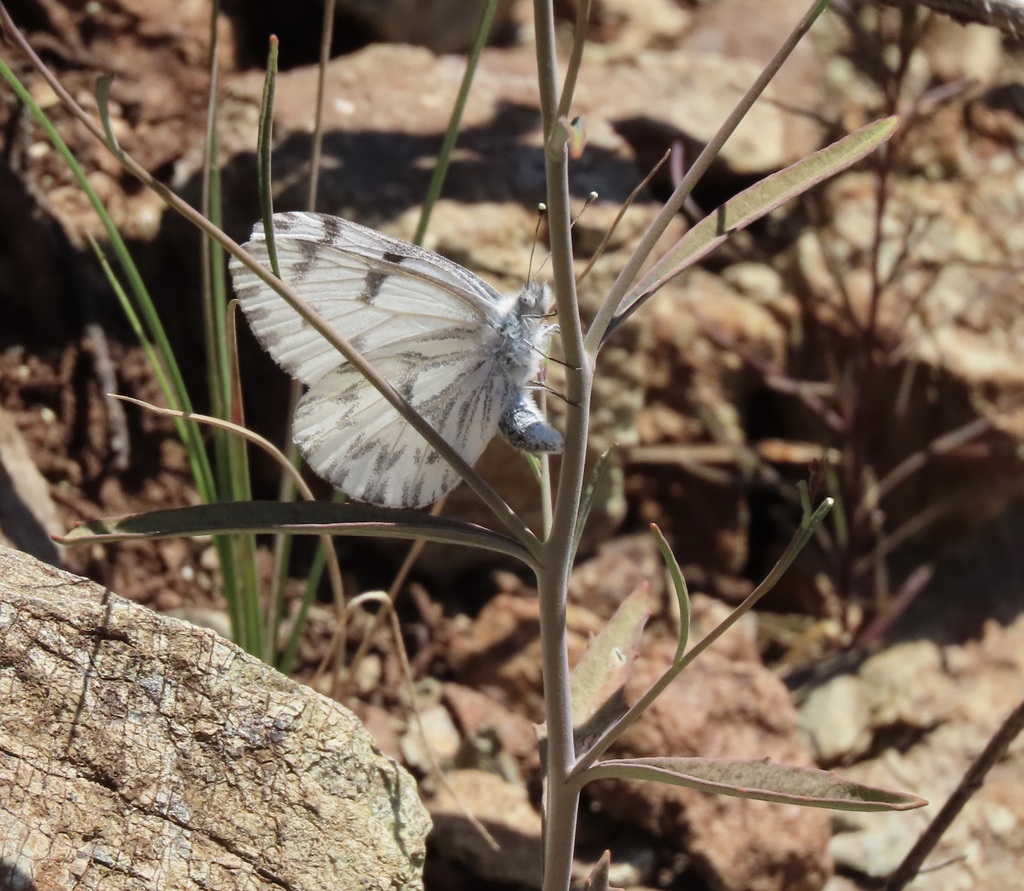
(c) John Hibbard, some rights reserved (CC BY) · licence
Family: Pieridae · Class: Insecta · Order: Lepidoptera
Pontia sisymbrii (Spring White) is a California animal in the Pieridae family.
The Spring White (Pontia sisymbrii) is a medium-sized butterfly in the family Pieridae, with a wingspan ranging from 32 to 45 mm (1.3 to 1.8 inches). Males display bright white wings with distinct black markings along the wing margins and black spots on the forewings. The undersides of the hindwings show greenish-gray marbling with white veining, particularly prominent in females. Females are typically larger than males and exhibit more extensive dark markings on the upper wing surfaces. The species can be distinguished from similar whites by the characteristic greenish marbling pattern on the hindwing undersides and the timing of its flight period. The Spring White ranges from British Columbia south to Baja California, east to western Nebraska and western South Dakota. Within California, the species occurs throughout much of the state, from coastal areas to the Sierra Nevada foothills. Populations are found at elevations ranging from sea level to approximately 2,400 meters (7,900 feet). The distribution encompasses diverse biogeographic regions including the Central Valley, Coast Ranges, and montane areas. This species inhabits open areas including grasslands, chaparral edges, desert washes, agricultural areas, and disturbed sites where host plants are abundant. Spring Whites prefer areas with moderate moisture levels and are commonly found along roadsides, field margins, and in suburban gardens. The species shows adaptability to human-modified landscapes, provided suitable mustard family plants are present for larval development. Spring Whites are univoltine in most of their range, with adults emerging from February through May, peaking in March and April. Males engage in patrolling behavior, flying low over suitable habitat in search of females. Mating occurs on or near host plants, and females deposit single, pale yellow eggs on flower buds, young leaves, or seed pods of mustard family plants. The species utilizes various plants in the mustard family (Brassicaceae) including hedge mustard (Sisymbrium), rock cresses (Arabis), and tansy-mustard (Descurainia) species. Larvae complete development through five instars over 3 to 4 weeks, feeding primarily on flowers, developing seeds, and young leaves. Pupation occurs in a chrysalis attached to the host plant or nearby vegetation, with the pupal stage lasting 8 to 10 months through summer, fall, and winter. The Spring White currently lacks formal conservation status listings at federal or state levels, suggesting stable populations across most of its range. However, like many butterfly species, it faces potential threats from habitat loss due to urbanization, agricultural intensification, and the use of herbicides that eliminate native mustard plants. Climate change may affect the timing of emergence and host plant availability. The species benefits from the widespread distribution of both native and introduced mustard family plants, though reliance on non-native species may present long-term ecological concerns. Conservation efforts focus on maintaining diverse plant communities and reducing pesticide use in areas where the species occurs.
Classification
Class: Insecta · Order: Lepidoptera · Family: Pieridae
Frequently asked questions
How is Pontia sisymbrii classified?
Pontia sisymbrii belongs to class Insecta, order Lepidoptera, family Pieridae.
What family does Pontia sisymbrii belong to?
Pontia sisymbrii is in the Pieridae family.
What is Pontia sisymbrii?
The Spring White (Pontia sisymbrii) is a medium-sized butterfly in the family Pieridae, with a wingspan ranging from 32 to 45 mm (1.3 to 1.8 inches).
Is Pontia sisymbrii found in California?
Yes. Pontia sisymbrii is recorded in California in The California Species Project's catalogue.
Related species
Other California species in the same genus, family, or bioregion.
Data from The California Species Project — 14,000+ California species with verified data from CNPS, CDFW, USFWS, and more.