Porcellio laevis
Swift Woodlouse
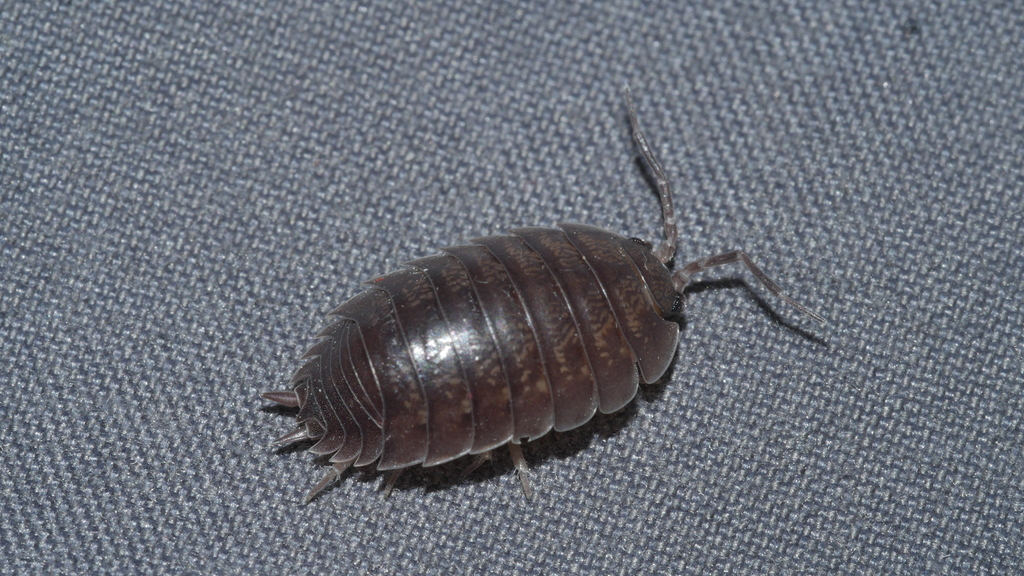
(c) Nathan T. Jones, some rights reserved (CC BY) · licence
Family: Porcellionidae · Class: Malacostraca · Order: Isopoda
Porcellio laevis (Swift Woodlouse) is a California animal in the Porcellionidae family.
The swift woodlouse (Porcellio laevis) is a terrestrial isopod crustacean in the family Porcellionidae. This non-native species is distinguished by its relatively smooth, oval-shaped exoskeleton and ability to partially roll into a ball when disturbed, though it cannot form a complete sphere like pill bugs. Adults typically measure 12-20 mm in length and display a grayish to brownish coloration with lighter edges along the body segments. The species possesses seven pairs of walking legs and prominent antennae that extend forward from the head region. In California, Porcellio laevis has established populations throughout much of the state, with documented occurrences from coastal areas to inland valleys. According to BugGuide records, California specimens have been collected year-round, with peak activity during spring and early summer months (BugGuide 2025). The species has also been documented in Arizona, Arkansas, Florida, Iowa, Nevada, New Mexico, and Texas, indicating a broad North American distribution following its introduction from Europe. Swift woodlice inhabit a variety of anthropogenic environments including gardens, parks, agricultural areas, and urban landscapes. They require moist conditions and are commonly found under logs, stones, leaf litter, and other debris that provides shelter and maintains humidity. The species shows particular affinity for disturbed habitats and human-modified environments, distinguishing it from many native isopod species that prefer more natural forest conditions. As detritivores, swift woodlice feed primarily on decaying organic matter including dead leaves, wood fragments, and other plant debris. They play an important role in nutrient cycling by breaking down organic material and contributing to soil formation. Reproduction occurs through direct development, with females carrying eggs in a ventral brood pouch called a marsupium. Young emerge as miniature versions of adults and molt several times before reaching sexual maturity. The species can reproduce multiple times per year under favorable conditions. Porcellio laevis is not federally or state-listed for conservation protection, reflecting its status as an introduced species that has successfully established across much of North America. However, the species has been noted as a useful bioindicator for heavy metal pollution, with studies demonstrating that individuals can accumulate lead, zinc, cadmium, and copper from contaminated soil and leaf litter (Hopkin et al. 1986). While not considered a major pest, large populations may occasionally impact native soil invertebrate communities through competition for resources and habitat. The species' tolerance for urban environments and ability to disperse through human activities suggests continued range expansion is likely. Management efforts typically focus on habitat modification rather than direct control, as the species generally provides beneficial ecosystem services through decomposition activities.
Classification
Class: Malacostraca · Order: Isopoda · Family: Porcellionidae
Frequently asked questions
How is Porcellio laevis classified?
Porcellio laevis belongs to class Malacostraca, order Isopoda, family Porcellionidae.
What family does Porcellio laevis belong to?
Porcellio laevis is in the Porcellionidae family.
What is Porcellio laevis?
The swift woodlouse (Porcellio laevis) is a terrestrial isopod crustacean in the family Porcellionidae.
Is Porcellio laevis found in California?
Yes. Porcellio laevis is recorded in California in The California Species Project's catalogue.
Related species
Other California species in the same genus, family, or bioregion.
Data from The California Species Project — 14,000+ California species with verified data from CNPS, CDFW, USFWS, and more.