Porcellio scaber
Common Rough Woodlouse
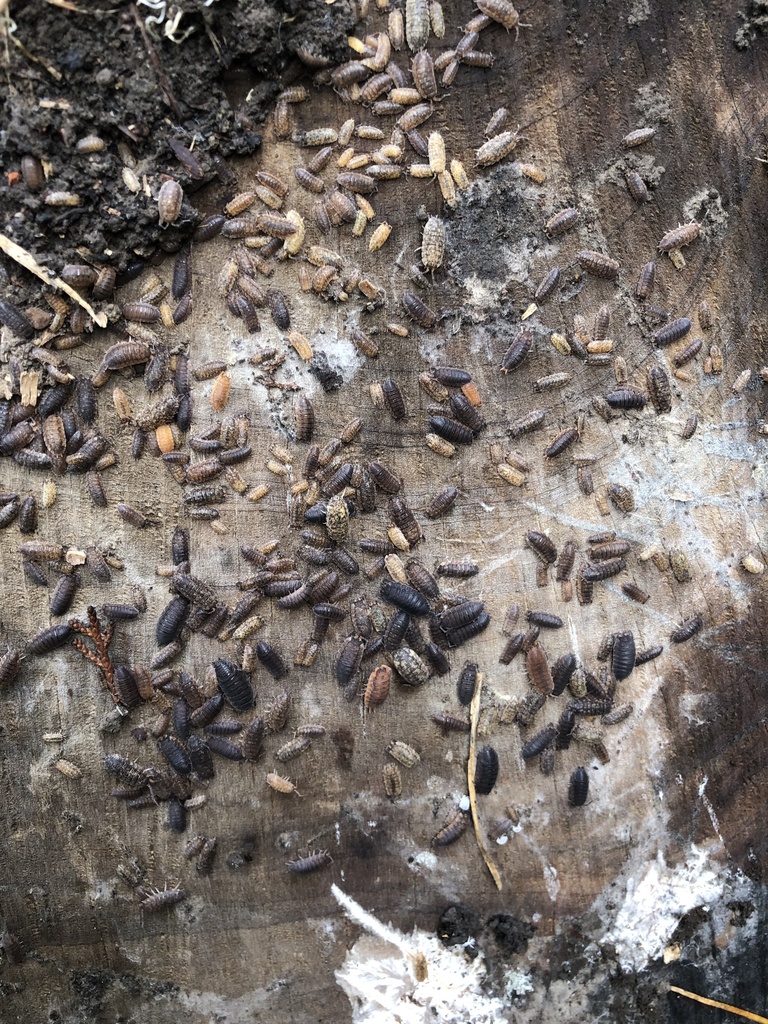
(c) Debriana Love, some rights reserved (CC BY-SA) · licence
Family: Porcellionidae · Class: Malacostraca · Order: Isopoda
Porcellio scaber (Common Rough Woodlouse) is a California animal in the Porcellionidae family.
The common rough woodlouse is a terrestrial isopod crustacean measuring 10 to 18 millimeters (0.4 to 0.7 inches) in length. The body is oval-shaped and dorsally flattened, with a segmented exoskeleton that appears rough or granulated, giving the species its common name. Coloration varies from gray to brown, often with mottled patterns that provide camouflage against soil and leaf litter. The species has seven pairs of walking legs and prominent antennae, with the ability to partially roll into a ball when disturbed, though less completely than pill bugs (Armadillidiidae). Porcellio scaber has achieved a nearly cosmopolitan distribution through human activities. In North America, the species occurs across much of the continent, with documented populations from California to the Atlantic coast. According to BugGuide observations, the species has been recorded in California throughout the year, with notable activity in spring and fall months. The species is considered non-native to North America, having been introduced from Europe where it is indigenous. This woodlouse inhabits a wide range of terrestrial environments, showing particular preference for moist, sheltered locations. Common habitats include leaf litter, under logs and stones, in compost piles, garden mulch, and basement areas. The species demonstrates considerable tolerance for varying moisture conditions compared to other woodlice, allowing it to colonize drier habitats including urban environments. It occurs from sea level to moderate elevations and can be found in both natural and disturbed habitats. Common rough woodlice are detritivores, feeding primarily on decomposing organic matter including dead leaves, rotting wood, and fungi. They play an important ecological role in nutrient cycling by breaking down organic material and enriching soil. Reproduction involves direct development, with females carrying eggs and young in a ventral brood pouch called a marsupium. Mating typically occurs in spring, and females can produce multiple broods per year under favorable conditions. The species exhibits negative phototaxis, actively avoiding light and remaining hidden during daylight hours. Portions of this species have been utilized in environmental monitoring studies. Research has demonstrated that Porcellio scaber can serve as a bioindicator for heavy metal contamination, particularly lead, with body burdens reflecting concentrations in surrounding soil and leaf litter (Hopkin et al. 1986). The species shows no special conservation status and is not listed under federal or state endangered species legislation. As an introduced species, it faces no significant conservation threats and has established stable populations across its introduced range. Climate change and habitat modification appear to have minimal impact on this adaptable species, which continues to expand its distribution through human-mediated dispersal. The species' ability to thrive in anthropogenic environments suggests populations will remain stable or potentially increase with continued urbanization.
Classification
Class: Malacostraca · Order: Isopoda · Family: Porcellionidae
Frequently asked questions
How is Porcellio scaber classified?
Porcellio scaber belongs to class Malacostraca, order Isopoda, family Porcellionidae.
What family does Porcellio scaber belong to?
Porcellio scaber is in the Porcellionidae family.
What is Porcellio scaber?
The common rough woodlouse is a terrestrial isopod crustacean measuring 10 to 18 millimeters (0.4 to 0.7 inches) in length.
Is Porcellio scaber found in California?
Yes. Porcellio scaber is recorded in California in The California Species Project's catalogue.
Related species
Other California species in the same genus, family, or bioregion.
Data from The California Species Project — 14,000+ California species with verified data from CNPS, CDFW, USFWS, and more.