Potamocorbula amurensis
Brackish-water Corbula
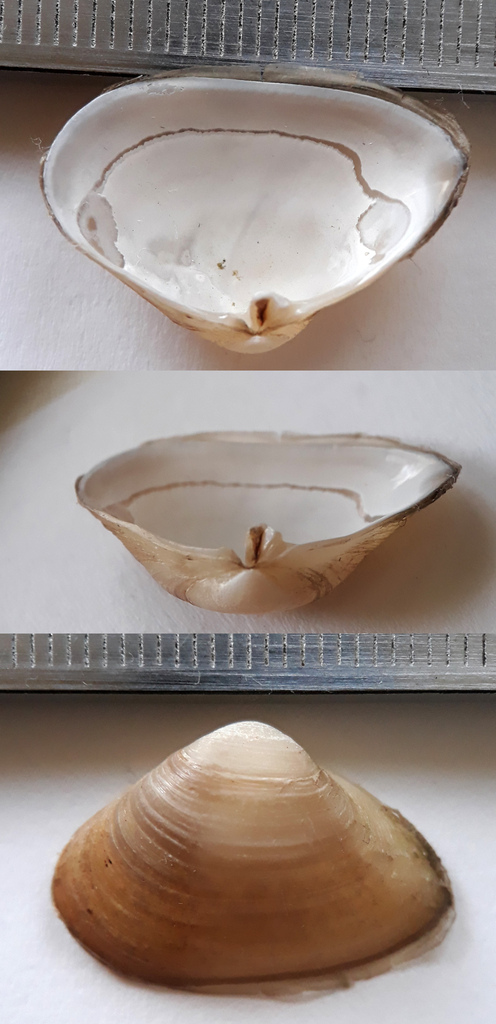
no rights reserved · CC0
Family: Corbulidae · Class: Bivalvia · Order: Myoida
Potamocorbula amurensis (Brackish-water Corbula) is a California animal in the Corbulidae family.
The brackish-water corbula (Potamocorbula amurensis), also known as the overbite clam or Asian clam, is a small invasive bivalve mollusk that has fundamentally altered the ecosystem of San Francisco Bay and the Sacramento-San Joaquin Delta. Adults typically measure 10-25 millimeters (0.4-1.0 inches) in length, with a distinctive asymmetrical shell where the left valve overlaps the right, creating the characteristic "overbite" appearance. The shell is typically brown to grayish-brown with concentric growth rings. Native to Asian coastal waters, P. amurensis was first discovered in San Francisco Estuary in October 1986, likely introduced through ballast water discharge (Carlton et al. 1990). Within two years, the species had established throughout the estuary system, spreading from nearly freshwater conditions at Rio Vista through the brackish waters of Suisun Bay and Carquinez Strait to the saline waters of Central and South San Francisco Bay. The species now occupies the entire salinity gradient of the estuary, from less than 1 part per thousand to over 30 parts per thousand. Brackish-water corbula demonstrates broad environmental tolerance, surviving in salinities from 0 to 30 parts per thousand and temperatures ranging from approximately 5 to 25 degrees Celsius (Nicolini & Penry 2000). The species inhabits soft sediments in subtidal and intertidal zones, thriving in both shallow and deeper waters throughout the estuary system. By 1988, populations exceeded 10,000 individuals per square meter in optimal habitats (Carlton et al. 1990). As suspension feeders, P. amurensis filter phytoplankton and organic particles from the water column. The species exhibits rapid reproductive rates with multiple spawning events per year. Larvae develop in the plankton before settling to the benthos. Adults can live 2-3 years and reach sexual maturity within their first year. The species' filtering capacity is so efficient that it has dramatically reduced phytoplankton abundance throughout San Francisco Bay, with chlorophyll levels consistently maintained at 3-4 micrograms per liter since establishment (Wilkerson et al. 2006). Potamocorbula amurensis represents one of the most ecologically significant invasive species in California waters. By 1990, it had become the dominant benthic species throughout the estuary, accounting for up to 95% of living biomass in some areas. The species' arrival coincided with major declines in native zooplankton, particularly mysid shrimp populations which decreased by up to 90% (Kimmerer & Orsi 1996). This dramatic shift in the food web has contributed to declines in native fish species, including delta smelt and longfin smelt, which historically relied on mysid shrimp as a primary food source. The invasion fundamentally altered energy flow in the estuary, redirecting primary production from the pelagic food web to the benthos, with cascading effects throughout the ecosystem that persist today.
Classification
Class: Bivalvia · Order: Myoida · Family: Corbulidae
Frequently asked questions
How is Potamocorbula amurensis classified?
Potamocorbula amurensis belongs to class Bivalvia, order Myoida, family Corbulidae.
What family does Potamocorbula amurensis belong to?
Potamocorbula amurensis is in the Corbulidae family.
What is Potamocorbula amurensis?
The brackish-water corbula (Potamocorbula amurensis), also known as the overbite clam or Asian clam, is a small invasive bivalve mollusk that has fundamentally altered the ecosystem of San Francisco Bay and the Sacramento-San Joaquin Delta.
Is Potamocorbula amurensis found in California?
Yes. Potamocorbula amurensis is recorded in California in The California Species Project's catalogue.
More California species
This species has no close relatives in our California data — here are other species to explore.
Data from The California Species Project — 14,000+ California species with verified data from CNPS, CDFW, USFWS, and more.