Praestheceraeus bellostriatus
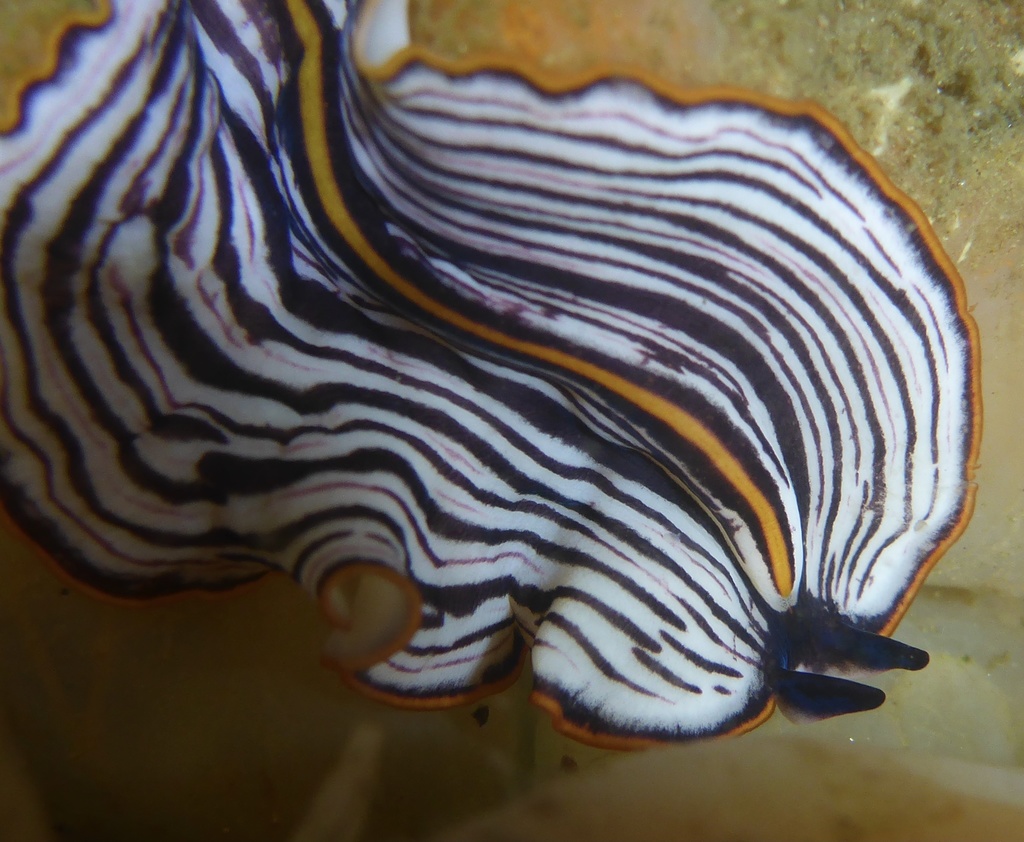
(c) Cricket Raspet, some rights reserved (CC BY) · licence
Family: Euryleptidae · Class: Polycladida · Order: Polycladida
Praestheceraeus bellostriatus is a California animal in the Euryleptidae family.
Praestheceraeus bellostriatus is a marine flatworm belonging to the order Polycladida and family Euryleptidae. This species represents one of the many polyclad flatworms found in marine environments, though detailed morphological descriptions remain limited in the scientific literature. Like other members of the Euryleptidae family, this species likely exhibits the characteristic flattened body plan typical of polyclad flatworms, with a dorsoventrally compressed form that facilitates benthic movement and feeding. The geographic distribution of P. bellostriatus has not been comprehensively documented in available scientific literature. The species appears in taxonomic databases maintained by the U.S. Fish and Wildlife Service, suggesting it occurs within U.S. coastal waters, though specific regional boundaries remain unclear. Many polyclad flatworms have restricted distributions tied to particular oceanographic conditions or substrate types, but the precise range limits for this species require further investigation. Habitat preferences for P. bellostriatus have not been well documented in the scientific literature. Most Euryleptidae species are benthic marine organisms that inhabit rocky intertidal zones, subtidal rocky reefs, or soft sediment environments. They typically require marine or fully saline conditions and are often found associated with specific prey organisms or substrate types. The depth range and specific microhabitat requirements for this species remain unknown. Ecological information for P. bellostriatus is extremely limited. Polyclad flatworms are generally carnivorous, feeding on various invertebrates including barnacles, bryozoans, tunicates, and other small marine organisms. Many species are specialized predators with specific prey preferences. Reproduction in polyclads typically involves hermaphroditic individuals that engage in complex mating behaviors, often including penis fencing in some taxa. Developmental patterns usually include a planktonic larval stage, though direct development occurs in some species. The specific feeding ecology, reproductive biology, and life cycle characteristics of P. bellostriatus have not been documented. The conservation status of P. bellostriatus is not established under federal or state endangered species legislation. The species does not appear to have formal conservation rankings from NatureServe or IUCN assessments. This absence of conservation status likely reflects the limited scientific knowledge about the species' population status, distribution, and potential threats rather than an indication of population stability. Many marine invertebrates, particularly smaller taxa like polyclad flatworms, lack comprehensive population assessments due to taxonomic challenges and limited research attention. Scientific documentation for this species remains limited. The information presented here is based on taxonomic placement within established databases and general knowledge of Euryleptidae biology. We welcome contributions of verified scientific data, photographs, or field observations to enhance this species account. Please contact Species List Pro to share additional information about the distribution, ecology, or conservation needs of this marine flatworm species.
Classification
Class: Polycladida · Order: Polycladida · Family: Euryleptidae
Frequently asked questions
How is Praestheceraeus bellostriatus classified?
Praestheceraeus bellostriatus belongs to class Polycladida, order Polycladida, family Euryleptidae.
What family does Praestheceraeus bellostriatus belong to?
Praestheceraeus bellostriatus is in the Euryleptidae family.
What is Praestheceraeus bellostriatus?
Praestheceraeus bellostriatus is a marine flatworm belonging to the order Polycladida and family Euryleptidae.
Is Praestheceraeus bellostriatus found in California?
Yes. Praestheceraeus bellostriatus is recorded in California in The California Species Project's catalogue.
More California species
This species has no close relatives in our California data — here are other species to explore.
Data from The California Species Project — 14,000+ California species with verified data from CNPS, CDFW, USFWS, and more.