Prionoxystus robiniae
Carpenterworm Moth
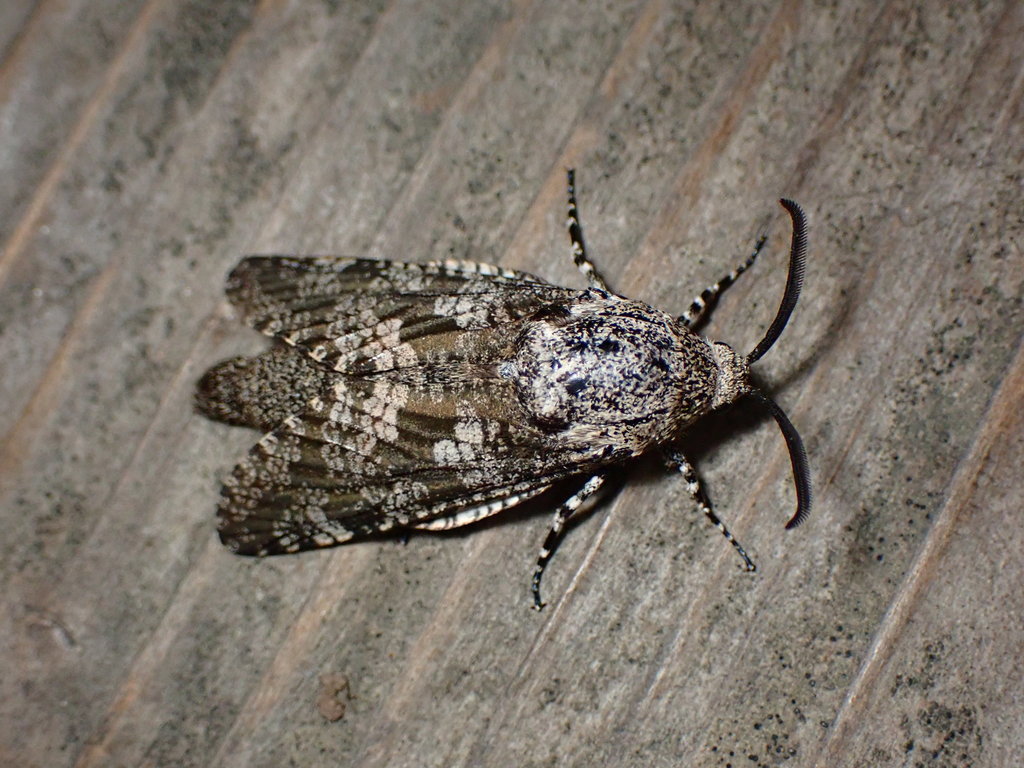
(c) Cricket Raspet, some rights reserved (CC BY) · licence
Family: Cossidae · Class: Insecta · Order: Lepidoptera
Prionoxystus robiniae (Carpenterworm Moth) is a California animal in the Cossidae family.
The carpenterworm moth (Prionoxystus robiniae) is a large wood-boring moth in the family Cossidae. Adults exhibit significant sexual dimorphism, with females considerably larger than males. Females have a wingspan of 65-90 mm (2.6-3.5 inches) and display mottled gray and brown forewings marked with darker wavy lines and pale spots. Males are smaller with wingspans of 40-55 mm (1.6-2.2 inches) and possess more contrasting black and white patterned forewings. Both sexes have pale hindwings with darker marginal bands. The robust body is densely covered with grayish-brown scales, and females possess a prominent ovipositor for egg placement. The species ranges throughout eastern North America, extending from southern Canada south to Florida and from the Atlantic coast west to the Great Plains. In California, the carpenterworm moth occurs primarily in urban and suburban areas where host trees are planted, as it is not native to the western United States. Established populations exist in the Central Valley, San Francisco Bay Area, and southern California metropolitan regions. Carpenterworm moths inhabit areas containing their woody host plants, which include ash, chestnut, locusts, oaks, poplars, willows, and other deciduous trees. Adults are attracted to areas with mature trees having trunk diameters exceeding 10 cm (4 inches). The species adapts to various elevations from sea level to approximately 1,500 meters (4,900 feet) and thrives in both natural forests and landscaped environments including parks, residential areas, and tree-lined streets. Adults are nocturnal and emerge from late spring through early summer, typically from May through July depending on local climate conditions. Mating occurs shortly after emergence, with females releasing pheromones to attract males. After mating, females deposit 200-400 eggs individually in bark crevices of host trees. Larvae bore into the wood upon hatching, creating extensive tunnel systems in the heartwood and sapwood. The larval stage lasts 2-3 years, during which caterpillars can reach lengths of 75 mm (3 inches). Pupation occurs within the larval galleries, and adults emerge through round exit holes approximately 12 mm (0.5 inches) in diameter. Larvae feed exclusively on wood tissue, weakening host trees through their extensive boring activities. Heavily infested trees may exhibit crown dieback, branch breakage, or mortality. Adult moths do not feed and live only long enough to reproduce, typically 7-14 days. The carpenterworm moth is not federally or state listed and faces no significant conservation concerns. As a widespread species, populations remain stable throughout most of its native range. In California, where it is introduced, the moth is sometimes considered a pest of ornamental and shade trees. Management typically focuses on maintaining tree health through proper irrigation and fertilization rather than direct control measures. The species serves as a food source for woodpeckers and other insectivorous birds, which help regulate population levels naturally.
Classification
Class: Insecta · Order: Lepidoptera · Family: Cossidae
Frequently asked questions
How is Prionoxystus robiniae classified?
Prionoxystus robiniae belongs to class Insecta, order Lepidoptera, family Cossidae.
What family does Prionoxystus robiniae belong to?
Prionoxystus robiniae is in the Cossidae family.
What is Prionoxystus robiniae?
The carpenterworm moth (Prionoxystus robiniae) is a large wood-boring moth in the family Cossidae.
Is Prionoxystus robiniae found in California?
Yes. Prionoxystus robiniae is recorded in California in The California Species Project's catalogue.
Related species
Other California species in the same genus, family, or bioregion.
Data from The California Species Project — 14,000+ California species with verified data from CNPS, CDFW, USFWS, and more.