Prionus californicus
California Root Borer
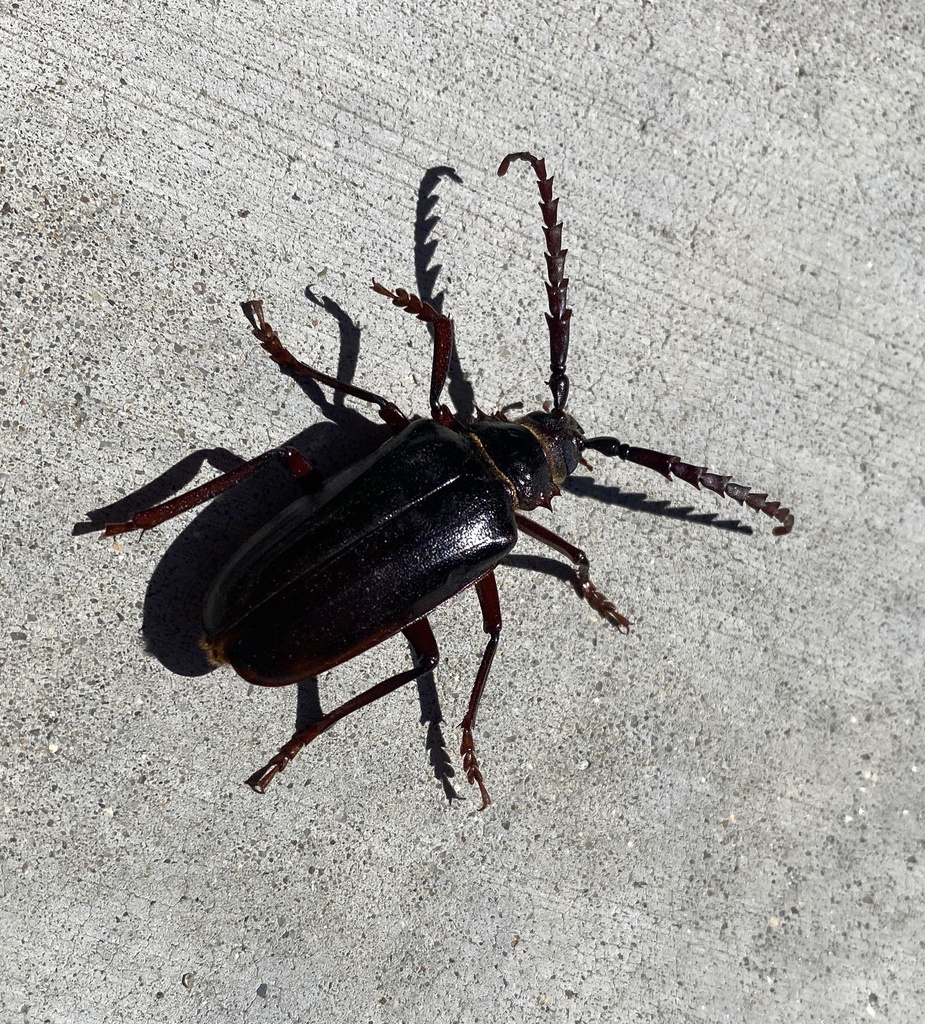
(c) lander1950, some rights reserved (CC BY) · licence
Family: Cerambycidae · Class: Insecta · Order: Coleoptera
Prionus californicus (California Root Borer) is a California animal in the Cerambycidae family.
The California Root Borer is a large longhorn beetle in the family Cerambycidae, subfamily Prioninae. Adults are among the largest beetles in North America, with females reaching up to 55 mm (2.2 inches) in length and males slightly smaller at 35-45 mm (1.4-1.8 inches). The body is robust and brown to reddish-brown in color, with powerful mandibles and long, serrated antennae. Males have proportionally longer antennae than females, extending beyond the body length. The elytra are thick and heavily sclerotized, providing protection for the flight muscles beneath. Prionus californicus occurs throughout western North America, ranging from British Columbia south through Washington, Oregon, Idaho, and California (BugGuide 2025). The species extends into Baja California, Mexico. In California, it is widely distributed from the coast to the Sierra Nevada foothills, typically at elevations below 1,500 meters (4,900 feet). The beetle has been documented from numerous counties including those in the Central Valley, Coast Ranges, and southern California. This species inhabits oak woodlands, mixed coniferous forests, chaparral, and riparian areas. Adults are most commonly found in areas with abundant dead and dying hardwood trees, particularly oaks (Quercus species), which serve as primary host plants for larval development. The beetles also utilize other hardwoods including willow, poplar, and fruit trees. They prefer areas with mature trees that provide suitable breeding substrate in the form of decaying wood and root systems. Adult California Root Borers are primarily nocturnal and are strongly attracted to lights during their flight period, which typically occurs from late spring through early fall, with peak activity in summer months. Adults feed on tree sap, fruits, and tender bark, while larvae are wood borers that develop in the roots and lower trunk of dead or dying hardwood trees. The larval stage is prolonged, lasting 2-3 years as they tunnel through woody tissue, creating extensive galleries. Females lay eggs in bark crevices or soil near the base of suitable host trees. The species plays an important ecological role in decomposing dead wood and nutrient cycling in forest ecosystems. Currently, Prionus californicus has no federal or state conservation listing status. The species appears to maintain stable populations throughout its range, though local abundances may vary based on habitat availability and forest management practices. As a native wood-boring beetle, it faces potential threats from habitat loss due to urban development, changes in forest composition, and removal of dead trees through forest management activities. However, the species' broad host range and wide distribution suggest it is not at immediate conservation risk. Climate change may affect population dynamics by altering the distribution and health of host tree species, particularly oaks which are experiencing stress from drought and disease in many areas of California.
Classification
Class: Insecta · Order: Coleoptera · Family: Cerambycidae
Frequently asked questions
How is Prionus californicus classified?
Prionus californicus belongs to class Insecta, order Coleoptera, family Cerambycidae.
What family does Prionus californicus belong to?
Prionus californicus is in the Cerambycidae family.
What is Prionus californicus?
The California Root Borer is a large longhorn beetle in the family Cerambycidae, subfamily Prioninae.
Is Prionus californicus found in California?
Yes. Prionus californicus is recorded in California in The California Species Project's catalogue.
Related species
Other California species in the same genus, family, or bioregion.
Data from The California Species Project — 14,000+ California species with verified data from CNPS, CDFW, USFWS, and more.