Procambarus clarkii
Red Swamp Crayfish
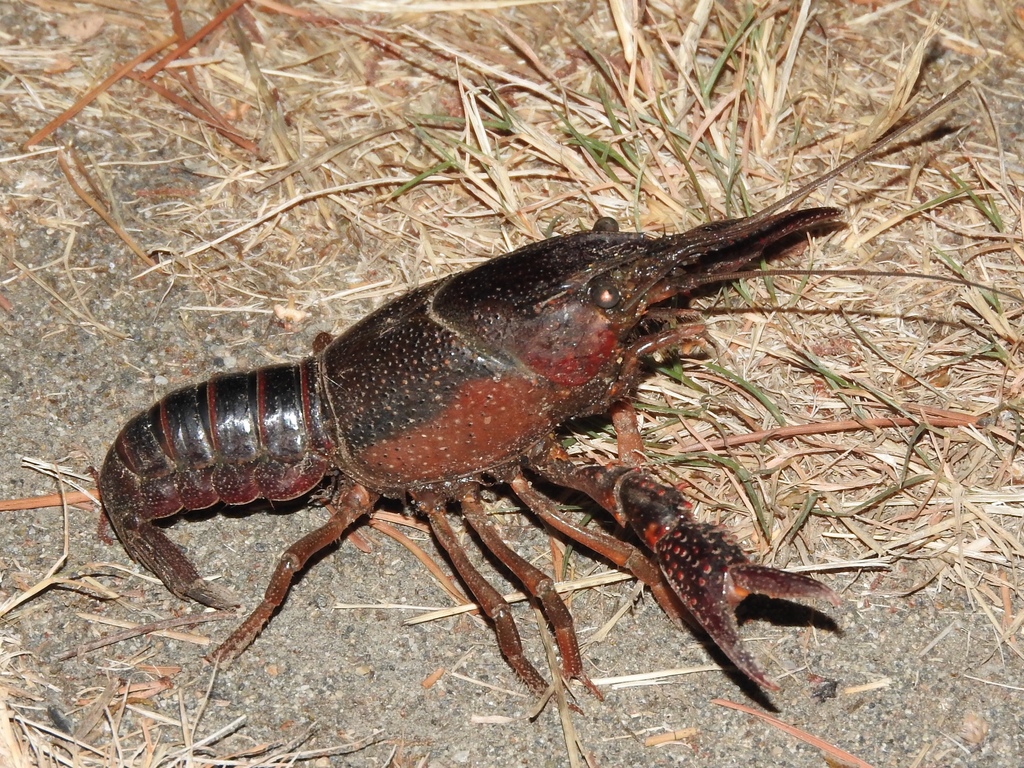
(c) westcoasthikers, some rights reserved (CC BY) · licence
Family: Cambaridae · Class: Malacostraca · Order: Decapoda
Procambarus clarkii (Red Swamp Crayfish) is a California animal in the Cambaridae family.
The red swamp crayfish is a freshwater decapod crustacean native to the Gulf coastal plain from the Florida panhandle to Mexico and the southern Mississippi River drainage north to Illinois and southwest Indiana (USFWS 2015). Adults typically measure 7.5 to 12 cm (3 to 5 inches) in total length, with males generally larger than females. The species displays characteristic bright red coloration on the claws and carapace, particularly during breeding season, though coloration can vary from brown to dark red depending on environmental conditions and molt stage. The rostrum is narrow with small marginal spines, and the areola is narrow to obliterated. Originally restricted to the southeastern United States, red swamp crayfish have established populations far beyond their native range due to human introduction. The species has been documented in California, with established populations in various water bodies throughout the state. According to the USGS Nonindigenous Aquatic Species Database, the species has been collected as far north as Alaska and has spread to numerous western states (Nagy et al. 2015). Internationally, red swamp crayfish have invaded water systems across Europe, Asia, and Africa, often with severe ecological consequences. Red swamp crayfish inhabit a wide range of freshwater environments including swamps, marshes, ditches, rice fields, slow-moving streams, and ponds. The species demonstrates exceptional physiological tolerance for varying water quality conditions, including low oxygen levels and high turbidity. They can survive in both permanent and temporary water bodies and are capable of limited terrestrial movement between aquatic habitats during moist conditions. The species thrives in warm water temperatures and can tolerate salinity levels up to 15 parts per thousand. This species exhibits omnivorous feeding behavior, consuming aquatic vegetation, detritus, small invertebrates, fish eggs, and amphibian larvae. Red swamp crayfish are highly aggressive and territorial, often outcompeting native crayfish species for food and shelter. Reproduction occurs year-round in suitable climates, with females producing multiple broods annually. Females carry 100 to 500 eggs attached to their pleopods for approximately three weeks before hatching. The species reaches sexual maturity at 2 to 5 months of age, contributing to rapid population growth. Red swamp crayfish are considered one of the world's most invasive freshwater species. The U.S. Fish and Wildlife Service has identified them as a significant threat to native aquatic ecosystems (USFWS 2024). Their impacts include predation on native amphibians, fish, and invertebrates, competition with native crayfish, habitat modification through burrowing, and disease transmission including crayfish plague. The species has contributed to the decline of several endangered amphibian species, including the California red-legged frog, through direct predation and habitat degradation. Management efforts focus on prevention of new introductions, early detection and rapid response protocols, and population control through trapping and removal programs. The species is commonly spread through aquarium releases and educational specimen disposal, highlighting the importance of public education regarding responsible pet ownership.
Classification
Class: Malacostraca · Order: Decapoda · Family: Cambaridae
Frequently asked questions
How is Procambarus clarkii classified?
Procambarus clarkii belongs to class Malacostraca, order Decapoda, family Cambaridae.
What family does Procambarus clarkii belong to?
Procambarus clarkii is in the Cambaridae family.
What is Procambarus clarkii?
The red swamp crayfish is a freshwater decapod crustacean native to the Gulf coastal plain from the Florida panhandle to Mexico and the southern Mississippi River drainage north to Illinois and southwest Indiana (USFWS 2015).
Is Procambarus clarkii found in California?
Yes. Procambarus clarkii is recorded in California in The California Species Project's catalogue.
More California species
This species has no close relatives in our California data — here are other species to explore.
Data from The California Species Project — 14,000+ California species with verified data from CNPS, CDFW, USFWS, and more.