Procellaria aequinoctialis
White-chinned Petrel
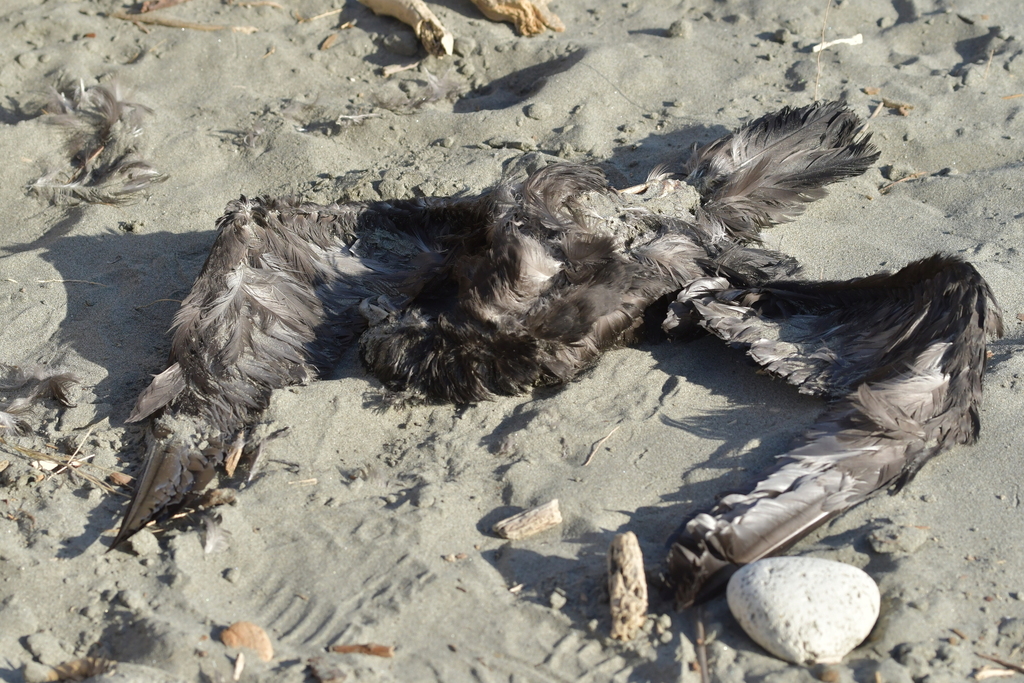
(c) Christopher Stephens, some rights reserved (CC BY-SA) · licence
Family: Procellariidae · Class: Aves · Order: Procellariiformes
Procellaria aequinoctialis (White-chinned Petrel) is a California animal in the Procellariidae family.
The White-chinned Petrel is a large seabird belonging to the family Procellariidae, distinguished by its predominantly dark plumage and characteristic white chin patch. Adults measure 51 to 58 centimeters (20 to 23 inches) in length with a wingspan of 134 to 147 centimeters (53 to 58 inches), weighing between 1.0 and 1.4 kilograms (2.2 to 3.1 pounds). The species exhibits sexually dimorphic bill coloration, with males displaying pale greenish-yellow bills marked by dark tips and females showing darker, more muted bill coloration. The white chin patch varies in size among individuals and may be absent in some birds, particularly juveniles. White-chinned Petrels breed primarily on subantarctic islands in the South Atlantic and southern Indian Oceans, including South Georgia, Prince Edward Islands, Crozet Islands, Kerguelen Islands, and Macquarie Island. During the non-breeding season, these highly pelagic birds disperse across the Southern Ocean and may range into the North Atlantic. In California waters, White-chinned Petrels are rare but regular visitors, typically observed far offshore during winter months from November through March. Most California records occur beyond the continental shelf edge in waters exceeding 1,000 meters depth. The species inhabits pelagic marine environments, preferring deep oceanic waters where upwelling creates productive feeding areas. During breeding season, White-chinned Petrels nest in burrows excavated in soft soil on tussock-covered slopes and coastal areas of subantarctic islands. Nesting colonies are typically established on islands with minimal human disturbance and abundant seabird prey species. White-chinned Petrels are opportunistic feeders, consuming a varied diet of squid, krill, fish, and crustaceans obtained through surface seizing, shallow diving, and scavenging. The species frequently associates with fishing vessels to exploit discarded bycatch and offal. Breeding occurs annually with a single egg laid in underground burrows during October and November. The incubation period extends 55 to 60 days, shared by both parents in alternating shifts lasting several days. Chick-rearing continues for approximately 100 days, with fledging typically occurring in March or April. White-chinned Petrels demonstrate high site fidelity, returning to natal colonies to breed. Globally, White-chinned Petrel populations face significant conservation challenges despite their wide distribution. The species experiences substantial mortality as bycatch in longline and trawl fisheries throughout their range. According to BirdLife International, the global population is estimated at 7 million individuals but is declining due to fisheries interactions, particularly in the Southern Ocean. Climate change poses additional threats through altered ocean productivity and prey distribution patterns. Several breeding colonies have documented population declines, with introduced predators on breeding islands representing localized threats. Conservation efforts focus on reducing fisheries bycatch through improved fishing practices and gear modifications. In California waters, the species benefits from federal protections under the Migratory Bird Treaty Act, though direct conservation measures are limited due to their pelagic nature and primary breeding range outside United States jurisdiction.
Classification
Class: Aves · Order: Procellariiformes · Family: Procellariidae
Frequently asked questions
How is Procellaria aequinoctialis classified?
Procellaria aequinoctialis belongs to class Aves, order Procellariiformes, family Procellariidae.
What family does Procellaria aequinoctialis belong to?
Procellaria aequinoctialis is in the Procellariidae family.
What is Procellaria aequinoctialis?
The White-chinned Petrel is a large seabird belonging to the family Procellariidae, distinguished by its predominantly dark plumage and characteristic white chin patch.
Is Procellaria aequinoctialis found in California?
Yes. Procellaria aequinoctialis is recorded in California in The California Species Project's catalogue.
Related species
Other California species in the same genus, family, or bioregion.
Data from The California Species Project — 14,000+ California species with verified data from CNPS, CDFW, USFWS, and more.