Procellaria parkinsoni
Parkinson's Petrel
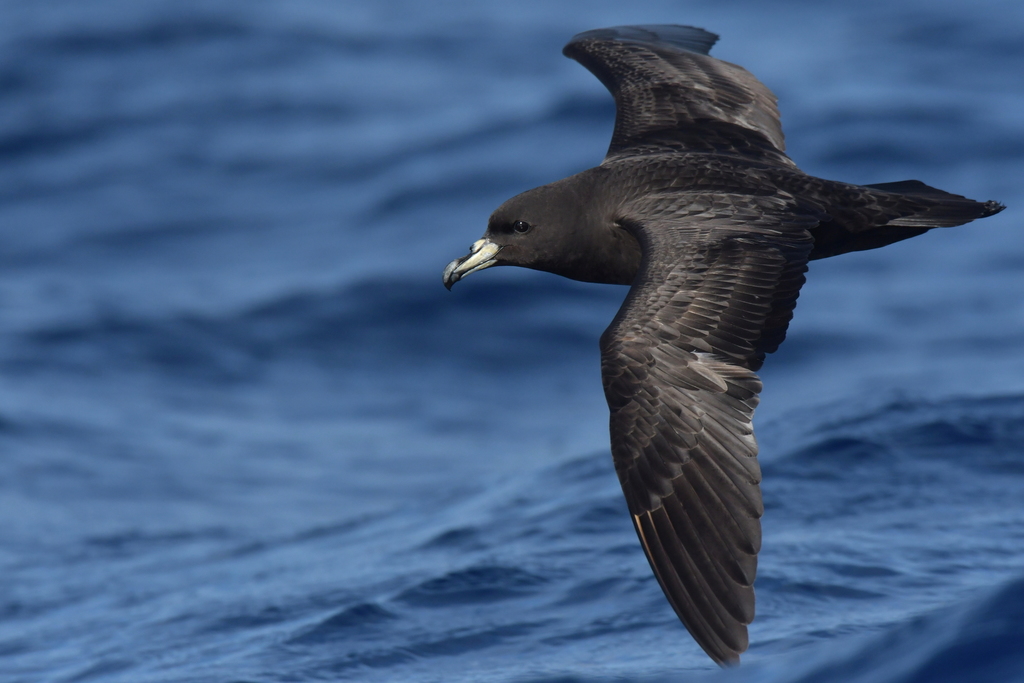
(c) Christopher Stephens, some rights reserved (CC BY-SA) · licence
Family: Procellariidae · Class: Aves · Order: Procellariiformes
Procellaria parkinsoni (Parkinson's Petrel) is a California animal in the Procellariidae family.
Parkinson's Petrel is a large, dark seabird in the family Procellariidae, measuring approximately 46 centimeters (18 inches) in length with a wingspan reaching 115 centimeters (45 inches). The species exhibits uniformly dark brown to blackish plumage across the entire body, with a slightly paler brown tone on the underparts. The bill is yellow with a dark tip, and the legs are dark. In flight, the species displays the characteristic tube-nosed appearance of petrels, with external nostrils housed in tubes on top of the hooked bill. The wings are long and narrow, adapted for dynamic soaring over ocean waters. Parkinson's Petrel breeds exclusively on islands off New Zealand, including the North Island's offshore islands and some locations around the South Island. Outside the breeding season, the species undertakes extensive transoceanic migrations, ranging throughout the Pacific Ocean from New Zealand waters to the coasts of South America, Central America, and North America. Along the California coast, Parkinson's Petrel occurs as a regular visitor in offshore waters, typically observed from late spring through early fall. The species is most commonly recorded in deep pelagic waters beyond the continental shelf, generally more than 50 kilometers (31 miles) from shore. This petrel inhabits exclusively marine environments, spending most of its life cycle over deep oceanic waters. The species prefers areas with upwelling currents and high productivity, where prey concentrations are elevated. During the breeding season, adults return to coastal islands with suitable nesting habitat, including areas with soil suitable for burrow excavation or rocky crevices for nest placement. In California waters, the species frequents areas where cold, nutrient-rich waters support abundant marine life. Parkinson's Petrel feeds primarily on squid, fish, and crustaceans obtained through surface feeding and shallow diving. The species employs a combination of surface seizing and pursuit diving techniques, typically feeding during dawn and dusk periods when prey species migrate vertically in the water column. Breeding occurs on islands from October through March, with adults excavating burrows in soil or utilizing natural rock crevices. Pairs lay a single white egg, and both parents participate in incubation duties lasting approximately 60 days. The chick remains in the nest for an extended fledging period of approximately 120 days. Parkinson's Petrel is classified as Vulnerable by the International Union for Conservation of Nature, with an estimated global population of fewer than 10,000 breeding pairs. The species faces threats from introduced predators at breeding colonies, including rats, cats, and stoats. Additional threats include fisheries bycatch, marine pollution, and climate change effects on ocean productivity. In New Zealand waters, conservation efforts focus on predator control at breeding sites and monitoring of population trends. The species' occurrence in California waters reflects its extensive pelagic range, though it remains uncommon in nearshore observations.
Classification
Class: Aves · Order: Procellariiformes · Family: Procellariidae
Frequently asked questions
How is Procellaria parkinsoni classified?
Procellaria parkinsoni belongs to class Aves, order Procellariiformes, family Procellariidae.
What family does Procellaria parkinsoni belong to?
Procellaria parkinsoni is in the Procellariidae family.
What is Procellaria parkinsoni?
Parkinson's Petrel is a large, dark seabird in the family Procellariidae, measuring approximately 46 centimeters (18 inches) in length with a wingspan reaching 115 centimeters (45 inches).
Is Procellaria parkinsoni found in California?
Yes. Procellaria parkinsoni is recorded in California in The California Species Project's catalogue.
Related species
Other California species in the same genus, family, or bioregion.
Data from The California Species Project — 14,000+ California species with verified data from CNPS, CDFW, USFWS, and more.