Proserpinus clarkiae
Clark's sphinx
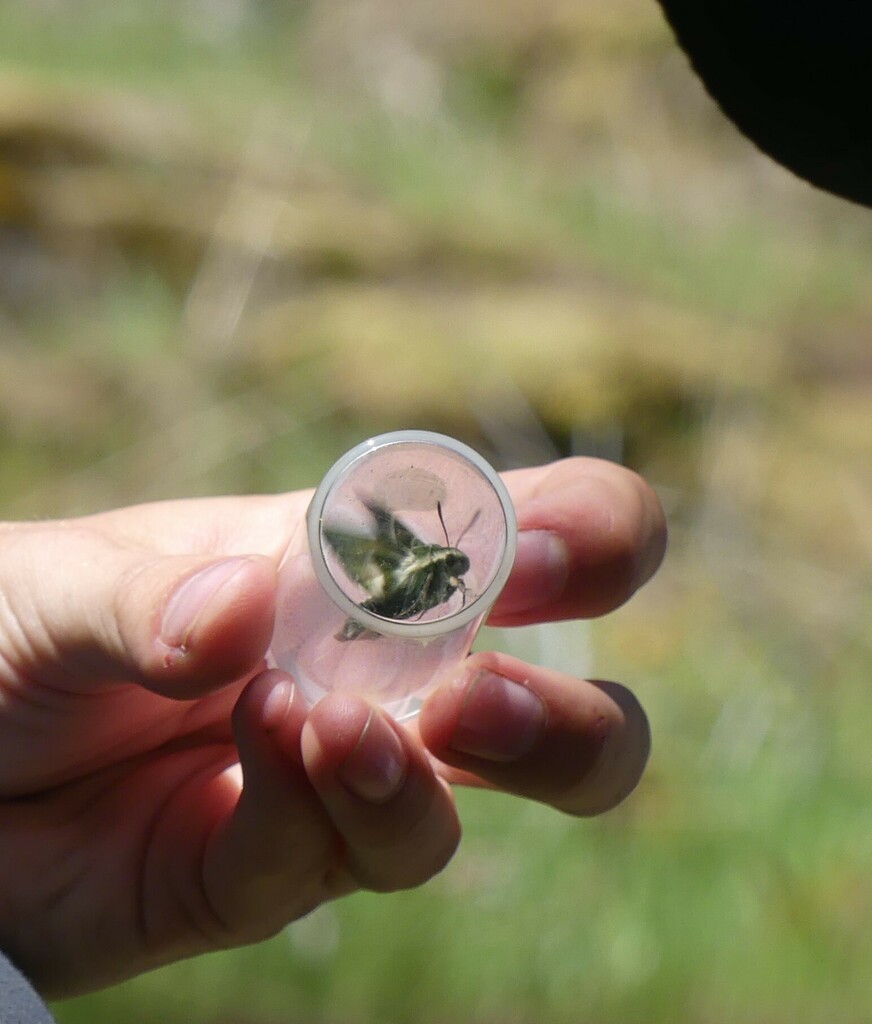
(c) Aiva Noringseth, some rights reserved (CC BY) · licence
Family: Sphingidae · Class: Insecta · Order: Lepidoptera
Proserpinus clarkiae (Clark's sphinx) is a California animal in the Sphingidae family.
Clark's sphinx (Proserpinus clarkiae) is a medium-sized moth in the hawkmoth family Sphingidae. Adults have a wingspan ranging from 32 to 42 mm (1.3 to 1.7 inches). The forewings are olive-brown to gray-brown with darker brown crosslines and a prominent pale tan or cream-colored patch near the wing tip. The hindwings are orange-red at the base, transitioning to dark brown along the outer margins. The body is robust and covered in olive-brown scales, with the abdomen displaying alternating light and dark bands. Males possess feathery antennae, while females have thread-like antennae. Clark's sphinx occurs from British Columbia and Washington south through California to Baja California Norte, extending east to Idaho, Wyoming, and Utah. In California, the species is documented from the Coast Ranges, Sierra Nevada foothills, and interior valleys. Populations are typically found at elevations below 1,500 meters (4,900 feet), though specific elevational limits vary across the range. The distribution closely follows that of its host plant throughout the western United States. This species inhabits open woodlands, chaparral, grasslands, and disturbed areas where the host plant, elegant fairyfan (Clarkia unguiculata), occurs. The moth is associated with areas containing native plant communities in the evening primrose family (Onagraceae). Suitable habitat includes oak woodlands, mixed evergreen forests, and grassland-chaparral transitions. The species appears to prefer areas with moderate disturbance that maintain populations of the annual host plant. Clark's sphinx is univoltine, producing one generation per year. Adults are active from late spring through early summer, typically flying from May through July depending on local conditions and elevation. The species is crepuscular and nocturnal, with adults most active during twilight hours. Females oviposit on Clarkia unguiculata, and larvae develop exclusively on this host plant. Caterpillars are green with white lateral stripes and a curved caudal horn characteristic of sphinx moth larvae. Pupation occurs in the soil, with pupae overwintering before adult emergence the following spring. Adults nectar at various flowering plants, including species in the families Caprifoliaceae and Scrophulariaceae. Clark's sphinx currently lacks federal or state conservation status designations. The species' conservation status appears stable across much of its range, though local populations may fluctuate with host plant availability. Primary conservation concerns include habitat modification and the potential impacts of invasive plant species on native Clarkia populations. Urban development and agricultural conversion in suitable habitat areas may pose localized threats. Climate change could affect the timing of adult emergence and host plant phenology, potentially creating mismatches between larval development and resource availability. The species' dependence on a single host plant species makes it vulnerable to factors affecting Clarkia unguiculata populations, including drought, altered fire regimes, and competition from non-native plants.
Classification
Class: Insecta · Order: Lepidoptera · Family: Sphingidae
Frequently asked questions
How is Proserpinus clarkiae classified?
Proserpinus clarkiae belongs to class Insecta, order Lepidoptera, family Sphingidae.
What family does Proserpinus clarkiae belong to?
Proserpinus clarkiae is in the Sphingidae family.
What is Proserpinus clarkiae?
Clark's sphinx (Proserpinus clarkiae) is a medium-sized moth in the hawkmoth family Sphingidae.
Is Proserpinus clarkiae found in California?
Yes. Proserpinus clarkiae is recorded in California in The California Species Project's catalogue.
Related species
Other California species in the same genus, family, or bioregion.
Data from The California Species Project — 14,000+ California species with verified data from CNPS, CDFW, USFWS, and more.