Proserpinus flavofasciata
Yellow-banded sphinx
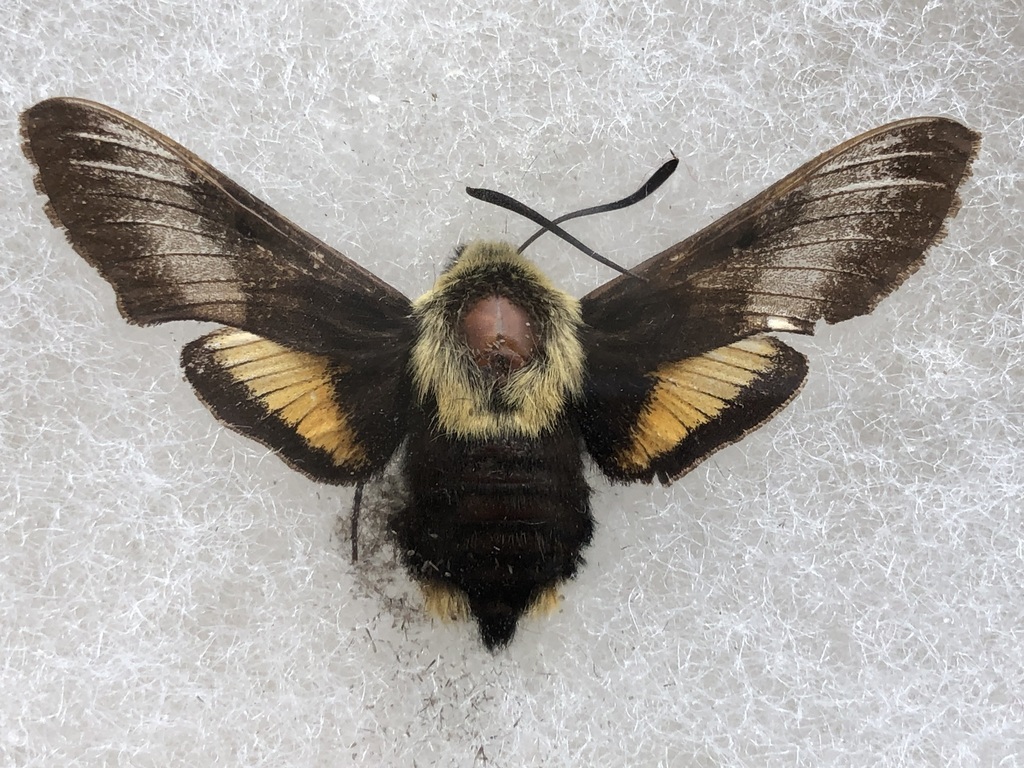
(c) Rob Foster, some rights reserved (CC BY) · licence
Family: Sphingidae · Class: Insecta · Order: Lepidoptera
Proserpinus flavofasciata (Yellow-banded sphinx) is a California animal in the Sphingidae family.
The yellow-banded sphinx (Proserpinus flavofasciata) is a medium-sized hawkmoth in the family Sphingidae. Adults have a wingspan of 32 to 40 mm (1.3 to 1.6 inches), with forewings displaying a mottled gray-brown pattern crossed by distinctive yellow bands that give the species its common name. The hindwings are orange-red with black borders and a dark median band. The body is robust and densely scaled, typical of sphinx moths, with a prominent yellow stripe along the thorax and abdomen segments marked with alternating dark and light bands. This species exhibits a broad transcontinental distribution across northern North America. The range extends from Alaska south through British Columbia to Washington, Oregon, Idaho, Wyoming, and Colorado, and from British Columbia east across southern Canada to Nova Scotia and Maine. In California, records are primarily from the northern counties, including the Sierra Nevada and Cascade ranges, though specific county-level distribution data remains limited. Yellow-banded sphinx moths inhabit montane and subalpine environments, typically occurring at elevations between 1,200 and 3,000 meters (4,000 to 10,000 feet). The species is associated with areas supporting its host plants, particularly in moist meadows, stream corridors, avalanche chutes, and forest clearings. Adults are most commonly encountered in habitats with abundant willowherb (Epilobium species) and areas where thimbleberry (Rubus parviflorus) grows in understory conditions. Larvae feed primarily on willowherb species (Epilobium), with fireweed (Epilobium angustifolium) serving as a documented host plant. Thimbleberry (Rubus parviflorus) is also reported as a potential host plant. Caterpillars are green with diagonal white stripes and possess a characteristic horn at the posterior end typical of sphinx moth larvae. The species is univoltine, producing one generation per year. Adults are active during summer months, typically from June through August, depending on elevation and latitude. Flight activity occurs primarily during daylight hours, distinguishing this species from many nocturnal sphinx moths. Adults exhibit rapid, hovering flight patterns while nectar feeding at flowers. The conservation status of Proserpinus flavofasciata appears stable across most of its range, with no current federal or state listing designations. However, like many montane species, populations may face pressure from climate change effects on high-elevation habitats. Habitat modification through logging, development, and fire suppression could potentially impact local populations by reducing suitable breeding sites and host plant availability. The species' dependence on specific host plants and montane habitats makes it potentially vulnerable to environmental changes, though comprehensive population monitoring data is lacking. Additional research is needed to assess population trends and habitat requirements throughout the species' range, particularly in peripheral areas such as California where distribution patterns are less well documented.
Classification
Class: Insecta · Order: Lepidoptera · Family: Sphingidae
Frequently asked questions
How is Proserpinus flavofasciata classified?
Proserpinus flavofasciata belongs to class Insecta, order Lepidoptera, family Sphingidae.
What family does Proserpinus flavofasciata belong to?
Proserpinus flavofasciata is in the Sphingidae family.
What is Proserpinus flavofasciata?
The yellow-banded sphinx (Proserpinus flavofasciata) is a medium-sized hawkmoth in the family Sphingidae.
Is Proserpinus flavofasciata found in California?
Yes. Proserpinus flavofasciata is recorded in California in The California Species Project's catalogue.
Related species
Other California species in the same genus, family, or bioregion.
Data from The California Species Project — 14,000+ California species with verified data from CNPS, CDFW, USFWS, and more.