Proserpinus lucidus
Pacific green sphinx
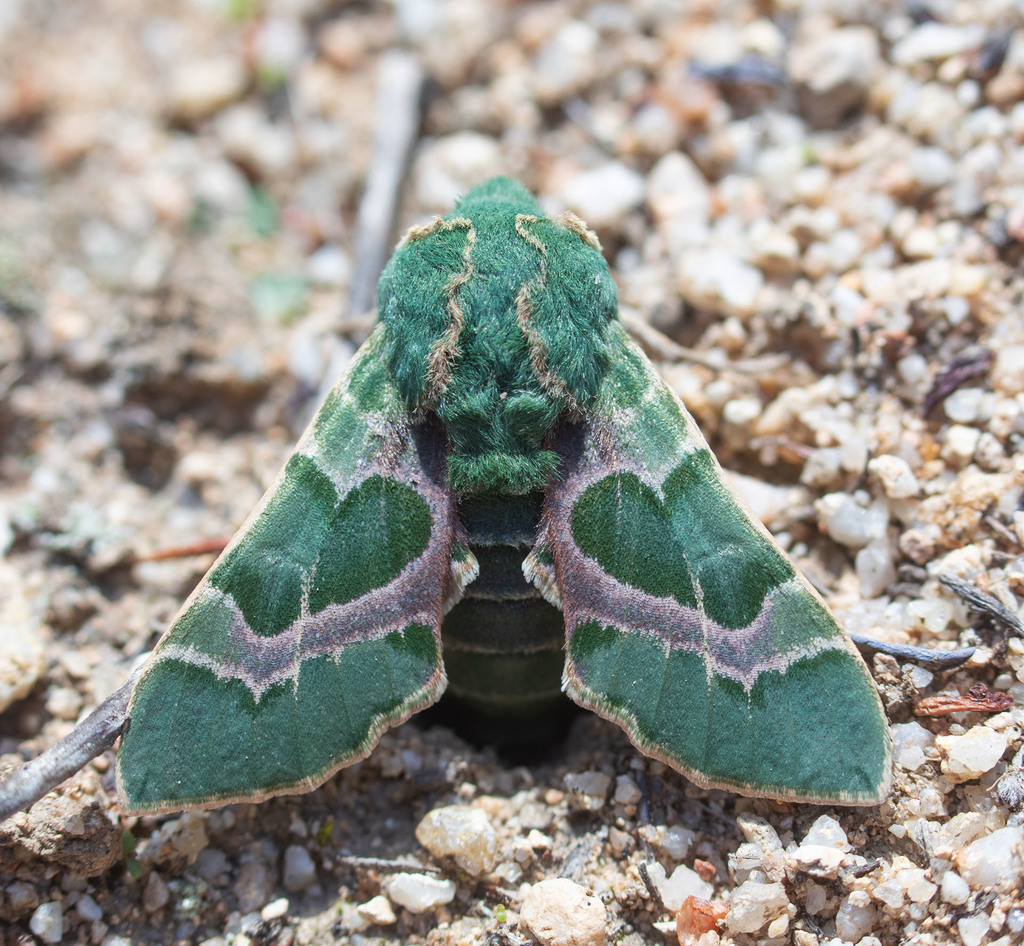
(c) Pinnacles National Park, some rights reserved (CC BY) · licence
Family: Sphingidae · Class: Insecta · Order: Lepidoptera
Proserpinus lucidus (Pacific green sphinx) is a California animal in the Sphingidae family.
The Pacific green sphinx is a medium-sized moth in the family Sphingidae. Adults display distinctive green to olive-green forewings with pink and brown markings, distinguishing them from related species in the genus Proserpinus. Unlike most sphinx moths, adults have reduced mouthparts and likely do not feed on nectar or other substances (BAMONA). This species occurs along the Pacific coast of North America, with populations documented in Washington, Idaho, Oregon, and California, extending south into Mexico. Within California, verified sightings have been recorded from numerous counties including Riverside, Santa Clara, Madera, Napa, San Luis Obispo, Stanislaus, Siskiyou, San Diego, and Modoc counties (BAMONA). The species appears to have a broad elevational range, occurring in both coastal and inland mountainous regions. Pacific green sphinx moths inhabit oak woodlands and pine-oak woodland areas in foothills and mountains. The species shows preference for areas supporting its primary host plants, which include evening primrose (Oenothera dentata var. campestris) and various clarkia species (Clarkia spp.). These habitats typically feature open to semi-open canopy structure with diverse understory vegetation. Unlike most members of the genus Proserpinus, Pacific green sphinx adults are nocturnal rather than diurnal (BAMONA). The species exhibits typical sphinx moth characteristics during flight, with rapid wingbeats and hovering behavior. Larvae feed on evening primrose and clarkia species, likely completing development on these host plants before pupating. Specific details regarding seasonal activity patterns, mating behavior, and voltinism have not been well documented in the scientific literature. The Pacific green sphinx currently has no federal or state conservation listing status. NatureServe has assigned the species a global conservation rank of G4G5, indicating it is apparently secure to secure globally (NatureServe Explorer). The species appears to maintain stable populations across much of its range, with documented sightings continuing through recent years. However, like many native moths, populations may face pressure from habitat loss due to development and agricultural conversion within its range, particularly in California's oak woodland ecosystems. The broad distribution spanning multiple states and diverse habitat types suggests some ecological resilience, though localized populations may be vulnerable to specific threats such as habitat fragmentation or changes in host plant availability. Climate change impacts on oak woodland and foothill ecosystems could potentially affect future population dynamics, particularly at the southern extent of the species' range. Scientific documentation for this species remains limited compared to more extensively studied sphinx moths. Additional research on population trends, detailed life history characteristics, and specific habitat requirements would enhance understanding of conservation needs. The information presented here is based on available sources including BAMONA and NatureServe databases. If you have additional verified information about this species' biology, distribution, or ecology, please contact us to help improve this species account.
Classification
Class: Insecta · Order: Lepidoptera · Family: Sphingidae
Frequently asked questions
How is Proserpinus lucidus classified?
Proserpinus lucidus belongs to class Insecta, order Lepidoptera, family Sphingidae.
What family does Proserpinus lucidus belong to?
Proserpinus lucidus is in the Sphingidae family.
What is Proserpinus lucidus?
The Pacific green sphinx is a medium-sized moth in the family Sphingidae.
Is Proserpinus lucidus found in California?
Yes. Proserpinus lucidus is recorded in California in The California Species Project's catalogue.
Related species
Other California species in the same genus, family, or bioregion.
Data from The California Species Project — 14,000+ California species with verified data from CNPS, CDFW, USFWS, and more.