Psaltriparus minimus
Bushtit
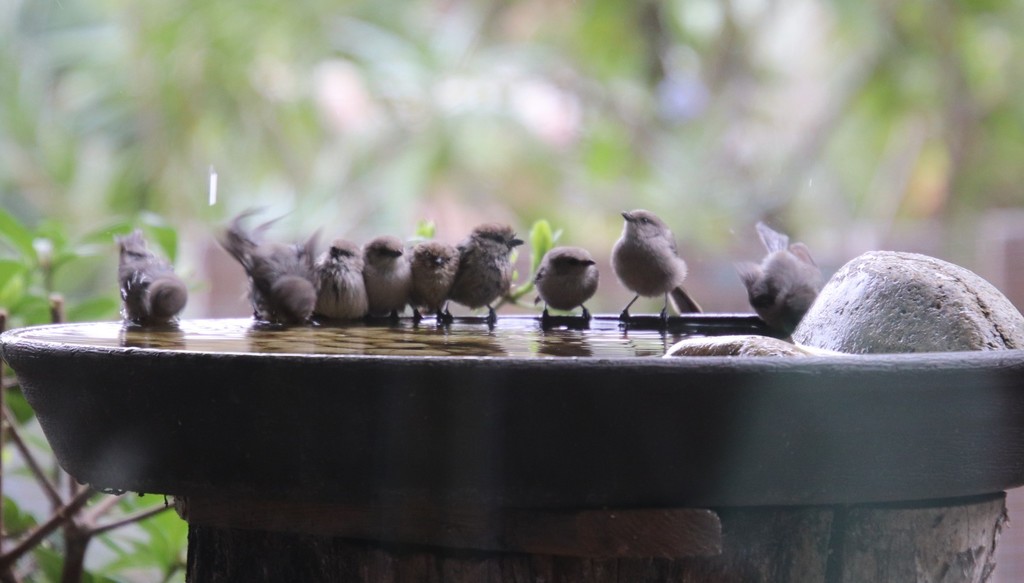
(c) Millie Basden, some rights reserved (CC BY) · licence
Family: Aegithalidae · Class: Aves · Order: Passeriformes
Psaltriparus minimus (Bushtit) is a California animal in the Aegithalidae family.
The Bushtit is a small, highly social passerine measuring 7.5 to 11 cm (3.0 to 4.3 inches) in length and weighing 4.5 to 9 grams. The species exhibits subtle sexual dimorphism in eye coloration: males have dark brown to black eyes, while females display pale yellow to white eyes. The plumage is predominantly gray-brown above with lighter underparts, and the tail is relatively long compared to body size. Adults lack distinct markings, presenting a uniform appearance that distinguishes them from other small songbirds. The bill is small, pointed, and well-adapted for gleaning insects from foliage. Bushtits range from southern British Columbia through much of western North America to Guatemala. In California, the species occurs throughout most of the state except for high-elevation areas of the Sierra Nevada above 2,400 meters (7,900 feet) and portions of the Central Valley floor. The subspecies Psaltriparus minimus californicus is resident throughout California's coastal regions, foothills, and lower mountains. Populations are generally non-migratory, maintaining year-round territories within their breeding range. The species inhabits diverse woodland and scrubland environments, including oak woodlands, mixed coniferous forests, chaparral, riparian corridors, and suburban areas with mature trees. Bushtits occur from sea level to approximately 2,400 meters elevation, showing preference for areas with dense shrub layers and mixed vegetation structure. They readily adapt to human-modified landscapes, utilizing parks, gardens, and residential areas that provide suitable foraging and nesting opportunities. Bushtits are highly gregarious outside the breeding season, forming flocks of 10 to 40 individuals that move through their territory in coordinated foraging groups. These mixed-age flocks maintain contact through constant soft chittering calls. The species feeds primarily on small insects, spiders, and their eggs, employing a gleaning foraging strategy on leaves, bark, and twigs. During winter months, they may supplement their diet with small seeds and berries. Breeding occurs from February through July, with peak activity in March and April. Pairs construct elaborate pendant nests measuring 15 to 25 cm in length, woven from spider webs, plant fibers, and moss, typically suspended from branch forks 1 to 8 meters above ground. Females lay 5 to 13 white eggs, with both parents participating in incubation for 12 to 13 days. Fledglings remain with parents for approximately three weeks after leaving the nest. Notably, related individuals and even unrelated helpers may assist with nest construction and feeding of young. Bushtits are not federally or state-listed and maintain stable populations throughout most of their range as of December 2025. The species benefits from habitat diversity and demonstrates resilience to moderate habitat modification. Climate change and urbanization represent potential long-term challenges, but current population trends show no significant decline. Their adaptability to suburban environments and broad habitat tolerance contribute to their conservation stability across California.
Classification
Class: Aves · Order: Passeriformes · Family: Aegithalidae
Frequently asked questions
How is Psaltriparus minimus classified?
Psaltriparus minimus belongs to class Aves, order Passeriformes, family Aegithalidae.
What family does Psaltriparus minimus belong to?
Psaltriparus minimus is in the Aegithalidae family.
What is Psaltriparus minimus?
The Bushtit is a small, highly social passerine measuring 7.5 to 11 cm (3.0 to 4.3 inches) in length and weighing 4.5 to 9 grams.
Is Psaltriparus minimus found in California?
Yes. Psaltriparus minimus is recorded in California in The California Species Project's catalogue.
More California species
This species has no close relatives in our California data — here are other species to explore.
Data from The California Species Project — 14,000+ California species with verified data from CNPS, CDFW, USFWS, and more.