Pseudeva palligera
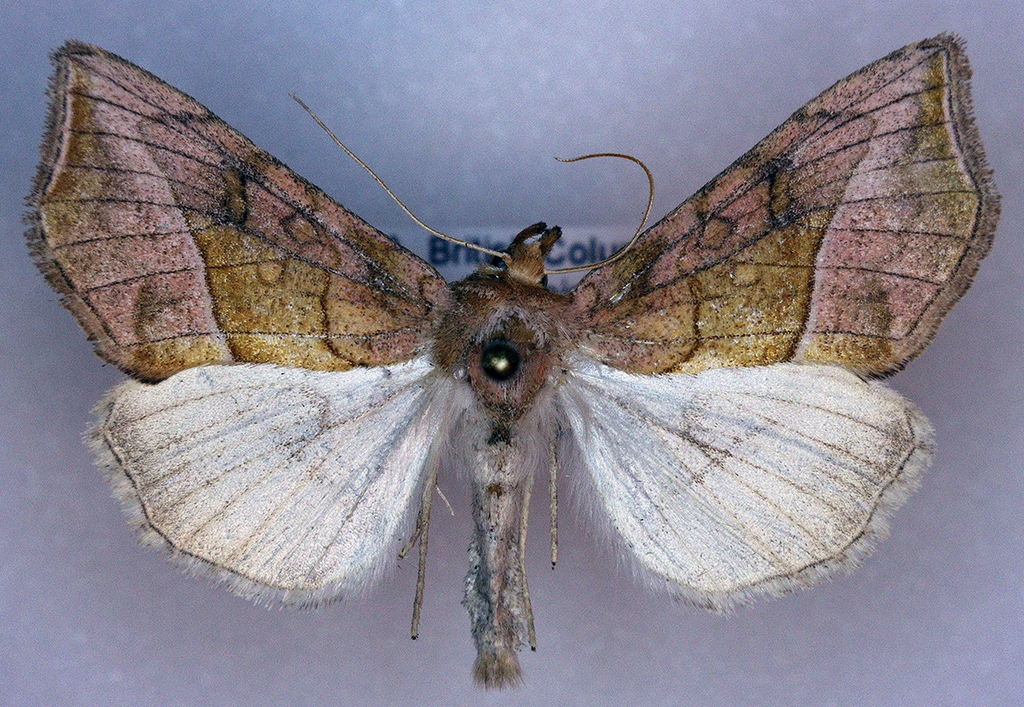
(c) Dave, some rights reserved (CC BY) · licence
Family: Noctuidae · Class: Insecta · Order: Lepidoptera
Pseudeva palligera is a California animal in the Noctuidae family.
The Western Unspotted Looper (Pseudeva palligera) is a medium-sized moth in the family Noctuidae, subfamily Plusiinae. Adults have a forewing length of 15 to 16 mm (0.6 inches), with golden-yellow forewings that distinguish it from related species (PNW Moths Database). The forewings display a smooth yellow coloration without the peppering of dark scales found in similar species, and lack the brass sheen characteristic of Pseudeva purpurigera. This species exhibits a broad distribution across western North America. The range extends from Vancouver Island and British Columbia south through western Oregon, continuing through California to San Diego County. The species also occurs in mountainous areas of northern Idaho and adjacent Montana. Within California, Pseudeva palligera is found throughout most of the state, representing one of the more widely distributed members of its genus in the region. Pseudeva palligera inhabits forested environments, particularly in areas south of southern British Columbia during summer months (PNW Moths Database). The species shows a preference for woodland and forest habitats, though specific vegetation associations and elevation requirements have not been thoroughly documented in the scientific literature. Like other members of the Plusiinae subfamily, this species likely requires specific microhabitat conditions related to its larval host plants. Adult flight period occurs during summer months, though precise timing and duration vary across the species' extensive range. Specific information regarding larval ecology, host plant relationships, and reproductive behavior remains poorly documented in published literature. The larvae presumably feed on herbaceous plants or low shrubs, following patterns typical of other Pseudeva species, though confirmed host plant records are lacking. The species appears in moth survey databases and citizen science platforms like iNaturalist, indicating regular encounters by lepidopterists and naturalists throughout its range. However, systematic population monitoring data is not available. Conservation assessments suggest potential concerns due to the species' reportedly restricted and patchy distribution patterns, with some sources indicating NatureServe rankings of N3N4, suggesting the species may be vulnerable to apparently secure globally. However, this conservation status requires verification from authoritative sources, as the species' actual abundance and population trends have not been comprehensively studied. Pseudeva palligera represents one component of western North American forest moth communities. The species' relatively broad geographic range suggests adaptability to various forest types and elevations, though habitat specificity at local scales may influence population distribution patterns. Scientific documentation for this species remains limited compared to more extensively studied moths. The information presented here is based on available sources including the PNW Moths Database and iNaturalist observations. If you have additional verified information about this species' biology, distribution, or ecology, please contact us to help improve this species account.
Classification
Class: Insecta · Order: Lepidoptera · Family: Noctuidae
Frequently asked questions
How is Pseudeva palligera classified?
Pseudeva palligera belongs to class Insecta, order Lepidoptera, family Noctuidae.
What family does Pseudeva palligera belong to?
Pseudeva palligera is in the Noctuidae family.
What is Pseudeva palligera?
The Western Unspotted Looper (Pseudeva palligera) is a medium-sized moth in the family Noctuidae, subfamily Plusiinae.
Is Pseudeva palligera found in California?
Yes. Pseudeva palligera is recorded in California in The California Species Project's catalogue.
Related species
Other California species in the same genus, family, or bioregion.
Data from The California Species Project — 14,000+ California species with verified data from CNPS, CDFW, USFWS, and more.