Pseudobryomima fallax
Fallacious Bryomima
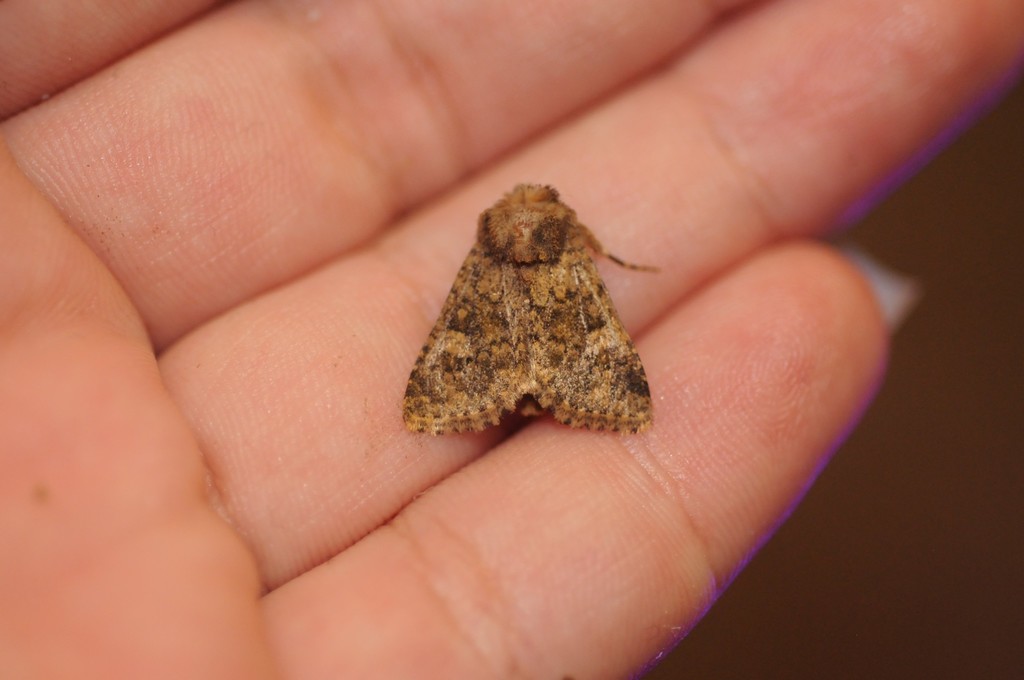
(c) Hawk T., some rights reserved (CC BY) · licence
Family: Noctuidae · Class: Insecta · Order: Lepidoptera
Pseudobryomima fallax (Fallacious Bryomima) is a California animal in the Noctuidae family.
Pseudobryomima fallax is a small noctuid moth in the subfamily Noctuinae, commonly known as a cutworm or dart moth. Adults have a wingspan of approximately 32 mm (1.3 inches), displaying typical noctuid coloration and wing patterns characteristic of the genus (Butterflies and Moths of North America). The species ranges from southern Oregon through California and Nevada, with the type locality in Arizona. This distribution encompasses diverse ecosystems across the southwestern United States, indicating adaptation to various climatic conditions within this geographic range. Pseudobryomima fallax exhibits specialized habitat requirements linked to its host plant associations. The species is closely associated with rocky, exposed areas where its primary host plant, Pellaea andromedifolia (coffee cliffbrake), grows naturally. This pteridophyte typically occurs on dry, rocky slopes and cliff faces in chaparral and woodland habitats throughout the species' range. The larval ecology of P. fallax represents a specialized feeding strategy within the Noctuidae. Caterpillars create distinctive blister mines on the leaves of coffee cliffbrake, a feeding behavior that distinguishes this species from most other noctuids that typically feed on flowering plants (Butterflies and Moths of North America). This pteridivory, or fern-feeding behavior, is relatively uncommon among North American Noctuoidea and represents an evolutionary adaptation to exploit an underutilized food resource. The mining behavior involves larvae feeding between the upper and lower leaf surfaces, creating characteristic translucent patches or blisters in the fern fronds. Taxonomically, the genus Pseudobryomima includes three described species, though recent research suggests these may be congeneric with species currently placed in the genus Properigea. This indicates ongoing taxonomic uncertainty and the need for additional systematic study to clarify relationships within this group (ResearchGate publications). The species was originally described by Hampson in 1906, with synonyms including Bryomima fallax Hampson, 1906, and Perigea falsa Grote, 1880 (BugGuide). Recorded sightings of P. fallax are sparse in online databases, with verified observations including specimens from Los Angeles County, California, documented as recently as March 2024 (Butterflies and Moths of North America). This limited observation record may reflect the species' specialized habitat requirements and potentially cryptic adult behavior, rather than actual rarity. The species holds Hodges number 9600 in the standard North American moth classification system. No federal or state conservation status has been assigned to P. fallax, suggesting populations are currently considered stable. However, the species' dependence on specific rocky habitat types and its specialized host plant relationship could make it vulnerable to habitat modification or climate change impacts affecting the distribution of coffee cliffbrake. Scientific documentation for this species remains limited beyond basic taxonomic and host plant information. The specialized ecological niche of P. fallax as a fern-mining moth warrants additional research to better understand its life history, population dynamics, and conservation needs.
Classification
Class: Insecta · Order: Lepidoptera · Family: Noctuidae
Frequently asked questions
How is Pseudobryomima fallax classified?
Pseudobryomima fallax belongs to class Insecta, order Lepidoptera, family Noctuidae.
What family does Pseudobryomima fallax belong to?
Pseudobryomima fallax is in the Noctuidae family.
What is Pseudobryomima fallax?
Pseudobryomima fallax is a small noctuid moth in the subfamily Noctuinae, commonly known as a cutworm or dart moth.
Is Pseudobryomima fallax found in California?
Yes. Pseudobryomima fallax is recorded in California in The California Species Project's catalogue.
Related species
Other California species in the same genus, family, or bioregion.
Data from The California Species Project — 14,000+ California species with verified data from CNPS, CDFW, USFWS, and more.