Pseudocotalpa andrewsi
Andrew's Dune Scarab Beetle
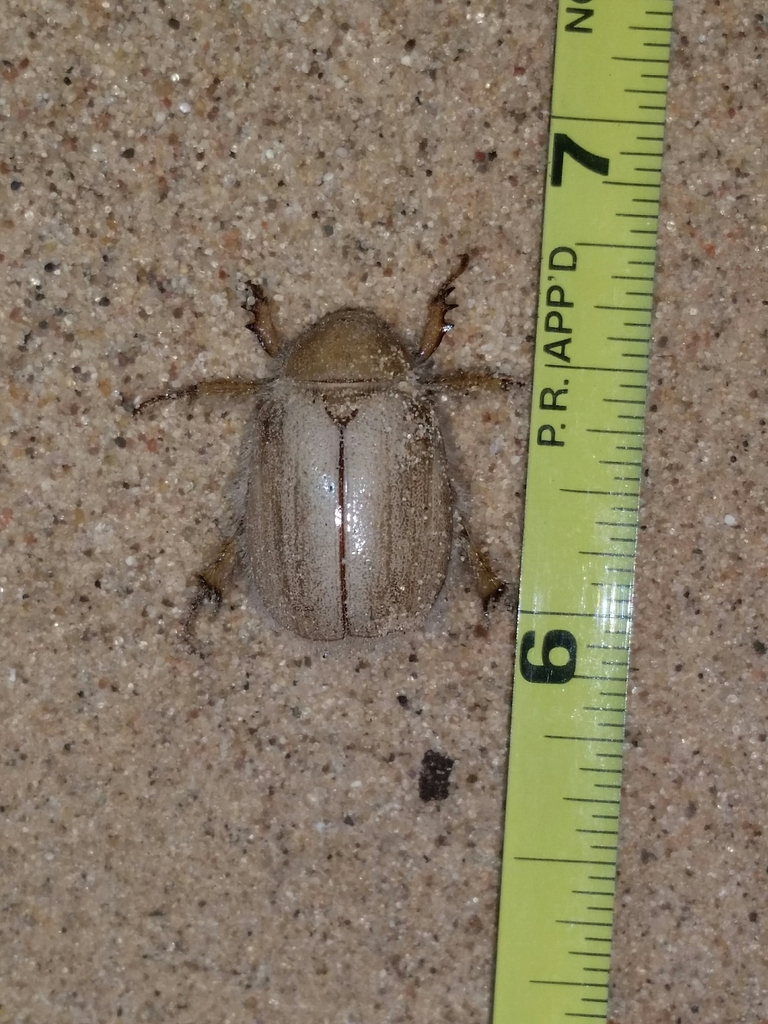
(c) Bob Miller, some rights reserved (CC BY) · licence
Family: Scarabaeidae · Class: Insecta · Order: Coleoptera
Conservation status: G1 S1
Pseudocotalpa andrewsi (Andrew's Dune Scarab Beetle) is a California animal in the Scarabaeidae family.
Andrews' dune scarab beetle is a small, golden-brown beetle endemic to the Imperial Sand Hills of southeastern California. Adults measure 7 to 10 mm (0.28 to 0.39 inches) in length for males and 7 to 9 mm (0.28 to 0.35 inches) for females. The species displays a distinctive light tan to golden-brown coloration and is covered with long, pale setae that give it a somewhat fuzzy appearance (Hardy 1974; Potts 1976). This scarab beetle belongs to the subfamily Rutelinae within the family Scarabaeidae and was first described by Hardy in 1971 as a monotypic species within the newly established genus Pseudocotalpa. The species occurs exclusively in the Glamis Dunes, also known as the Imperial Sand Hills, of Imperial County in southeastern California. This represents one of the most geographically restricted ranges of any North American scarab beetle. The beetle's distribution is centered near the town of Glamis, where Hardy collected the original type specimens in 1971. Additional specimens totaling 82 individuals were subsequently collected from this same type locality (Hardy 1974). The species has not been documented from any other location despite extensive surveys of similar dune systems in the region. Andrews' dune scarab beetle inhabits active sand dune environments characterized by shifting sands and sparse vegetation. Adults are most commonly found on north- or east-facing dune slip faces, suggesting specific microhabitat preferences related to moisture retention or temperature regulation (Hardy and Andrews 1980). Unlike many scarab beetles that have well-documented plant associations, no known relationship exists between adults and any specific plant species. The species appears adapted to the dynamic dune ecosystem where sand movement and sparse vegetation create a unique ecological niche. Adult beetles are active at dusk, exhibiting crepuscular behavior typical of many desert-adapted insects (Hardy and Andrews 1980). Little is known about the species' complete life cycle, including larval development, feeding habits, or reproductive behavior. The seasonal activity patterns and population dynamics remain poorly documented, with most specimens collected during limited survey periods. The species likely follows the general scarab beetle pattern of underground larval development, but specific details about larval habitat requirements and duration of development are unknown. Andrews' dune scarab beetle holds a Global and State conservation rank of G1 S1, indicating it is critically imperiled. The U.S. Fish and Wildlife Service received a petition to list the species as threatened or endangered in December 2002, but determined in 2006 that the petition did not provide substantial information indicating that listing was warranted (USFWS 2006). Primary conservation concerns include the species' extremely limited range, potential impacts from off-road vehicle use in the Imperial Sand Hills, habitat modification from development or recreational activities, and the inherent vulnerability associated with single-location endemism. The dynamic nature of dune systems, while providing the species' required habitat, also creates natural uncertainty about long-term population persistence. Current population size and trends remain unknown due to limited monitoring efforts.
Classification
Class: Insecta · Order: Coleoptera · Family: Scarabaeidae
Conservation status
G1 S1
Frequently asked questions
How is Pseudocotalpa andrewsi classified?
Pseudocotalpa andrewsi belongs to class Insecta, order Coleoptera, family Scarabaeidae.
What family does Pseudocotalpa andrewsi belong to?
Pseudocotalpa andrewsi is in the Scarabaeidae family.
Is Pseudocotalpa andrewsi protected or of conservation concern?
Pseudocotalpa andrewsi carries the following status: G1 S1.
What is Pseudocotalpa andrewsi?
Andrews' dune scarab beetle is a small, golden-brown beetle endemic to the Imperial Sand Hills of southeastern California.
Is Pseudocotalpa andrewsi found in California?
Yes. Pseudocotalpa andrewsi is recorded in California in The California Species Project's catalogue.
Related species
Other California species in the same genus, family, or bioregion.
Data from The California Species Project — 14,000+ California species with verified data from CNPS, CDFW, USFWS, and more.