Pseudomasaris edwardsii
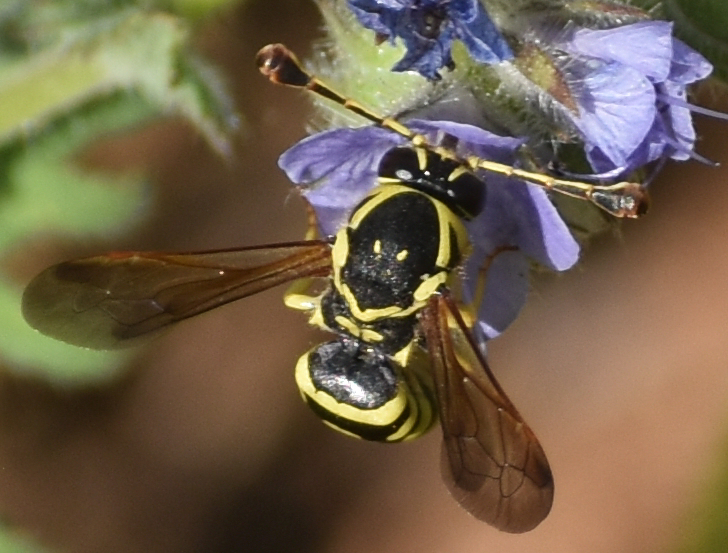
(c) Jim Julius, some rights reserved (CC BY) · licence
Family: Vespidae · Class: Insecta · Order: Hymenoptera
Pseudomasaris edwardsii is a California animal in the Vespidae family.
Pseudomasaris edwardsii is a species of pollen wasp in the family Vespidae, subfamily Masarinae. These wasps are distinguished from other vespids by their unique feeding behavior and morphological adaptations for pollen collection. Adult females possess specialized branched hairs on their legs and body for gathering pollen, and both sexes have elongated mouthparts adapted for nectar feeding. The species exhibits the typical wasp body plan with a narrow waist between the thorax and abdomen, though masarine wasps tend to be more robust than their carnivorous relatives. The distribution of P. edwardsii appears to be limited within North America, though specific range information for this species requires further documentation. Masarine wasps generally occur in arid and semi-arid regions of western North America, where their host plants are abundant. The genus Pseudomasaris is primarily found in southwestern United States, suggesting this species likely occurs in similar geographic regions. Habitat preferences for P. edwardsii center around areas supporting suitable pollen and nectar sources. Masarine wasps typically inhabit desert scrubland, chaparral, and oak woodland environments where diverse flowering plants provide necessary resources. These wasps show strong associations with specific plant families, particularly those producing easily accessible pollen. The species likely requires areas with both nesting substrates and proximity to preferred flowering plants. Unlike most vespid wasps which are predatory, P. edwardsii exhibits specialized behavior as a pollen wasp. Females collect pollen and nectar to provision their nests, making them functionally similar to solitary bees despite their wasp morphology. Adults are active during flowering seasons of their host plants, with females constructing mud or clay nests in protected locations such as rock crevices or under overhangs. Each cell within the nest is provisioned with a pollen-nectar mixture before a single egg is deposited. The larvae develop on this plant-based diet, pupating within the nest cell before emerging as adults. Males typically emerge before females and may patrol areas near nesting sites or flower patches where mating occurs. The conservation status of Pseudomasaris edwardsii has not been formally assessed by federal or state wildlife agencies. As with many specialized native pollinators, potential threats include habitat loss, pesticide use, and climate change impacts on host plant phenology. The apparent limited distribution and specific habitat requirements of masarine wasps suggest that populations could be vulnerable to environmental changes. However, the lack of comprehensive population surveys and ecological studies limits current understanding of the species' conservation needs. Research into the distribution, abundance, and ecological requirements of P. edwardsii would be valuable for assessing its long-term conservation status and identifying potential management needs.
Classification
Class: Insecta · Order: Hymenoptera · Family: Vespidae
Frequently asked questions
How is Pseudomasaris edwardsii classified?
Pseudomasaris edwardsii belongs to class Insecta, order Hymenoptera, family Vespidae.
What family does Pseudomasaris edwardsii belong to?
Pseudomasaris edwardsii is in the Vespidae family.
What is Pseudomasaris edwardsii?
Pseudomasaris edwardsii is a species of pollen wasp in the family Vespidae, subfamily Masarinae.
Is Pseudomasaris edwardsii found in California?
Yes. Pseudomasaris edwardsii is recorded in California in The California Species Project's catalogue.
Related species
Other California species in the same genus, family, or bioregion.
Data from The California Species Project — 14,000+ California species with verified data from CNPS, CDFW, USFWS, and more.