Pseudomasaris vespoides
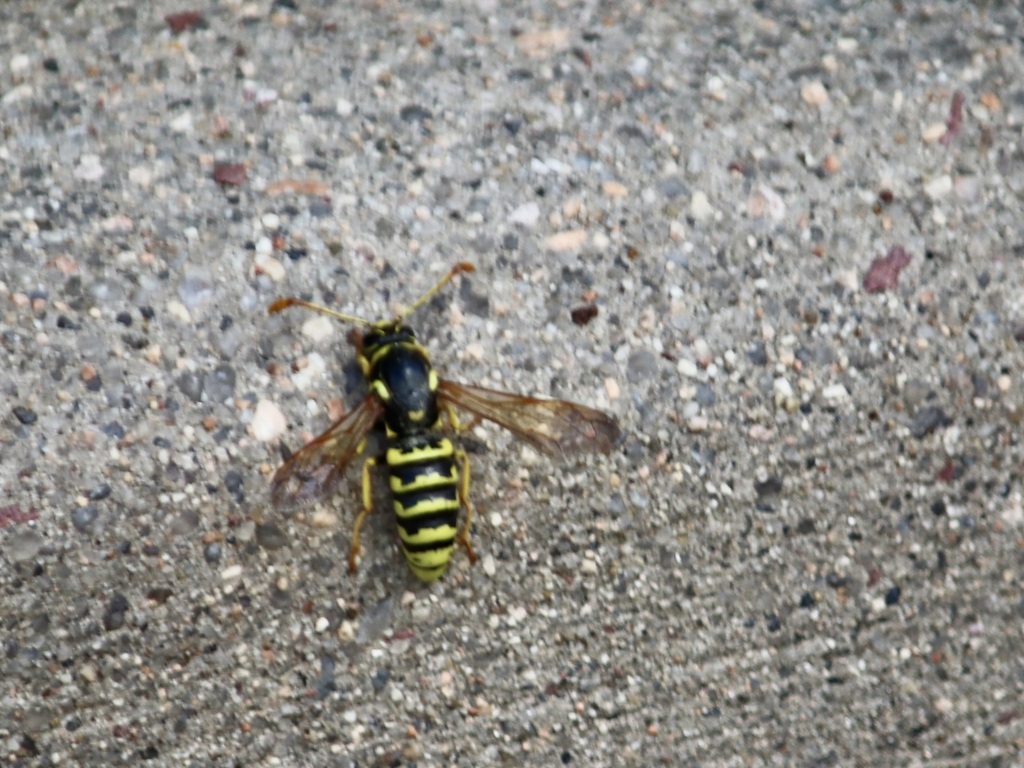
(c) Cheryl McCleary-Catalano, some rights reserved (CC BY) · licence
Family: Vespidae · Class: Insecta · Order: Hymenoptera
Pseudomasaris vespoides is a California animal in the Vespidae family.
Pseudomasaris vespoides is a specialized masarid wasp in the family Vespidae, distinguished from typical social wasps by its solitary lifestyle and unique ecological role as a Penstemon specialist pollinator. This small wasp exhibits the characteristic features of masarid wasps, with a slender body and distinctive coloration patterns, though detailed morphological descriptions remain limited in the scientific literature. The species occurs in the western United States, with documented populations in Utah and Colorado associated with Penstemon species habitats. Based on federal documentation, P. vespoides has been recorded in the Uinta Basin region of eastern Utah, where it serves as a primary pollinator for several rare beardtongue species (USFWS 2014). The wasp's range appears closely tied to the distribution of its host plants, particularly in areas supporting populations of Graham's beardtongue (Penstemon grahamii) and White River beardtongue (P. scariosus var. albifluvis). Pseutomasaris vespoides inhabits shrubland and semi-arid environments characterized by well-drained soils and sparse vegetation typical of Great Basin ecosystems. The species is associated with areas containing native Penstemon populations, including shale knolls and slopes where beardtongue species naturally occur. These habitats typically feature scattered shrubs, exposed mineral soils, and elevation ranges suitable for cold desert plant communities. This wasp demonstrates highly specialized behavior as a Penstemon pollinator, with federal documentation identifying it as "the most consistent pollinator" and "likely the most common pollinator" for Graham's beardtongue (USFWS 2006, 2014). Unlike generalist pollinators, P. vespoides shows strong fidelity to beardtongue flowers, making it particularly effective at transferring pollen between plants. The species visits multiple Penstemon taxa, including P. grahamii, P. scariosus var. albifluvis, P. pachyphyllus, P. fremontii, and P. strictus, with peak activity during the May through June flowering period when beardtongues bloom. Federal assessments note that successful P. grahamii reproduction depends heavily on P. vespoides populations, which require diverse Penstemon communities to maintain viable numbers during periods when individual species have limited floral resources (USFWS 2006). While P. vespoides itself has no federal conservation status, its ecological importance has been recognized in federal listing assessments for endangered beardtongue species. The U.S. Fish and Wildlife Service has identified maintaining P. vespoides populations as essential for the conservation of threatened Penstemon species, noting that habitat management must consider both plant and pollinator requirements (USFWS 2014). Conservation efforts for rare beardtongues emphasize protecting intact native plant communities that support diverse Penstemon assemblages, ensuring adequate floral resources to sustain P. vespoides throughout its flight season. The species' specialized relationship with rare plants makes it vulnerable to habitat fragmentation and loss of native plant diversity, highlighting the interconnected nature of plant-pollinator conservation in western shrubland ecosystems.
Classification
Class: Insecta · Order: Hymenoptera · Family: Vespidae
Frequently asked questions
How is Pseudomasaris vespoides classified?
Pseudomasaris vespoides belongs to class Insecta, order Hymenoptera, family Vespidae.
What family does Pseudomasaris vespoides belong to?
Pseudomasaris vespoides is in the Vespidae family.
What is Pseudomasaris vespoides?
Pseudomasaris vespoides is a specialized masarid wasp in the family Vespidae, distinguished from typical social wasps by its solitary lifestyle and unique ecological role as a Penstemon specialist pollinator.
Is Pseudomasaris vespoides found in California?
Yes. Pseudomasaris vespoides is recorded in California in The California Species Project's catalogue.
Related species
Other California species in the same genus, family, or bioregion.
Data from The California Species Project — 14,000+ California species with verified data from CNPS, CDFW, USFWS, and more.