Pseudorca crassidens
False Killer Whale
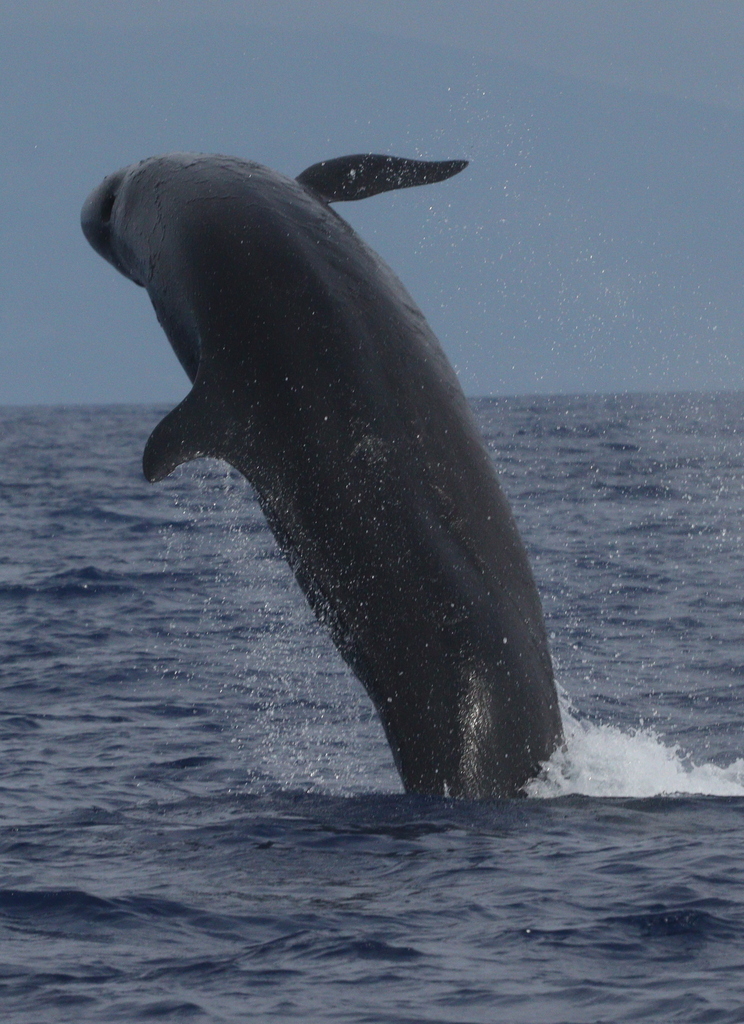
(c) Jan Ebr & Ivana Ebrová, some rights reserved (CC BY) · licence
Family: Delphinidae · Class: Mammalia · Order: Artiodactyla
Pseudorca crassidens (False Killer Whale) is a California animal in the Delphinidae family.
The false killer whale is a large oceanic dolphin species belonging to the family Delphinidae. Adults typically measure 4.3 to 6.1 meters (14 to 20 feet) in length, with males reaching larger sizes than females. Body weight ranges from 1,100 to 2,200 kilograms (2,400 to 4,900 pounds). The species exhibits a uniformly dark gray to black coloration with a lighter gray patch on the ventral surface between the flippers. The head is rounded and lacks a distinct beak, with a characteristic overhanging upper jaw. The dorsal fin is tall, falcate, and positioned at the midpoint of the back. Flippers are distinctive with a characteristic S-shaped leading edge and an elbow-like bend. False killer whales have a cosmopolitan distribution in tropical and warm temperate waters worldwide. In the eastern North Pacific, they occur from British Columbia south to Ecuador, including California waters. The species is found year-round in offshore waters of the California Current system, typically beyond the continental shelf edge in waters deeper than 1,000 meters (3,280 feet). Occasional sightings occur closer to shore, particularly around the Channel Islands and Monterey Bay. This pelagic species inhabits deep oceanic waters, preferring areas with steep bathymetric features such as seamounts, continental slopes, and submarine canyons. False killer whales are highly social, forming stable pods of 10 to 30 individuals, though aggregations of several hundred animals have been documented. They exhibit strong social bonds and cooperative behaviors, including food sharing between pod members. False killer whales are opportunistic predators that feed primarily on large pelagic fish and cephalopods. Their diet includes yellowfin tuna, mahi-mahi, wahoo, and various squid species. They employ cooperative hunting strategies and are capable of taking prey up to two-thirds of their own body length. Reproduction is characterized by a gestation period of approximately 15 months, with calving intervals of 6 to 7 years. Sexual maturity occurs at 8 to 14 years of age. Globally, false killer whales are classified as Near Threatened by the International Union for Conservation of Nature. While not federally listed in U.S. waters, the Hawaii distinct population segment was designated as endangered under the Endangered Species Act in 2012 due to interactions with longline fisheries and small population size. In California waters, the species faces threats from entanglement in fishing gear, ship strikes, pollution including persistent organic pollutants and marine debris, and potential impacts from military sonar operations. Climate change may affect prey distribution and abundance, indirectly impacting false killer whale populations. The species' tendency to mass strand, though rare in California, poses an additional conservation concern. Population estimates for the California Current region are uncertain, with recent surveys suggesting several thousand individuals occur in the broader eastern North Pacific.
Classification
Class: Mammalia · Order: Artiodactyla · Family: Delphinidae
Frequently asked questions
How is Pseudorca crassidens classified?
Pseudorca crassidens belongs to class Mammalia, order Artiodactyla, family Delphinidae.
What family does Pseudorca crassidens belong to?
Pseudorca crassidens is in the Delphinidae family.
What is Pseudorca crassidens?
The false killer whale is a large oceanic dolphin species belonging to the family Delphinidae.
Is Pseudorca crassidens found in California?
Yes. Pseudorca crassidens is recorded in California in The California Species Project's catalogue.
Related species
Other California species in the same genus, family, or bioregion.
Data from The California Species Project — 14,000+ California species with verified data from CNPS, CDFW, USFWS, and more.