Psiloscops flammeolus
Flammulated Owl
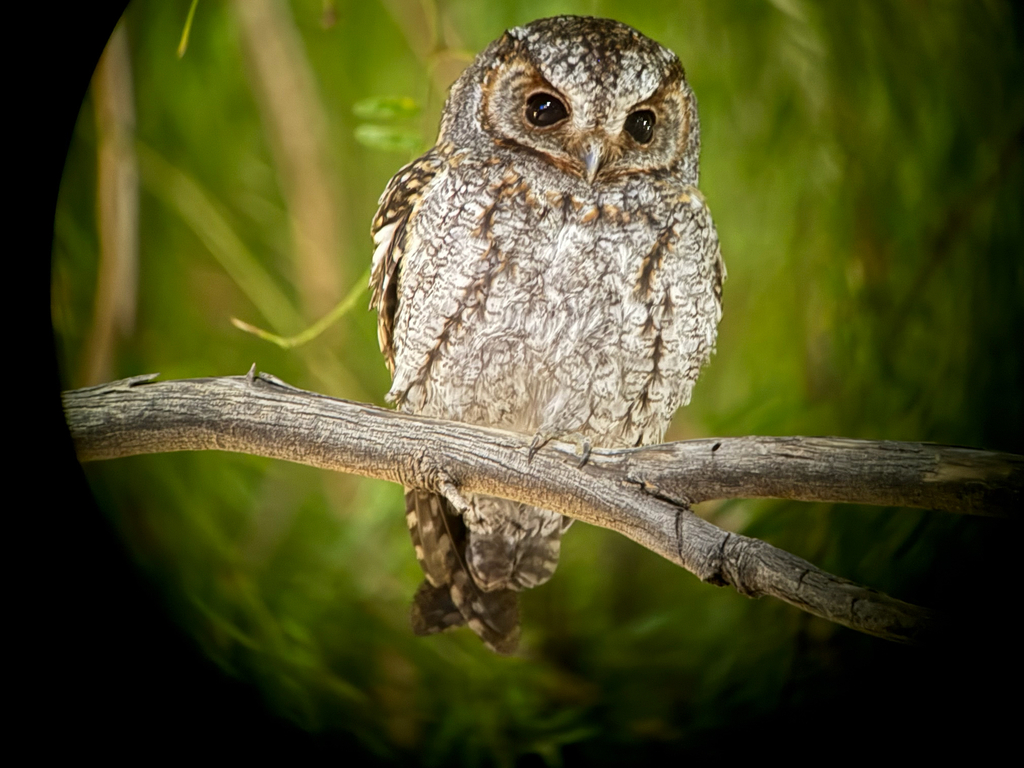
(c) Kevin Floyd, some rights reserved (CC BY) · licence
Family: Strigidae · Class: Aves · Order: Strigiformes
Conservation status: G4 S2S4
Psiloscops flammeolus (Flammulated Owl) is a California animal in the Strigidae family.
The Flammulated Owl is a small, nocturnal raptor measuring 15 to 17 centimeters (6 to 6.7 inches) in length with a wingspan of 35 to 40 centimeters (14 to 16 inches). Adults weigh between 45 and 63 grams (1.6 to 2.2 ounces), making them one of North America's smallest owls. The species exhibits two distinct color morphs: a gray morph with ashy-gray plumage and darker vermiculations, and a rufous morph with reddish-brown coloration. Both morphs display distinctive facial discs with prominent dark borders and orange to amber eyes. The species lacks ear tufts, distinguishing it from similarly-sized screech owls. Males and females are similar in appearance, though females are typically slightly larger. Flammulated Owls breed across western North America from British Columbia south to Guatemala, with California populations representing the southern extent of their Pacific Coast range. In California, the species occurs primarily in montane forests of the Sierra Nevada, Cascade Range, and scattered locations in the Coast Ranges and Transverse Ranges. According to eBird data, breeding populations are documented from Siskiyou County south to Kern County, with scattered records in coastal mountains including the Santa Lucia Range. The species inhabits mature coniferous and mixed conifer-oak forests at elevations typically ranging from 1,200 to 2,800 meters (3,900 to 9,200 feet). Flammulated Owls show strong association with ponderosa pine, Douglas-fir, white fir, and mixed oak woodlands. They require forests with open understories and moderate canopy closure, often selecting areas with recent low-intensity fires or selective logging that creates the preferred habitat structure. Nest sites are located in natural tree cavities or old woodpecker holes, typically in snags or mature trees. Flammulated Owls are strictly migratory, wintering from Mexico south to Guatemala and returning to breeding grounds between April and May. The species is primarily insectivorous, with moths, beetles, and other nocturnal arthropods comprising over 90 percent of their diet. Breeding occurs from May through August, with females laying two to four glossy white eggs in tree cavities. Incubation lasts 21 to 24 days, performed entirely by the female while the male provides food. Young fledge after 25 to 32 days but remain dependent on parents for several weeks. Flammulated Owls are considered a Species of Special Concern by various conservation organizations due to habitat loss and fragmentation. The species' global rank of G4 indicates apparently secure populations globally, while California's S2S4 rank suggests state populations range from imperiled to apparently secure. Primary threats include intensive forest management practices, fire suppression leading to altered forest structure, and climate change affecting prey availability and suitable habitat elevation ranges. The species' dependence on specific forest conditions and migratory nature make it particularly vulnerable to habitat modifications across its range.
Classification
Class: Aves · Order: Strigiformes · Family: Strigidae
Conservation status
G4 S2S4
Frequently asked questions
How is Psiloscops flammeolus classified?
Psiloscops flammeolus belongs to class Aves, order Strigiformes, family Strigidae.
What family does Psiloscops flammeolus belong to?
Psiloscops flammeolus is in the Strigidae family.
Is Psiloscops flammeolus protected or of conservation concern?
Psiloscops flammeolus carries the following status: G4 S2S4.
What is Psiloscops flammeolus?
The Flammulated Owl is a small, nocturnal raptor measuring 15 to 17 centimeters (6 to 6.7 inches) in length with a wingspan of 35 to 40 centimeters (14 to 16 inches).
Is Psiloscops flammeolus found in California?
Yes. Psiloscops flammeolus is recorded in California in The California Species Project's catalogue.
Related species
Other California species in the same genus, family, or bioregion.
Data from The California Species Project — 14,000+ California species with verified data from CNPS, CDFW, USFWS, and more.