Psittacara erythrogenys
Red-masked Parakeet
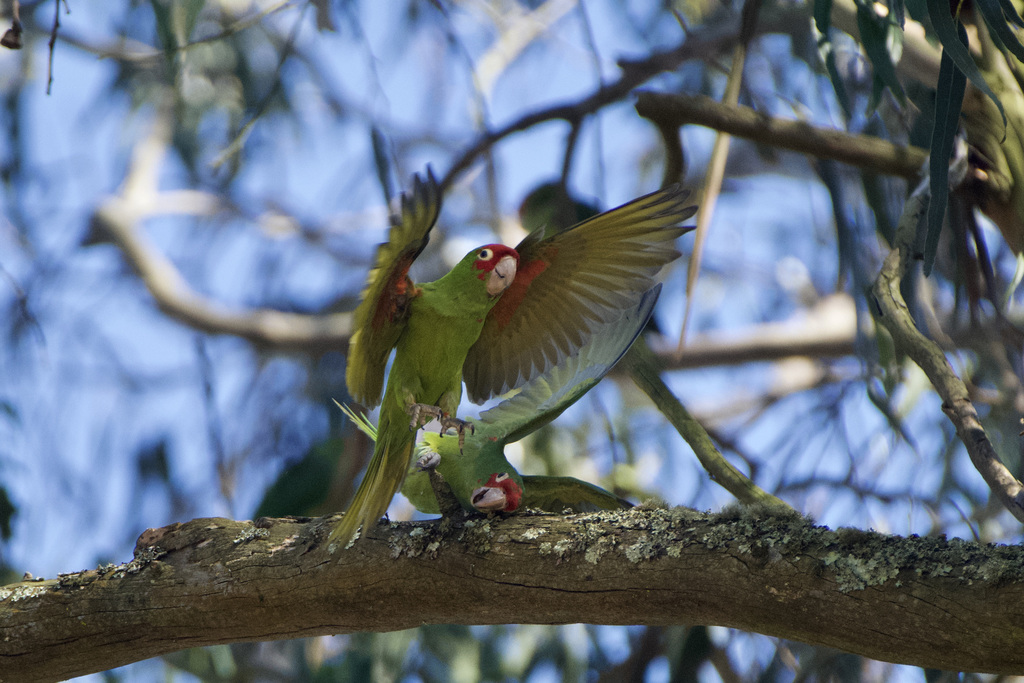
no rights reserved · CC0
Family: Psittacidae · Class: Aves · Order: Psittaciformes
Psittacara erythrogenys (Red-masked Parakeet) is a California animal in the Psittacidae family.
The Red-masked Parakeet is a medium-sized parrot native to South America that has established non-native populations in California. Adults measure approximately 33 centimeters (13 inches) in length and weigh 140 to 170 grams (4.9 to 6.0 ounces). The species displays predominantly green plumage with a distinctive bright red forecrown, lores, and leading edge of the wings. The red facial markings extend from the forehead to just above the eye, creating the characteristic "mask" appearance. The bend of the wing shows red coloration, while the primary flight feathers appear blue-black. Both sexes display similar plumage, though males may show slightly more extensive red markings. The bill is pale horn-colored, and the iris is orange to red in adults. Naturally occurring from western Ecuador through northwestern Peru, Red-masked Parakeets have established introduced populations in several California urban areas. The species was first documented breeding in the San Francisco Bay Area in the 1980s, with populations now established in San Francisco, particularly around Telegraph Hill, as well as in portions of Marin, San Mateo, and Santa Clara counties. Additional populations occur in Southern California, including areas of Los Angeles and Orange counties. The total California population is estimated at several hundred individuals across multiple established flocks. In their native range, Red-masked Parakeets inhabit dry forests, forest edges, and agricultural areas from sea level to 2,500 meters (8,200 feet) elevation. In California, the species has adapted to urban and suburban environments, utilizing ornamental trees, parks, and residential areas. They show particular affinity for areas with diverse fruiting trees and palms. The birds roost communally in large trees, often palm species, and may use the same roost sites for extended periods. Red-masked Parakeets are highly social, typically observed in flocks of 6 to 30 individuals, though larger aggregations may occur at abundant food sources. Their diet consists primarily of fruits, seeds, flowers, and leaf buds. In California, they feed on various ornamental plants including cherry, apple, and citrus fruits, as well as seeds from eucalyptus and cypress trees. The species breeds in tree cavities, with the female laying 2 to 4 white eggs. Incubation lasts approximately 24 days, with chicks fledging after 7 to 8 weeks. In California, breeding activity typically occurs from February through July. The Red-masked Parakeet is not federally or state listed in California, as it is a non-native species. In their native South American range, populations face pressure from habitat loss and capture for the pet trade, though the species is not considered globally threatened. California populations appear stable and self-sustaining, though they remain geographically limited to specific urban areas. The species' establishment in California likely resulted from escaped or released pet birds, a common pathway for parrot introductions worldwide.
Classification
Class: Aves · Order: Psittaciformes · Family: Psittacidae
Frequently asked questions
How is Psittacara erythrogenys classified?
Psittacara erythrogenys belongs to class Aves, order Psittaciformes, family Psittacidae.
What family does Psittacara erythrogenys belong to?
Psittacara erythrogenys is in the Psittacidae family.
What is Psittacara erythrogenys?
The Red-masked Parakeet is a medium-sized parrot native to South America that has established non-native populations in California.
Is Psittacara erythrogenys found in California?
Yes. Psittacara erythrogenys is recorded in California in The California Species Project's catalogue.
Related species
Other California species in the same genus, family, or bioregion.
Data from The California Species Project — 14,000+ California species with verified data from CNPS, CDFW, USFWS, and more.