Psittacara mitratus
Mitred Parakeet
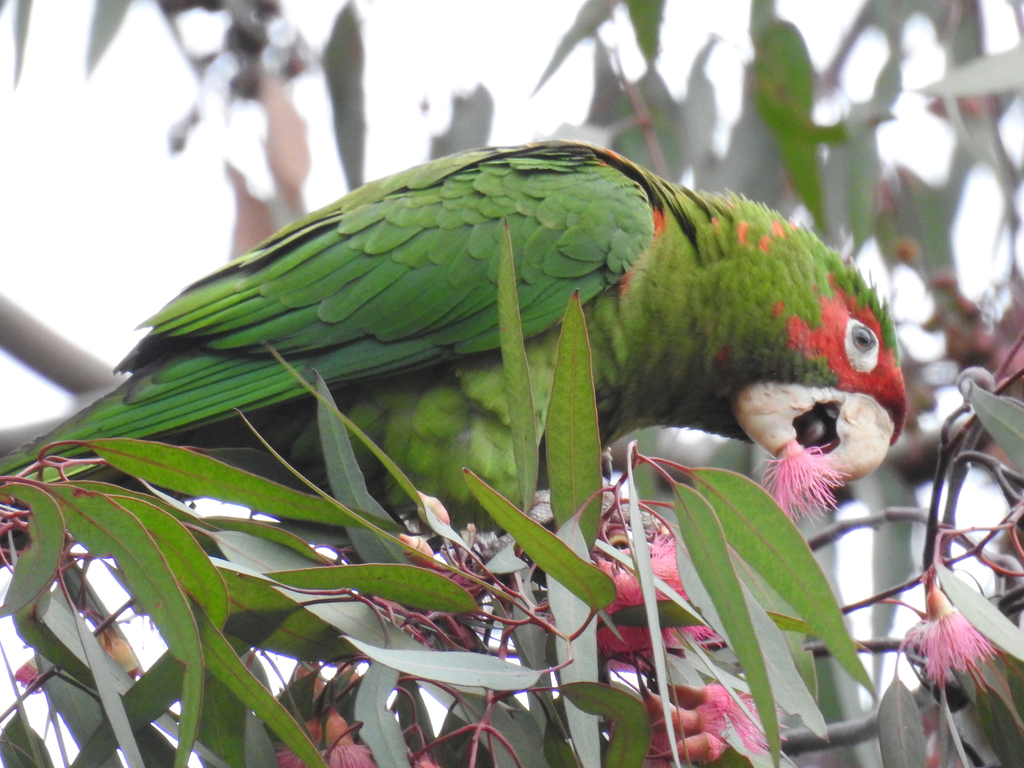
(c) James M. Maley, some rights reserved (CC BY) · licence
Family: Psittacidae · Class: Aves · Order: Psittaciformes
Psittacara mitratus (Mitred Parakeet) is a California animal in the Psittacidae family.
The Mitred Parakeet is a medium-sized neotropical parrot measuring 32 to 36 cm (12.6 to 14.2 inches) in length with a wingspan of approximately 43 to 48 cm (17 to 19 inches). Adults weigh between 165 to 220 grams (5.8 to 7.8 ounces). The species displays predominantly bright green plumage with a distinctive red forehead and forecrown that extends variably around the eyes and cheeks. The red markings are more extensive in adult birds and can vary significantly among individuals. The wings show blue flight feathers, particularly visible during flight, and the tail is long and graduated. The bill is pale orange to horn-colored, and the legs are grayish-pink. Native to South America, Mitred Parakeets naturally occur along the eastern slopes of the Andes Mountains from Peru through Bolivia to northwestern Argentina, typically at elevations between 1,000 to 3,000 meters (3,280 to 9,840 feet). In California, established populations exist as a result of escaped or released captive birds. The largest concentrations occur in urban and suburban areas of Los Angeles County, Orange County, and parts of the San Francisco Bay Area, including cities such as Pasadena, San Gabriel, Arcadia, and Palo Alto. Smaller populations have been documented in San Diego County and other coastal regions. In their native range, Mitred Parakeets inhabit cloud forests, woodland edges, and agricultural areas with scattered trees. In California, they have adapted to urban environments, frequenting parks, residential neighborhoods with mature trees, golf courses, and areas with abundant fruit trees. They show particular preference for areas with palm trees, eucalyptus, and various fruit-bearing species including figs, citrus, and loquats. Mitred Parakeets are highly social birds that form flocks ranging from small groups of 10 to 20 individuals to larger congregations of over 100 birds, particularly at roosting sites. They are primarily frugivorous, feeding on a variety of fruits, seeds, nuts, and flowers. Their diet includes native and non-native plant species, with documented feeding on palm fruits, eucalyptus flowers, and cultivated fruits. Breeding typically occurs from February through July in California populations. Pairs nest in tree cavities, often in palm trees or other suitable hollow-bearing species. Females lay 3 to 4 white eggs with an incubation period of approximately 26 to 28 days. The Mitred Parakeet is not federally listed and holds no special conservation status in California as it is a non-native species. In their native South American range, populations are considered stable though face localized pressures from habitat loss and capture for the pet trade. California populations have shown steady growth since establishment in the 1980s, with annual Christmas Bird Count data indicating increasing numbers and expanding range. The species demonstrates successful adaptation to urban environments but may compete with native cavity-nesting birds for nesting sites. Management considerations focus on monitoring population growth and potential impacts on native species rather than conservation measures.
Classification
Class: Aves · Order: Psittaciformes · Family: Psittacidae
Frequently asked questions
How is Psittacara mitratus classified?
Psittacara mitratus belongs to class Aves, order Psittaciformes, family Psittacidae.
What family does Psittacara mitratus belong to?
Psittacara mitratus is in the Psittacidae family.
What is Psittacara mitratus?
The Mitred Parakeet is a medium-sized neotropical parrot measuring 32 to 36 cm (12.6 to 14.2 inches) in length with a wingspan of approximately 43 to 48 cm (17 to 19 inches).
Is Psittacara mitratus found in California?
Yes. Psittacara mitratus is recorded in California in The California Species Project's catalogue.
Related species
Other California species in the same genus, family, or bioregion.
Data from The California Species Project — 14,000+ California species with verified data from CNPS, CDFW, USFWS, and more.