Psychoda alternata
Trickling Filter Fly
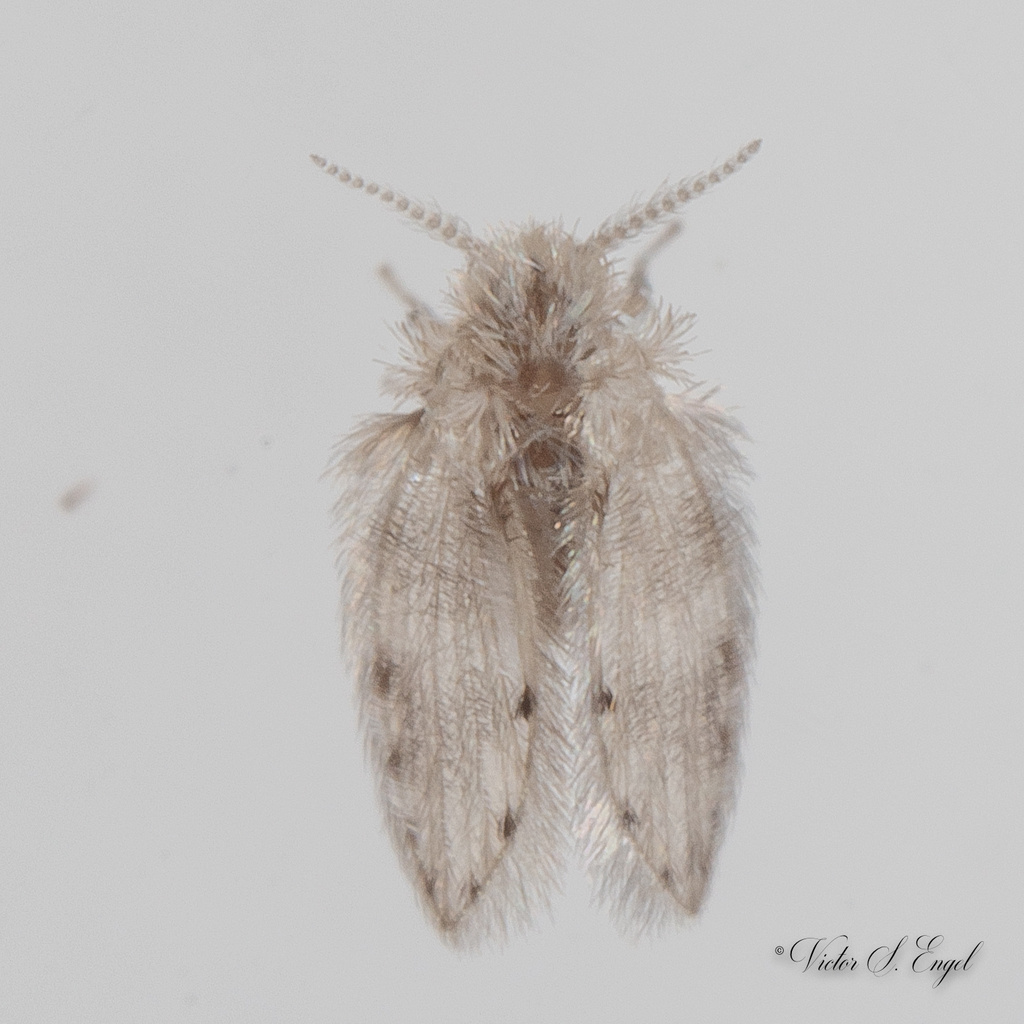
(c) Victor Engel, some rights reserved (CC BY) · licence
Family: Psychodidae · Class: Insecta · Order: Diptera
Psychoda alternata (Trickling Filter Fly) is a California animal in the Psychodidae family.
Psychoda alternata, commonly known as the trickling filter fly, is a small dipteran belonging to the family Psychodidae, also known as drain flies or moth flies. This species is part of the genus Psychoda, which comprises numerous small flies typically associated with moist environments and decaying organic matter. Psychodidae flies are generally characterized by their small size, typically measuring 2-5 mm in length, though specific measurements for P. alternata have not been well documented. Like other members of the family, this species likely exhibits the characteristic moth-like appearance with densely hairy wings and body, giving them a fuzzy or woolly appearance. The wings are typically held roof-like over the body when at rest, and the antennae are relatively long with numerous segments. The distribution and range of Psychoda alternata within California and North America remain poorly documented in available scientific literature. The species appears in federal taxonomic databases maintained by the U.S. Fish and Wildlife Service, indicating its presence has been recorded, but detailed range maps and locality records are not readily available in current scientific sources. Habitat requirements for this species are not well characterized in the literature. However, based on the common name "trickling filter fly" and the ecology of related Psychoda species, P. alternata likely inhabits environments associated with wastewater treatment facilities, particularly trickling filter systems used in sewage treatment. These artificial wetland systems provide the moist, organic-rich conditions typical of psychodid breeding habitats. Other members of the genus are commonly found in drains, sewers, compost piles, and other areas where organic matter accumulates in moist conditions. Life history and behavioral information for Psychoda alternata are largely undocumented. Like other drain flies, the species likely undergoes complete metamorphosis with aquatic or semi-aquatic larvae developing in films of organic matter. Larvae typically feed on bacteria, fungi, and decaying organic material. Adult flies are generally weak fliers and tend to remain close to their breeding sites. Reproduction likely involves females laying eggs in suitable moist organic substrates. Psychoda alternata does not appear on federal or state endangered species lists and lacks formal conservation status designations. As with many small dipteran species, population trends and conservation needs have not been assessed. The species' apparent association with artificial wastewater treatment systems may provide relatively stable habitat, though this remains speculative without detailed ecological studies. Detailed ecological studies of this species are lacking. The above information synthesizes available taxonomic records and inferences based on related species' biology. We welcome contributions of verified scientific data, photographs, or field observations to enhance this species account.
Classification
Class: Insecta · Order: Diptera · Family: Psychodidae
Frequently asked questions
How is Psychoda alternata classified?
Psychoda alternata belongs to class Insecta, order Diptera, family Psychodidae.
What family does Psychoda alternata belong to?
Psychoda alternata is in the Psychodidae family.
What is Psychoda alternata?
Psychoda alternata, commonly known as the trickling filter fly, is a small dipteran belonging to the family Psychodidae, also known as drain flies or moth flies.
Is Psychoda alternata found in California?
Yes. Psychoda alternata is recorded in California in The California Species Project's catalogue.
Related species
Other California species in the same genus, family, or bioregion.
Data from The California Species Project — 14,000+ California species with verified data from CNPS, CDFW, USFWS, and more.