Psyllobora borealis
Western Fairy Lady Beetle
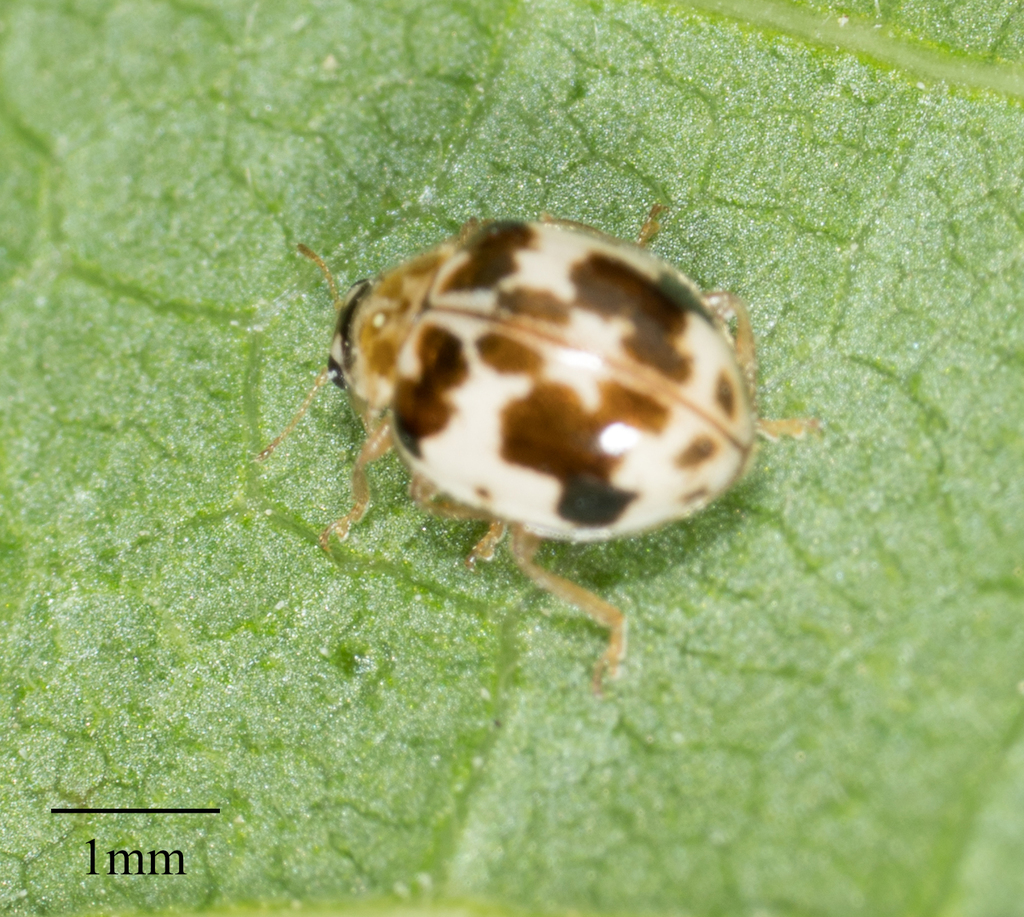
no rights reserved · CC0
Family: Coccinellidae · Class: Insecta · Order: Coleoptera
Psyllobora borealis (Western Fairy Lady Beetle) is a California animal in the Coccinellidae family.
The Western Fairy Lady Beetle (Psyllobora borealis) is a small member of the Coccinellidae family, measuring 1 to 3 millimeters (0.04 to 0.12 inches) in length. This diminutive beetle displays characteristic coloration of the Halyziini tribe, with a white or light brown base color marked by brown, black, or orange spots (BugGuide). The pronotum is notably transparent, distinguishing it from many other lady beetle species. The elytra typically exhibit multiple dark spots arranged in a pattern that varies among individuals. Psyllobora borealis occurs across western North America, with documented populations extending from coastal California to interior regions. The species has been recorded in California's coastal dune environments, including areas within the Guadalupe-Nipomo Dunes Complex in San Luis Obispo and Santa Barbara counties. Distribution records also indicate presence in inland areas, though specific range boundaries require further documentation. The species appears to have a broader western distribution beyond California, though detailed range maps are not well established. This species inhabits diverse environments ranging from coastal dune systems to interior habitats with suitable fungal resources. In California's coastal areas, P. borealis has been documented in dune vegetation communities where it likely exploits fungal growth on various plant substrates. The species shows adaptation to both maritime and inland climatic conditions, suggesting tolerance for varying temperature and humidity regimes. Specific microhabitat preferences within these broader ecosystem types remain poorly documented. As a member of the fungus-eating lady beetles (tribe Halyziini), P. borealis feeds primarily on fungal spores, mycelia, and associated microorganisms rather than aphids like many coccinellids (BugGuide). Both larvae and adults consume fungi, making them beneficial for controlling plant pathogenic fungi in some circumstances. Larvae are described as light gray and may display black and orange markings. The species likely completes multiple generations per year in favorable conditions, though specific reproductive timing and clutch sizes have not been well documented. Adults are active during warmer months when fungal growth is abundant. Psyllobora borealis currently holds no federal or state conservation listing status. The species appears to maintain stable populations across its range, though comprehensive population assessments have not been conducted. NatureServe lists the species with no special conservation concern as of December 2025. Primary threats likely include habitat loss from development in coastal areas and changes to fungal communities through altered fire regimes or introduced plant species. Climate change may affect the species through impacts on host fungi and suitable habitat availability. The small size and cryptic nature of P. borealis means it is often overlooked in biological surveys, potentially leading to underestimation of its actual distribution and abundance. Scientific documentation for this species remains limited compared to more conspicuous lady beetles. Additional research on specific host fungi, reproductive biology, and detailed distribution patterns would enhance understanding of this native California beetle's ecological role and conservation needs.
Classification
Class: Insecta · Order: Coleoptera · Family: Coccinellidae
Frequently asked questions
How is Psyllobora borealis classified?
Psyllobora borealis belongs to class Insecta, order Coleoptera, family Coccinellidae.
What family does Psyllobora borealis belong to?
Psyllobora borealis is in the Coccinellidae family.
What is Psyllobora borealis?
The Western Fairy Lady Beetle (Psyllobora borealis) is a small member of the Coccinellidae family, measuring 1 to 3 millimeters (0.04 to 0.12 inches) in length.
Is Psyllobora borealis found in California?
Yes. Psyllobora borealis is recorded in California in The California Species Project's catalogue.
Related species
Other California species in the same genus, family, or bioregion.
Data from The California Species Project — 14,000+ California species with verified data from CNPS, CDFW, USFWS, and more.