Psyllobora renifer
Kidney-spotted Fairy Lady Beetle
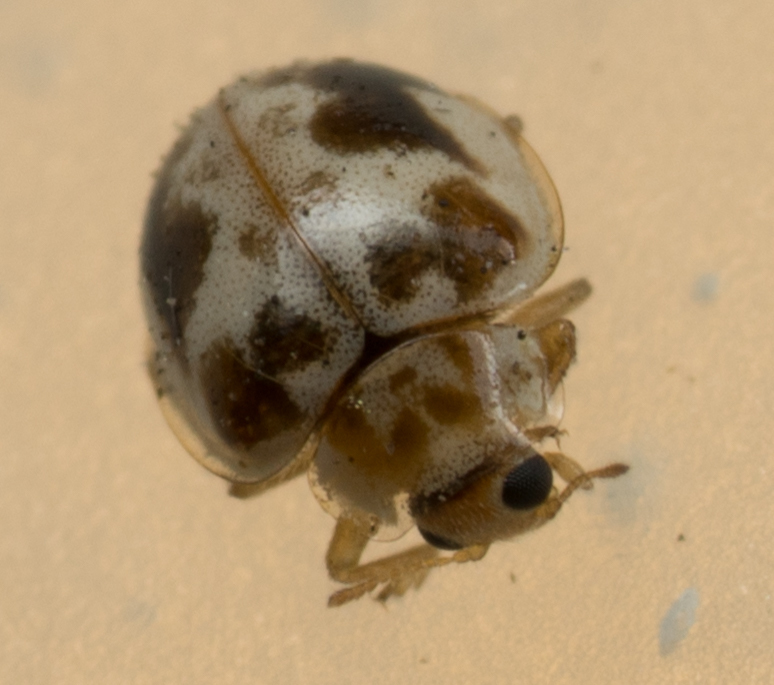
no rights reserved · CC0
Family: Coccinellidae · Class: Insecta · Order: Coleoptera
Psyllobora renifer (Kidney-spotted Fairy Lady Beetle) is a California animal in the Coccinellidae family.
The Kidney-spotted Fairy Lady Beetle (Psyllobora renifer) is a small member of the lady beetle family Coccinellidae. As a member of the genus Psyllobora, commonly known as fairy lady beetles, this species is among the smaller coccinellids and likely measures 2-4 mm in length, typical for the genus. The common name suggests the presence of kidney-shaped spots on the elytra, though detailed morphological descriptions are not well documented in scientific literature. The geographic range of P. renifer appears to include portions of the eastern and southeastern United States, based on its inclusion in state wildlife action plans. According to BugGuide, the species is listed as a Species of Greatest Conservation Need in both Louisiana and New York state wildlife action plans (Louisiana Department of Wildlife and Fisheries 2015, New York State Department of Environmental Conservation). This broad latitudinal distribution suggests the species may have specific habitat requirements that limit its local abundance despite its wide potential range. Specific habitat preferences for this species have not been well documented. Like other fairy lady beetles in the genus Psyllobora, it likely inhabits areas with fungal growth, as most Psyllobora species are mycophagous (fungus-feeding) rather than aphidophagous like most lady beetles. The species may be associated with forest edges, grasslands, or other habitats where suitable fungi occur on plant surfaces or decaying organic matter. The ecological role and behavior of P. renifer remain poorly studied. Most fairy lady beetles feed primarily on powdery mildew and other plant surface fungi rather than aphids or other soft-bodied insects. Adults likely overwinter in leaf litter or under bark, emerging in spring to mate and lay eggs near fungal food sources. Larvae presumably feed on similar fungal resources as adults, developing through typical coccinellid instars before pupating. The conservation status of this species reflects broader concerns about native arthropod diversity. Its designation as a Species of Greatest Conservation Need in multiple states indicates population declines or habitat threats, though specific population data are not available. The Louisiana Wildlife Action Plan evaluation considered factors including abundance and population trends when designating conservation priority species. Potential threats may include habitat loss, pesticide use, and competition from introduced species, though specific threat assessments for this species have not been published. Scientific documentation for this species remains extremely limited despite its conservation designations. The information presented here synthesizes available data from state wildlife action plans and taxonomic databases. Enhanced field surveys and ecological studies are needed to better understand the distribution, habitat requirements, and conservation needs of this poorly known native lady beetle species.
Classification
Class: Insecta · Order: Coleoptera · Family: Coccinellidae
Frequently asked questions
How is Psyllobora renifer classified?
Psyllobora renifer belongs to class Insecta, order Coleoptera, family Coccinellidae.
What family does Psyllobora renifer belong to?
Psyllobora renifer is in the Coccinellidae family.
What is Psyllobora renifer?
The Kidney-spotted Fairy Lady Beetle (Psyllobora renifer) is a small member of the lady beetle family Coccinellidae.
Is Psyllobora renifer found in California?
Yes. Psyllobora renifer is recorded in California in The California Species Project's catalogue.
Related species
Other California species in the same genus, family, or bioregion.
Data from The California Species Project — 14,000+ California species with verified data from CNPS, CDFW, USFWS, and more.