Pteraster tesselatus
Slime Star
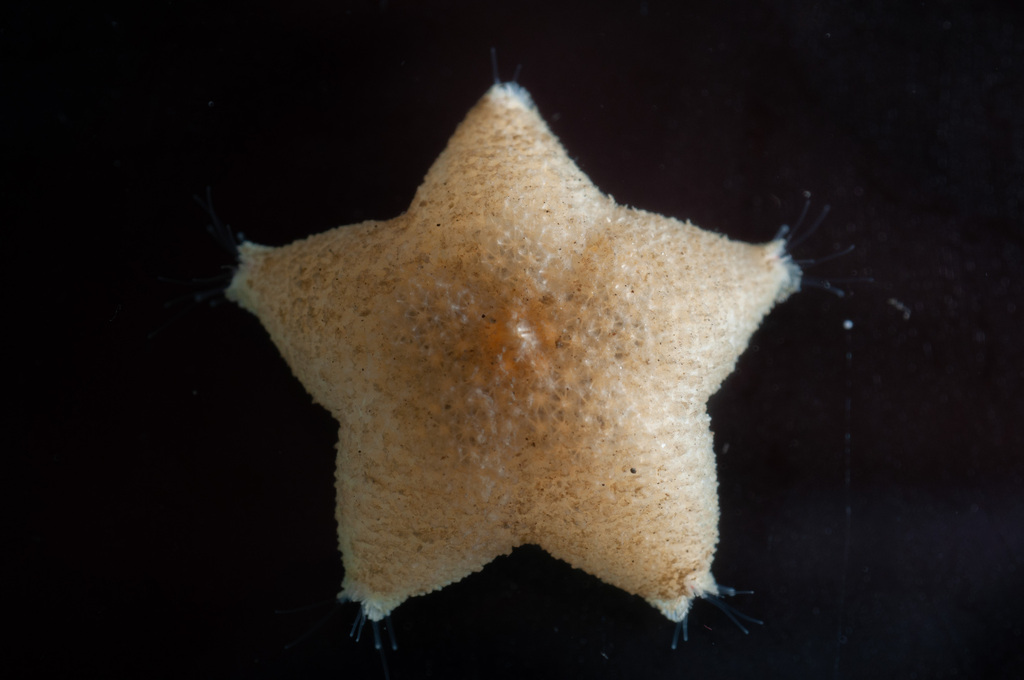
(c) Jorge I. Merchán Mayorga, some rights reserved (CC BY-SA) · licence
Family: Pterasteridae · Class: Asteroidea · Order: Velatida
Pteraster tesselatus (Slime Star) is a California animal in the Pterasteridae family.
The Slime Star (Pteraster tesselatus) is a distinctive sea star belonging to the family Pterasteridae within the order Velatida. This echinoderm is characterized by its unique protective membrane that covers the aboral (upper) surface, creating a sac-like structure that can be inflated with seawater. The body typically measures 5 to 15 centimeters (2 to 6 inches) in diameter, with five broad, triangular arms that are not clearly demarcated from the central disc. The dorsal surface appears smooth due to the overlying membrane, while the ventral surface displays typical tube feet arranged in grooves along each arm. Coloration ranges from pale yellow to orange-brown, often with darker mottled patterns. Pteraster tesselatus occurs along the Pacific coast from Alaska to California, inhabiting subtidal rocky reefs and kelp forest environments. In California waters, the species is found from the intertidal zone to depths exceeding 200 meters (656 feet), though it is most commonly encountered between 10 and 100 meters (33 to 328 feet) depth. The species shows preference for areas with moderate to strong currents and hard substrates where it can secure attachment. This sea star inhabits rocky subtidal environments, particularly areas with complex three-dimensional structure provided by rock outcrops, boulders, and kelp holdfasts. The species favors locations with good water circulation and is often found on vertical surfaces or overhangs where particulate matter and plankton are abundant in the water column. Pteraster tesselatus can tolerate a range of water temperatures typical of California's temperate marine environment, generally between 8 and 18 degrees Celsius (46 to 64 degrees Fahrenheit). Unlike many sea stars that are active predators, Pteraster tesselatus is primarily a suspension feeder. The species extends its inflatable dorsal membrane to create a filtering chamber, trapping plankton, detritus, and small organic particles from the water column. The captured material is then transported to the mouth via ciliary action along specialized grooves. This feeding strategy allows the species to exploit food resources unavailable to most other asteroids. Reproduction follows the typical asteroid pattern, with separate sexes releasing gametes into the water column for external fertilization. Larvae undergo a planktonic developmental stage before settling and metamorphosing into juvenile sea stars. Pteraster tesselatus currently holds no federal or state conservation listing status. The species appears to maintain stable populations throughout its range, though like many marine invertebrates, it faces potential threats from climate change, ocean acidification, and coastal development. The species' suspension-feeding lifestyle may make it particularly vulnerable to changes in water quality and plankton communities. Marine protected areas along the California coast provide some habitat protection for this species and associated rocky reef communities.
Classification
Class: Asteroidea · Order: Velatida · Family: Pterasteridae
Frequently asked questions
How is Pteraster tesselatus classified?
Pteraster tesselatus belongs to class Asteroidea, order Velatida, family Pterasteridae.
What family does Pteraster tesselatus belong to?
Pteraster tesselatus is in the Pterasteridae family.
What is Pteraster tesselatus?
The Slime Star (Pteraster tesselatus) is a distinctive sea star belonging to the family Pterasteridae within the order Velatida.
Is Pteraster tesselatus found in California?
Yes. Pteraster tesselatus is recorded in California in The California Species Project's catalogue.
More California species
This species has no close relatives in our California data — here are other species to explore.
Data from The California Species Project — 14,000+ California species with verified data from CNPS, CDFW, USFWS, and more.