Pterodroma cookii
Cook's Petrel
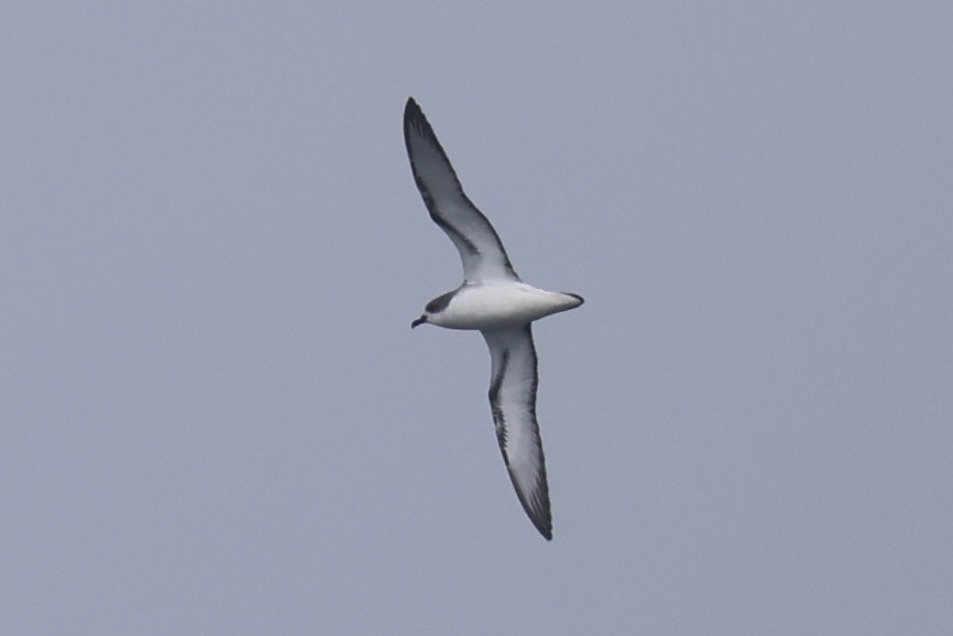
no rights reserved · CC0
Family: Procellariidae · Class: Aves · Order: Procellariiformes
Pterodroma cookii (Cook's Petrel) is a California animal in the Procellariidae family.
Cook's Petrel is a small seabird in the gadfly petrel group, measuring approximately 25-30 cm (10-12 inches) in length with a wingspan of 65-66 cm (25-26 inches). The species exhibits the typical petrel body plan with long, narrow wings adapted for dynamic soaring. The upperparts are dark grey to blackish-brown, while the underparts are predominantly white. A distinctive dark 'M' pattern is visible across the wings when viewed from above, formed by darker markings on the wing coverts and flight feathers. The species has a black bill with a hooked tip characteristic of tube-nosed seabirds, and the legs and feet are flesh-colored to pale pink. Cook's Petrel breeds exclusively on islands off New Zealand, primarily on Little Barrier Island (Hauturu) and Great Barrier Island in the Hauraki Gulf, with smaller populations on Codfish Island near Stewart Island. Outside the breeding season, the species undertakes extensive transoceanic migrations across the Pacific Ocean. During non-breeding periods, Cook's Petrel ranges from the central Pacific to the eastern Pacific, with regular occurrence in waters off California, Oregon, and Washington. The species is most commonly observed in California waters from May through October, typically 20-100 kilometers offshore. At sea, Cook's Petrel inhabits pelagic waters over the continental shelf and beyond, typically in areas with sea surface temperatures between 15-20°C (59-68°F). The species shows preference for areas of upwelling and convergence zones where prey concentrations are elevated. During the breeding season on New Zealand islands, nests are constructed in burrows excavated in forest soil under dense canopy cover, typically at elevations between sea level and 400 meters. Cook's Petrel employs a dynamic soaring flight style, utilizing wind gradients over ocean swells to minimize energy expenditure during long-distance travel. The diet consists primarily of small fish, squid, and crustaceans obtained through surface seizing and shallow plunge-diving, typically during dawn and dusk hours. Breeding occurs from October to May in the Southern Hemisphere, with females laying a single white egg in burrow nests. The incubation period extends approximately 50 days, with both parents sharing duties. Chicks fledge after 90-100 days and begin their first transoceanic migration. The global population of Cook's Petrel is estimated at 1.2-1.7 million individuals based on recent surveys of breeding colonies. While not currently listed under the U.S. Endangered Species Act, the species faces threats from introduced predators on breeding islands, climate change effects on ocean productivity, fisheries bycatch, and plastic pollution. New Zealand conservation efforts focus on predator control programs on breeding islands and habitat restoration. The species' dependence on specific breeding locations makes it vulnerable to localized threats, though current population trends appear stable.
Classification
Class: Aves · Order: Procellariiformes · Family: Procellariidae
Frequently asked questions
How is Pterodroma cookii classified?
Pterodroma cookii belongs to class Aves, order Procellariiformes, family Procellariidae.
What family does Pterodroma cookii belong to?
Pterodroma cookii is in the Procellariidae family.
What is Pterodroma cookii?
Cook's Petrel is a small seabird in the gadfly petrel group, measuring approximately 25-30 cm (10-12 inches) in length with a wingspan of 65-66 cm (25-26 inches).
Is Pterodroma cookii found in California?
Yes. Pterodroma cookii is recorded in California in The California Species Project's catalogue.
Related species
Other California species in the same genus, family, or bioregion.
Data from The California Species Project — 14,000+ California species with verified data from CNPS, CDFW, USFWS, and more.