Pterodroma longirostris
Stejneger's Petrel
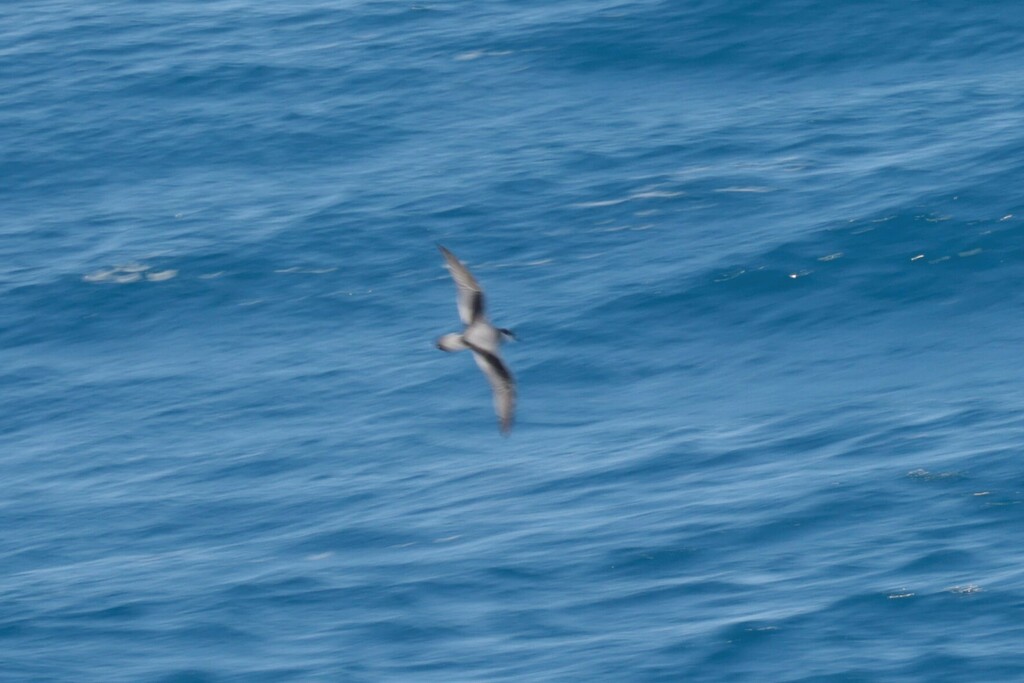
no rights reserved · CC0
Family: Procellariidae · Class: Aves · Order: Procellariiformes
Pterodroma longirostris (Stejneger's Petrel) is a California animal in the Procellariidae family.
Stejneger's Petrel is a medium-sized seabird in the gadfly petrel group, measuring approximately 26-30 cm (10-12 inches) in length with a wingspan of 65-75 cm (26-30 inches). The species exhibits the typical sleek, aerodynamic build of Pterodroma petrels, with long, narrow wings adapted for dynamic soaring over open ocean. Adults display dark brownish-gray upperparts with a distinctive pale gray rump patch and white underparts. The head shows a dark cap extending below the eye, contrasting with white throat and forehead. The bill is black and relatively long compared to other petrels in the genus, giving the species its scientific name longirostris. Steijneger's Petrel has a highly fragmented breeding range in the North Pacific, with colonies restricted to small oceanic islands. The species breeds on remote volcanic islands in the western North Pacific, including islands off Japan and possibly Russia's Kuril Islands. During non-breeding periods, these petrels disperse across the North Pacific Ocean, with some individuals reaching waters off California, Oregon, and Alaska. Records from California waters are extremely rare, typically involving vagrant individuals far offshore in deep oceanic waters beyond the continental shelf. The species inhabits pelagic marine environments, remaining almost exclusively over deep oceanic waters except when returning to breeding colonies. Stejneger's Petrel nests in burrows excavated in soft soil on steep, vegetated slopes of oceanic islands, typically at elevations between 200-800 meters. Outside the breeding season, the species occurs in open ocean waters, often associated with areas of upwelling and high productivity where prey concentrations are elevated. Steijneger's Petrel feeds primarily on small fish, squid, and crustaceans captured at or near the ocean surface through surface-seizing and shallow plunge-diving techniques. The species is predominantly nocturnal at breeding colonies, returning to nest burrows under cover of darkness to avoid predation. Breeding occurs from May through October, with females laying a single white egg in burrows that can extend up to 2 meters in length. Both parents share incubation duties over approximately 50 days, followed by an extended chick-rearing period of 90-100 days. Like other Pterodroma petrels, adults exhibit strong site fidelity, returning to the same colony and often the same burrow annually. The conservation status of Stejneger's Petrel remains poorly understood due to limited research and the species' remote breeding locations. The global population is estimated to be small, likely fewer than 10,000 breeding pairs. Primary threats include habitat degradation at breeding colonies from introduced mammals, particularly rats and feral ungulates that destroy nesting habitat and prey on eggs and chicks. Climate change poses additional risks through altered ocean productivity patterns and sea-level rise affecting low-lying nesting areas. The species' occurrence in California waters is so infrequent that it plays no significant role in the state's marine ecosystem, appearing only as an occasional vagrant during extreme weather events or unusual oceanographic conditions.
Classification
Class: Aves · Order: Procellariiformes · Family: Procellariidae
Frequently asked questions
How is Pterodroma longirostris classified?
Pterodroma longirostris belongs to class Aves, order Procellariiformes, family Procellariidae.
What family does Pterodroma longirostris belong to?
Pterodroma longirostris is in the Procellariidae family.
What is Pterodroma longirostris?
Stejneger's Petrel is a medium-sized seabird in the gadfly petrel group, measuring approximately 26-30 cm (10-12 inches) in length with a wingspan of 65-75 cm (26-30 inches).
Is Pterodroma longirostris found in California?
Yes. Pterodroma longirostris is recorded in California in The California Species Project's catalogue.
Related species
Other California species in the same genus, family, or bioregion.
Data from The California Species Project — 14,000+ California species with verified data from CNPS, CDFW, USFWS, and more.