Pteronarcys californica
California Giant Stonefly
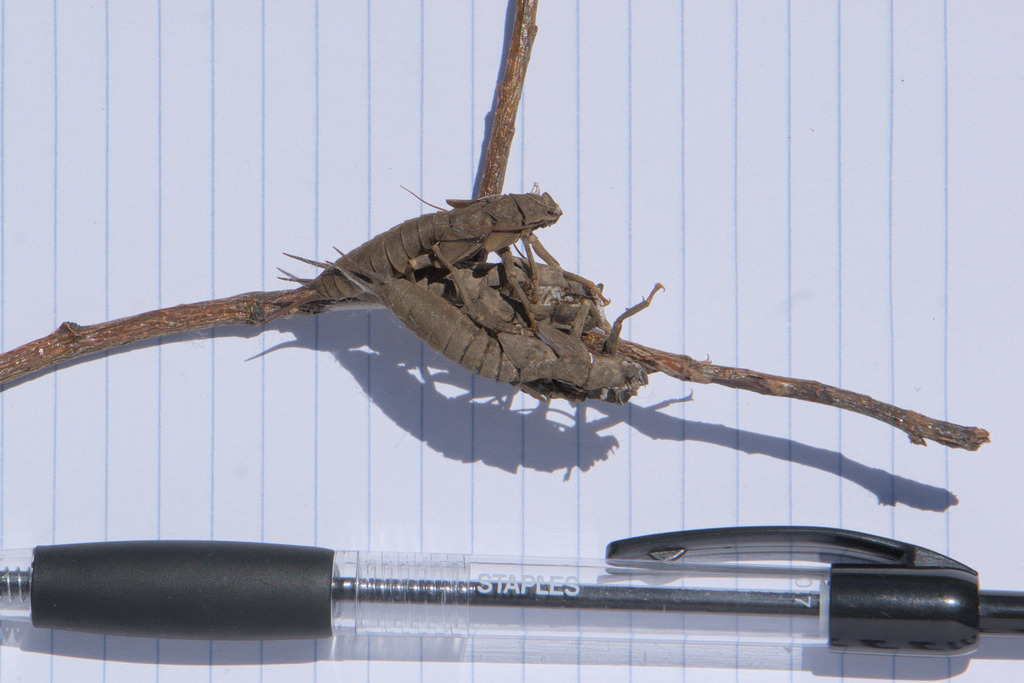
no rights reserved · CC0
Family: Pteronarcyidae · Class: Insecta · Order: Plecoptera
Pteronarcys californica (California Giant Stonefly) is a California animal in the Pteronarcyidae family.
The California giant stonefly is a large aquatic insect in the family Pteronarcyidae, one of the most substantial stonefly species in North America. Adults reach lengths of 25 to 40 mm (1.0 to 1.6 inches), with females typically larger than males. The robust body is dark brown to black with a somewhat flattened appearance. Adults possess two pairs of membranous wings held horizontally over the body when at rest, though flight capability is limited. The antennae are long and thread-like, and the abdomen terminates in two prominent cerci (tail filaments). Pteronarcys californica occurs throughout the northern and eastern Basin and Range province of the western United States but is notably absent from the western Great Basin (NatureServe). In California, the species is distributed primarily in montane regions where suitable cold-water habitats exist. The range extends into Nevada, Oregon, Washington, Idaho, and other western states, following the distribution of appropriate stream systems. This species inhabits cold, well-oxygenated streams and rivers, typically at moderate to high elevations. Nymphs require rocky substrates with swift currents and are sensitive to water temperature increases and pollution. They are commonly found in forested watersheds where canopy cover helps maintain cool water temperatures. The species serves as an indicator of high water quality, as stoneflies are among the first aquatic insects to disappear when stream conditions deteriorate. The life cycle spans two to three years, with most development occurring in the aquatic nymphal stage. Nymphs are predatory, feeding on smaller aquatic invertebrates including mayfly nymphs, midge larvae, and other soft-bodied prey. They undergo multiple molts over their extended development period. Adults emerge during spring and early summer months, with emergence timing varying by elevation and local climate conditions. Adult stoneflies are weak fliers and remain near water sources. Mating occurs shortly after emergence, with females depositing eggs in streams by dipping their abdomens into the water surface or by crawling underwater to attach eggs to substrates. Adults are short-lived, focusing primarily on reproduction rather than feeding, though some may consume algae or organic matter. The species exhibits strong fidelity to natal streams, with limited dispersal capability restricting colonization of new habitats. While Pteronarcys californica lacks formal conservation listing status, populations face pressure from habitat degradation, water diversions, and climate change effects on montane stream systems. Rising water temperatures associated with climate warming pose particular concerns for this cold-water specialist. The species' sensitivity to environmental changes makes it valuable for biomonitoring programs assessing stream ecosystem health. Maintaining adequate stream flows, riparian vegetation, and water quality standards is essential for population persistence. The California giant stonefly's role as both predator and prey makes it a critical component of aquatic food webs, supporting fish populations and other stream-dependent wildlife.
Classification
Class: Insecta · Order: Plecoptera · Family: Pteronarcyidae
Frequently asked questions
How is Pteronarcys californica classified?
Pteronarcys californica belongs to class Insecta, order Plecoptera, family Pteronarcyidae.
What family does Pteronarcys californica belong to?
Pteronarcys californica is in the Pteronarcyidae family.
What is Pteronarcys californica?
The California giant stonefly is a large aquatic insect in the family Pteronarcyidae, one of the most substantial stonefly species in North America.
Is Pteronarcys californica found in California?
Yes. Pteronarcys californica is recorded in California in The California Species Project's catalogue.
More California species
This species has no close relatives in our California data — here are other species to explore.
Data from The California Species Project — 14,000+ California species with verified data from CNPS, CDFW, USFWS, and more.