Ptychocheilus grandis
Sacramento pikeminnow
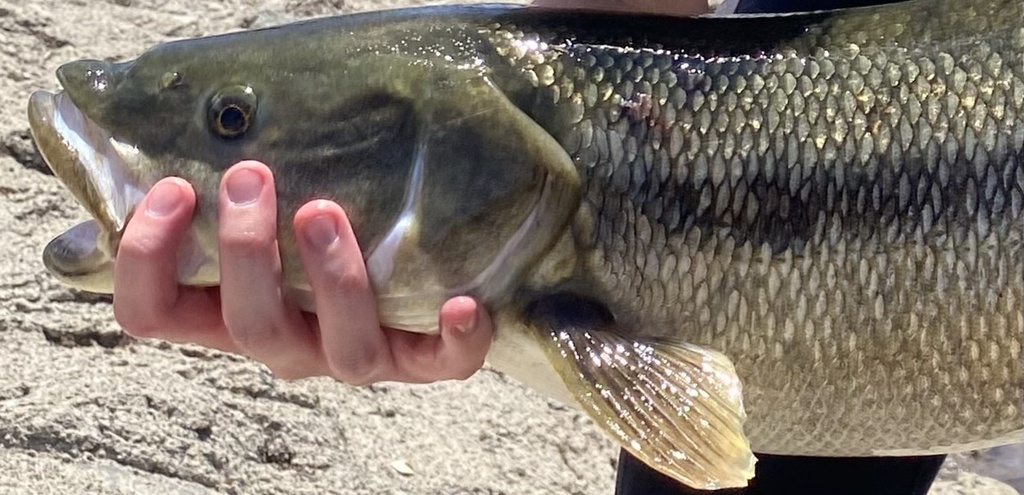
(c) Skyler K, some rights reserved (CC BY) · licence
Family: Cyprinidae · Class: Actinopterygii · Order: Cypriniformes
Ptychocheilus grandis (Sacramento pikeminnow) is a California animal in the Cyprinidae family.
The Sacramento pikeminnow is California's largest native minnow, reaching lengths up to 1.4 meters (4.6 feet) and weights exceeding 14 kilograms (30 pounds). Adults display an elongated, torpedo-shaped body with a large terminal mouth equipped with pharyngeal teeth adapted for piscivory. The dorsal coloration ranges from olive-green to bronze, transitioning to silvery-white on the sides and belly. Juveniles exhibit a more compressed body form with distinct dark lateral stripes that fade with maturity. The species lacks barbels and possesses large pectoral fins positioned low on the body. Historically, Sacramento pikeminnow occupied the entire Sacramento-San Joaquin River system and its tributaries, extending from the Sacramento River headwaters in Shasta County south through the Delta to the San Joaquin River basin. The species occurred in coastal drainages from the Russian River in Sonoma County to Monterey Bay. Current distribution has contracted significantly, with populations now restricted primarily to the Sacramento River system above Red Bluff, the American River, and select tributaries including the Feather, Yuba, and Tuolumne rivers. Sacramento pikeminnow inhabit diverse aquatic environments, from cool mountain streams at elevations up to 1,200 meters (3,940 feet) to warm valley rivers and reservoirs. Adults prefer deeper pools and runs with moderate to swift current, often associated with rocky substrates, submerged logs, or undercut banks that provide cover. Juveniles occupy shallow nearshore areas with vegetation or woody debris. Water temperatures between 10-24°C (50-75°F) support optimal growth, though the species tolerates seasonal temperature fluctuations. This apex predator undergoes significant dietary shifts with age. Juveniles consume zooplankton, aquatic insects, and small crustaceans. Sub-adults transition to feeding on larger invertebrates and small fish. Mature pikeminnow are primarily piscivorous, preying on native species including Sacramento sucker, hardhead, and juvenile salmon and steelhead. Spawning occurs from April through July when water temperatures reach 14-18°C (57-64°F). Males develop pronounced tubercles on the head and fins during breeding season. Females deposit 6,000-100,000 adhesive eggs in gravel nests constructed in riffles or pool tailouts. Sexual maturity occurs at 3-4 years of age. Sacramento pikeminnow is not federally or state-listed but faces substantial conservation challenges. Population declines result from habitat fragmentation by dams, water diversions reducing streamflows, and degraded water quality from agricultural runoff and urban development. The species' predation on juvenile salmonids has led to management conflicts, with some agencies implementing removal programs in salmon recovery areas. Climate change poses additional threats through increased water temperatures and altered precipitation patterns affecting spawning success and prey availability. Despite these pressures, stable populations persist in several river systems, and the species serves as an important indicator of aquatic ecosystem health in California's Central Valley watersheds.
Classification
Class: Actinopterygii · Order: Cypriniformes · Family: Cyprinidae
Frequently asked questions
How is Ptychocheilus grandis classified?
Ptychocheilus grandis belongs to class Actinopterygii, order Cypriniformes, family Cyprinidae.
What family does Ptychocheilus grandis belong to?
Ptychocheilus grandis is in the Cyprinidae family.
What is Ptychocheilus grandis?
The Sacramento pikeminnow is California's largest native minnow, reaching lengths up to 1.4 meters (4.6 feet) and weights exceeding 14 kilograms (30 pounds).
Is Ptychocheilus grandis found in California?
Yes. Ptychocheilus grandis is recorded in California in The California Species Project's catalogue.
Related species
Other California species in the same genus, family, or bioregion.
Data from The California Species Project — 14,000+ California species with verified data from CNPS, CDFW, USFWS, and more.