Ptychocheilus lucius
Colorado pikeminnow
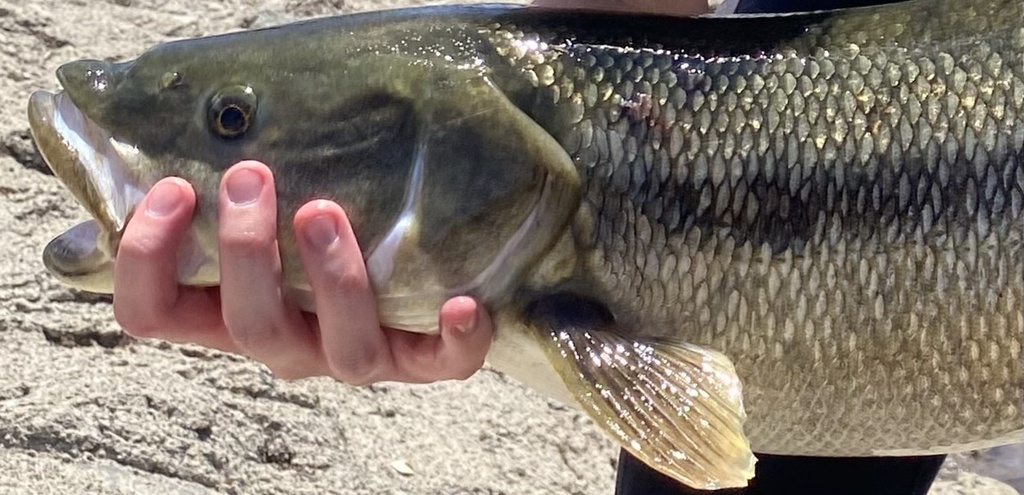
(c) Skyler K, some rights reserved (CC BY) · licence
Family: Cyprinidae · Class: Actinopterygii · Order: Cypriniformes
Conservation status: FP · Endangered · G1 SX
Ptychocheilus lucius (Colorado pikeminnow) is a California animal in the Cyprinidae family.
The Colorado pikeminnow is the largest native minnow in North America, historically reaching lengths up to 1.8 meters (6 feet) and weights exceeding 36 kilograms (80 pounds). Modern populations are significantly smaller, with adults typically measuring 30 to 61 centimeters (12 to 24 inches). The species exhibits a streamlined, torpedo-shaped body adapted for fast-flowing waters. Adults display an olive-green to brassy coloration on the dorsal surface, transitioning to silvery-white on the sides and belly. The head is elongated with a pronounced, subterminal mouth extending beyond the eye. Juveniles possess a distinct dark lateral stripe that fades with maturity. The species lacks barbels and has a deeply forked tail fin. Historically, Colorado pikeminnow inhabited warm-water reaches of the Colorado River system throughout Colorado, Utah, Arizona, and New Mexico. The species once ranged from the headwaters in Colorado downstream to the Colorado River Delta in Mexico, occupying approximately 1,600 kilometers of river habitat. Current populations are restricted to the upper Colorado River basin, primarily in Colorado and Utah, with smaller populations in Arizona and New Mexico. The species has been extirpated from the lower Colorado River basin and California. Colorado pikeminnow inhabit large, warm-water rivers and their major tributaries within the Colorado River system. Adults prefer deep pools, eddies, and backwater areas with moderate to swift currents and temperatures ranging from 16 to 24 degrees Celsius (61 to 75 degrees Fahrenheit). Spawning occurs over gravel or cobble substrates in areas with moderate flow. Juveniles utilize shallow, vegetated backwaters and tributary mouths that provide protection from predation and access to prey. The species requires unimpounded river reaches with natural flow regimes and connected habitat corridors for migration. Colorado pikeminnow are piscivorous predators, with adults feeding primarily on other fish species including suckers, chubs, and smaller cyprinids. Juveniles consume zooplankton, aquatic insects, and small fish. The species exhibits potamodromous behavior, undertaking extensive migrations of up to 300 kilometers for spawning and feeding. Spawning occurs from late June through August when water temperatures reach 18 to 22 degrees Celsius. Females broadcast adhesive eggs over gravel substrates, with clutch sizes ranging from 10,000 to 100,000 eggs. Sexual maturity occurs at 4 to 6 years of age. The U.S. Fish and Wildlife Service listed Colorado pikeminnow as endangered in 1967, making it one of the first fish species protected under federal legislation. Population estimates indicate fewer than 10,000 adults remain in the wild, representing a decline of more than 95 percent from historical levels. Primary threats include habitat fragmentation from dam construction, altered flow regimes, water diversions, and competition from introduced fish species. The Upper Colorado River Endangered Fish Recovery Program, established in 1988, coordinates recovery efforts including habitat restoration, flow management, and nonnative fish removal. Recent augmentation programs have established small populations in previously occupied habitats, though natural recruitment remains limited.
Classification
Class: Actinopterygii · Order: Cypriniformes · Family: Cyprinidae
Conservation status
FP · Endangered · G1 SX
Frequently asked questions
How is Ptychocheilus lucius classified?
Ptychocheilus lucius belongs to class Actinopterygii, order Cypriniformes, family Cyprinidae.
What family does Ptychocheilus lucius belong to?
Ptychocheilus lucius is in the Cyprinidae family.
Is Ptychocheilus lucius protected or of conservation concern?
Ptychocheilus lucius carries the following status: FP · Endangered · G1 SX.
What is Ptychocheilus lucius?
The Colorado pikeminnow is the largest native minnow in North America, historically reaching lengths up to 1.8 meters (6 feet) and weights exceeding 36 kilograms (80 pounds).
Is Ptychocheilus lucius found in California?
Yes. Ptychocheilus lucius is recorded in California in The California Species Project's catalogue.
Related species
Other California species in the same genus, family, or bioregion.
Data from The California Species Project — 14,000+ California species with verified data from CNPS, CDFW, USFWS, and more.