Ptychoramphus aleuticus
Cassin's Auklet
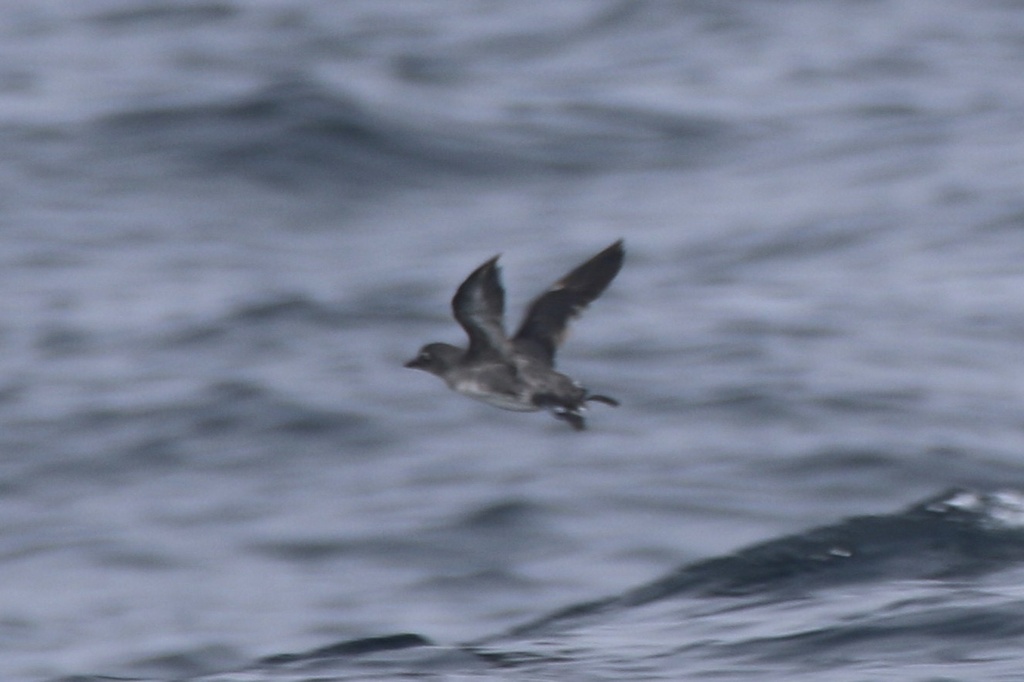
(c) Cricket Raspet, some rights reserved (CC BY) · licence
Family: Alcidae · Class: Aves · Order: Charadriiformes
Conservation status: G4 S3
Ptychoramphus aleuticus (Cassin's Auklet) is a California animal in the Alcidae family.
Cassin's Auklet is a small, stocky seabird measuring 20 to 25 cm (8 to 10 inches) in length with a wingspan of 35 to 40 cm (14 to 16 inches). Adults weigh between 150 to 220 grams (5.3 to 7.8 ounces). The species displays subtle but distinctive plumage with dark gray to brownish-gray upperparts and pale gray underparts. The head appears relatively large with a short, thick neck. A small white crescent above each eye and pale spots at the base of the lower mandible distinguish adults from similar alcids. The bill is short and dark with a pale tip, and the legs and feet are blue-gray. Juveniles resemble adults but show more brownish tones overall. Cassin's Auklet ranges along the Pacific coast from the Aleutian Islands of Alaska south to Baja California, Mexico. In California, the species breeds on offshore islands and rocks from the Farallon Islands near San Francisco south to the Channel Islands. Major breeding colonies occur on Southeast Farallon Island, Ano Nuevo Island, Castle Rock, and several Channel Islands including San Miguel, Santa Cruz, and Anacapa. During winter, birds disperse widely across the continental shelf waters of the northeastern Pacific, with some individuals moving as far south as central Baja California. The species nests in natural rock crevices, burrows, and cavities on offshore islands and sea stacks. Breeding sites are typically located on slopes with soil suitable for excavating burrows, often among native vegetation such as grasses and low shrubs. Cassin's Auklets prefer nesting areas protected from direct wind exposure. At sea, they inhabit continental shelf and slope waters, typically within 200 km of shore, where upwelling creates productive feeding areas. They forage primarily in the upper 30 meters of the water column. Cassin's Auklets are pursuit divers that feed primarily on small planktonic crustaceans, particularly copepods, krill, and larval stages of various marine invertebrates. During the breeding season, they also consume small fish and squid larvae. The species breeds from March through August, with peak activity from April to July. Adults excavate burrows up to one meter deep or utilize existing crevices. Females lay a single white egg, and both parents incubate for 37 to 42 days. Chicks fledge after 35 to 45 days, fed through regurgitation of partially digested prey. Cassin's Auklets can produce two broods per season when conditions are favorable. The species is not federally listed but holds a global rank of G4 (apparently secure) and a California state rank of S3 (vulnerable). Population estimates suggest approximately 1.2 million breeding pairs range-wide, with California supporting roughly 200,000 to 250,000 breeding pairs. Primary threats include oceanographic changes affecting prey availability, predation by introduced mammals on breeding islands, oil spills, plastic ingestion, and climate change impacts on marine food webs. El Niño events can cause significant breeding failures and population fluctuations. Conservation efforts focus on predator control at breeding colonies and marine protected area designations.
Classification
Class: Aves · Order: Charadriiformes · Family: Alcidae
Conservation status
G4 S3
Frequently asked questions
How is Ptychoramphus aleuticus classified?
Ptychoramphus aleuticus belongs to class Aves, order Charadriiformes, family Alcidae.
What family does Ptychoramphus aleuticus belong to?
Ptychoramphus aleuticus is in the Alcidae family.
Is Ptychoramphus aleuticus protected or of conservation concern?
Ptychoramphus aleuticus carries the following status: G4 S3.
What is Ptychoramphus aleuticus?
Cassin's Auklet is a small, stocky seabird measuring 20 to 25 cm (8 to 10 inches) in length with a wingspan of 35 to 40 cm (14 to 16 inches).
Is Ptychoramphus aleuticus found in California?
Yes. Ptychoramphus aleuticus is recorded in California in The California Species Project's catalogue.
Related species
Other California species in the same genus, family, or bioregion.
Data from The California Species Project — 14,000+ California species with verified data from CNPS, CDFW, USFWS, and more.