Puffinus opisthomelas
Black-vented Shearwater
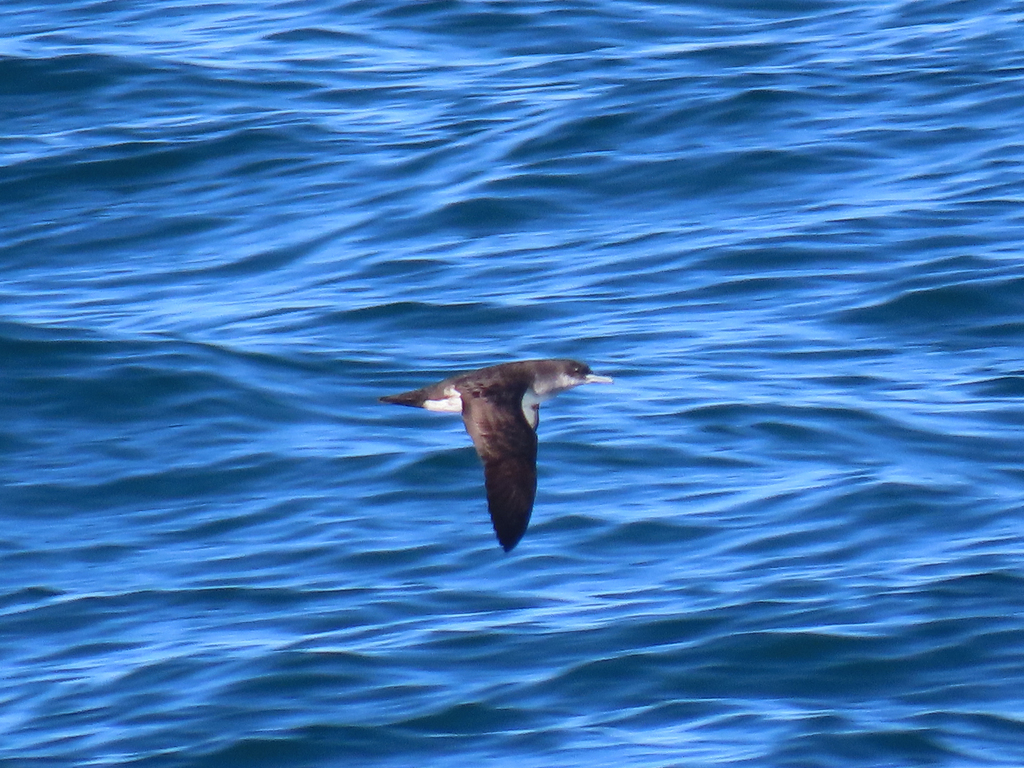
(c) Alina Martin, some rights reserved (CC BY) · licence
Family: Procellariidae · Class: Aves · Order: Procellariiformes
Puffinus opisthomelas (Black-vented Shearwater) is a California animal in the Procellariidae family.
The Black-vented Shearwater is a medium-sized seabird endemic to the northeastern Pacific Ocean. Adults measure 30-38 cm (12-15 inches) in length with a wingspan of 76-89 cm (30-35 inches) and weigh approximately 350-500 grams. The species exhibits the typical shearwater body plan with long, narrow wings adapted for dynamic soaring. The upperparts are dark brownish-black, contrasting sharply with white underparts. The distinctive black undertail coverts, from which the species derives its common name, are visible in flight. The bill is dark gray to black, relatively short and stout compared to other shearwater species, with prominent tube-shaped nostrils characteristic of the Procellariidae family. The Black-vented Shearwater has a highly restricted breeding range, nesting exclusively on islands off the Pacific coast of Baja California, Mexico. Primary breeding colonies occur on the San Benito Islands, Natividad Island, and Guadalupe Island. During the non-breeding season, the species disperses northward along the California coast, regularly occurring in waters from Point Conception to Monterey Bay, with smaller numbers reaching as far north as central Oregon. The species is most commonly observed in California waters from August through April, with peak abundance occurring during fall and winter months. This species inhabits marine environments, typically foraging in continental shelf and slope waters within 200 km of shore. Black-vented Shearwaters prefer areas with upwelling currents that concentrate prey organisms near the surface. They are commonly observed in mixed-species feeding flocks with other seabirds. During the breeding season, they utilize rocky islands with suitable nesting cavities, including natural crevices, caves, and abandoned burrows of other seabirds. Black-vented Shearwaters are highly pelagic, spending most of their lives at sea. They employ surface-seizing and shallow diving techniques to capture small schooling fish, particularly anchovies, sardines, and juvenile rockfish, as well as squid and crustaceans. The species exhibits classic shearwater flight behavior, using dynamic soaring to travel efficiently over ocean surfaces with minimal energy expenditure. Breeding occurs from February through July, with birds returning to traditional colony sites. Females lay a single white egg in rock crevices or shallow burrows. Both parents share incubation duties for approximately 51 days, and the chick fledges after 65-75 days. The Black-vented Shearwater is not currently listed under the U.S. Endangered Species Act or California Endangered Species Act. However, the species faces several conservation concerns due to its restricted breeding range and small population size. According to BirdLife International, the global population is estimated at 33,000-50,000 individuals as of 2020. Primary threats include introduced predators at breeding colonies, particularly cats and rats on nesting islands, plastic pollution and marine debris ingestion, fisheries bycatch, and climate change impacts on prey availability. Oil spills pose an additional risk given the species' concentration in California waters during non-breeding periods. Conservation efforts focus on predator control at breeding sites and marine protected area designation in critical foraging areas.
Classification
Class: Aves · Order: Procellariiformes · Family: Procellariidae
Frequently asked questions
How is Puffinus opisthomelas classified?
Puffinus opisthomelas belongs to class Aves, order Procellariiformes, family Procellariidae.
What family does Puffinus opisthomelas belong to?
Puffinus opisthomelas is in the Procellariidae family.
What is Puffinus opisthomelas?
The Black-vented Shearwater is a medium-sized seabird endemic to the northeastern Pacific Ocean.
Is Puffinus opisthomelas found in California?
Yes. Puffinus opisthomelas is recorded in California in The California Species Project's catalogue.
Related species
Other California species in the same genus, family, or bioregion.
Data from The California Species Project — 14,000+ California species with verified data from CNPS, CDFW, USFWS, and more.